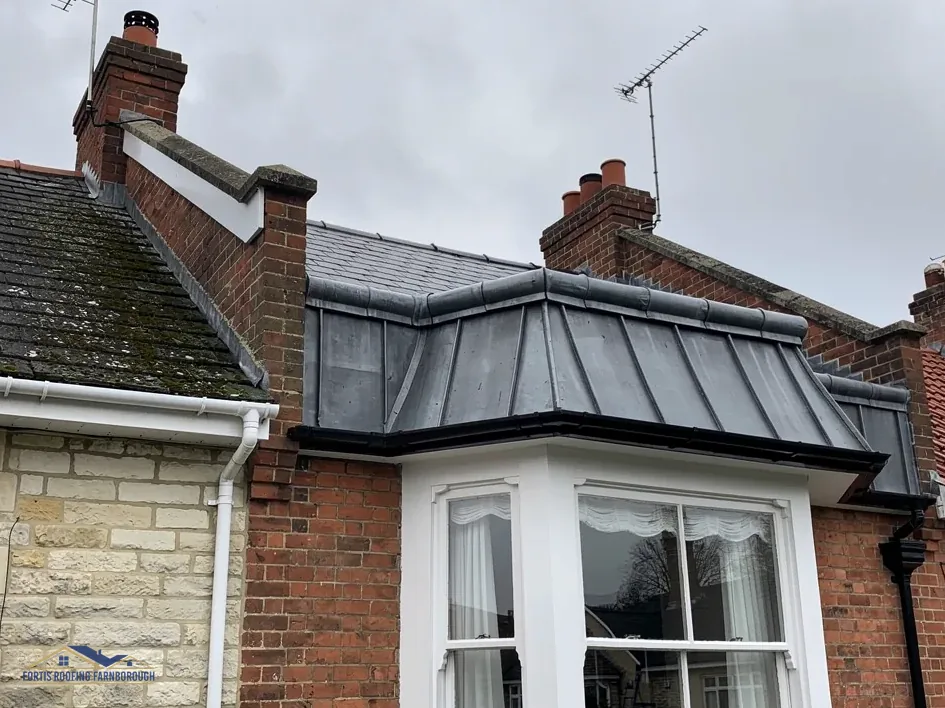
Every roofer who quotes for lead will mention a code: Code 4 for the flashings, Code 5 for the valley. The numbers sound like trade shorthand, and they are, but they are also the single most useful thing a homeowner can ask to see written on a quote. The code tells you what thickness of metal is going on your roof, and thickness is the main reason one lead job lasts and another splits.
Lead sheet in the UK is sold in codes from 3 up to 8. The higher the number, the thicker and heavier the sheet. Each code has a set of jobs it is made for, from the small hidden soaker under a tile to the broad gutter round a parapet. Where a code is too thin for its place, the metal is asked to span more than it can, and it fatigues and cracks.
This post explains the codes, shows which one goes where, and then looks at the places on older Rushmoor streets where lead is most often found: bays, porches and dormers. It ends with the standard that lead work follows, because that is the part people most often get wrong.
What a lead code actually measures
A code is a label for a nominal thickness and weight. It does not describe the quality of the lead, only how much of it there is in a square metre. Royston Lead, a lead sheet maker, gives the figures in its cast lead brochure, and the table below sets them out with the colour each code is marked in.
| Code | Thickness | Weight per m² | Colour |
|---|---|---|---|
| Code 3 | 1.32 mm | 14.97 kg | Green |
| Code 4 | 1.80 mm | 20.41 kg | Blue |
| Code 5 | 2.24 mm | 25.40 kg | Red |
| Code 6 | 2.65 mm | 30.05 kg | Black |
| Code 7 | 3.15 mm | 35.72 kg | White |
| Code 8 | 3.55 mm | 40.26 kg | Orange |
Why the colours exist
The colour is a quick check on site. A roll marked blue is Code 4, and a roll marked red is Code 5. If you want to confirm what is going up, ask to see the roll before it is cut.
Thickness and weight
Each step up in code adds roughly half a millimetre to the sheet, and the weight rises with it, from about 15 kg per square metre at Code 3 to over 40 kg at Code 8. That is a real difference when one person carries a roll up a ladder. Heavier sheet costs more to buy and to carry up the scaffold, which is why you should expect a higher code to appear in a higher price and should be wary of a quote that offers a thick code for a thin price.
Which code goes where on a roof
Royston groups the jobs on a roof under five letters: soakers, flashings, pitched valley gutters, parapet, box and tapered valley gutters, and dormers. The table shows which codes it lists for each.
| Job | Codes listed |
|---|---|
| Soakers | 3, 4 |
| Flashings | 4, 5, 6 |
| Pitched valley gutters | 4, 5, 6, 7, 8 |
| Parapet, box and tapered valley gutters | 5, 6, 7, 8 |
| Dormers | 4, 5, 6, 7, 8 |
Code 3 stays small
Royston lists Code 3 for soakers only. A soaker is a small, hidden piece of lead bent over the edge of a tile or slate where the roof runs up against a wall or chimney. It is thin because it sits under the covering and carries little exposure.
Codes 4 and 5 do most of the visible work
Flashings, the strips at chimneys and walls, are listed for Code 4, 5 and 6. Code 4 and Code 5 each appear against four of the five jobs in Royston's table. Our answer on Code 4 against Code 5 goes into when the heavier one is worth it.
Larger gutters take more
A valley that drains a long slope, or a box gutter between two roofs, holds more water for longer than a flashing ever does, and the sheet has to stand up to that for decades. Parapet and box gutters collect water from a wide roof area and hold it. Royston lists Code 5 and above for them, and Codes 7 and 8 appear only against the three heaviest-duty jobs: pitched valleys, the larger gutters and dormers.
Why the thin code fails
When lead splits, the cause is usually a mismatch between the sheet and the job, and the mismatch is a code that is too light or a piece that is too long.
Movement
Lead expands in warm sun and shrinks again overnight. Each cycle moves the sheet a little, and where it is held at both ends it cannot move without stretching. Over years the stretching leaves a crack along a fold. A heavier code resists this better, and a sheet cut shorter, with more laps, simply has less room to stretch.
Weight underfoot and water on top
A valley or box gutter that carries running water all year is working harder than a flashing that only sheds splash. Putting a light code in a gutter that collects a whole roof slope asks too much of it. A flat roof that is walked on regularly is in the same position.
Code 3 where it does not belong
Code 3 is the lightest sheet in the range. Royston lists it for soakers only, so a quote that puts Code 3 in a valley or a flashing departs from the maker's own listing. If you see Code 3 against anything other than soakers, ask why.
What the fix looks like
Our guide on lead bay window roofs shows a case where the lead's shape and the code both matter. In every case the fix is the right code, a sensible length of sheet and a fixing that lets the lead move. A thicker code does not rescue a sheet that has been cut too long or nailed down tight, so all three points need to be right together.
Bays, porches and dormers on older Rushmoor streets
Lead turns up most on the features that stick out of a main roof, because each one makes a joint that has to be sealed with metal. On older houses around South Farnborough and Farnborough Street you can see this from the pavement.
Bay windows
A bay often has its own small roof, lead-covered, with a lead apron flashing where it meets the wall above. Where the bay roof is a small flat or a shallow slope, we check the code and the laps there first.
Porches
A porch roof may be a small lead flat or a slate or tile pitch with lead flashings against the house wall. It is exposed on three sides, so we look at how the lead is dressed at the edges, not only at the flat.
Dormers
A dormer is a small roofed window that stands up from the main slope, and it is one of the busiest lead jobs on any house. Its cheeks, the side walls, and its front and roof edge are all lead-dressed joints. Our answer on lead dormer cheeks explains how the pieces fit together.
Conservation areas
Rushmoor lists nine conservation areas, among them South Farnborough, designated in 1987 and revised in 2025, and Farnborough Street, designated in 2025. If your house sits in one, check with the planning team at Rushmoor Borough Council before changing the look of lead or any other roofing material. A like-for-like lead repair is a different matter from a change of material, and the council can tell you which applies to your address.
The standard lead work follows
People often assume that all roofing is covered by one standard, and in the case of lead the assumption causes errors, so it is worth being exact.
BS 6915 for lead sheet
Approved Document C, the Building Regulations guidance on moisture, points to BS 6915:2001 for recommendations on lead sheet, which is the document a lead specification is measured against. That standard is the reference for lead used on roofs, including the thicknesses and the way sheets are laid and fixed.
Not BS 6229
BS 6229 is the flat roof standard for flexible membranes such as EPDM, GRP and felt laid over a continuous deck. BSI lists BS 6229:2025 as current, and it covers membranes only. A flat roof covered in lead sits outside it, and the lead follows BS 6915. A quote that quotes the wrong standard for a lead roof is a quote to question.
Lifespan
Lead is long-lived. HomeBuilding puts a lead flat roof at 60 to 100 years, and flashing is quoted at "over 80 years" at the low end. Those are published ranges and no promise, and they hold only with the right code, laid in the right lengths and fixed to move.
What to ask for
Ask for the code of each piece to be written on the quote, and ask that it follows BS 6915. Our lead roofing and leadwork page lists the lead jobs we take on across Farnborough, Aldershot, Fleet and Camberley.
Questions to put to a roofer about code
You do not need to be a lead worker to check a lead quote. A short list of questions shows quickly whether the roofer has thought about the job.
Which code for each piece?
The answer should be specific: Code 4 or 5 for the flashings, a code for the valley and a code for any flat, each stated for the piece it covers. A single code for everything is a sign that nobody has looked at the roof closely.
How long are the sheets?
A cut length that is too long for the code will fatigue. Ask how the lead will be laid so that it can move, where the laps and joints fall and how far each sheet runs before it ends.
How is it fixed?
Lead should be held at its top edge and left free to move below. Fixings that pin the sheet all over will tear it. The answer is a quick way to see whether the roofer knows lead.
What goes under it?
Lead needs a clean, smooth bed. A rotten board or rough surface wears the underside of the sheet. Ask whether the boards are checked and what happens if they are bad, since a sound bed belongs to the job and the quote should say so.
Can you show me the roll?
The colour marking makes it easy to check. A roofer who has nothing to hide will be glad to show you. Citizens Advice recommends at least 3 written quotes, and with the codes on each one you can see whether the roofers have priced the same job.