The short answer
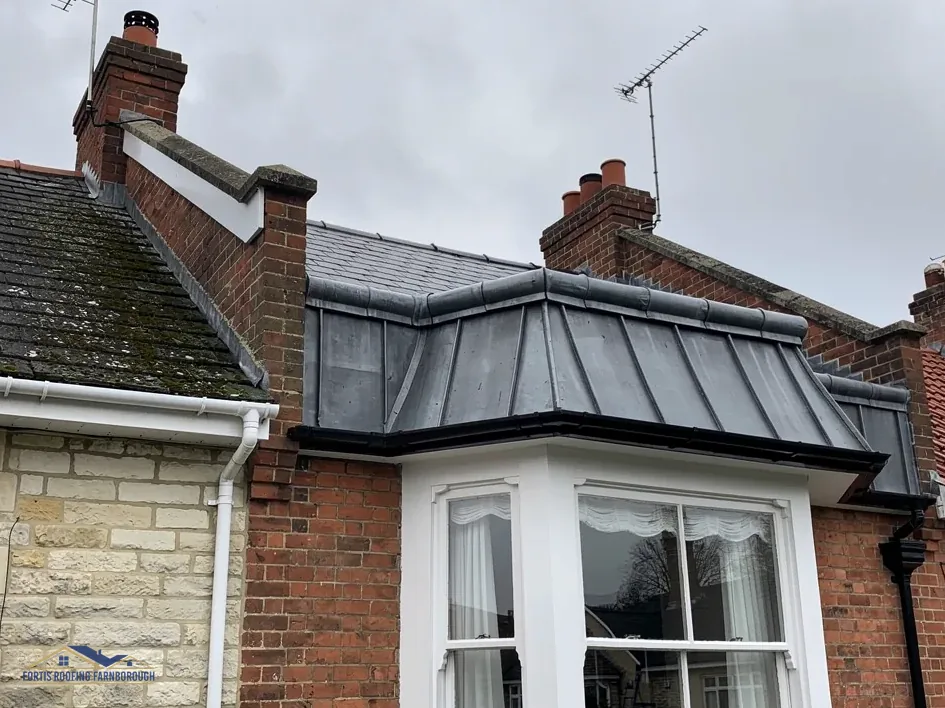
Where an extension roof meets the house wall, lead flashing closes the joint. On a pitched extension roof, stepped lead soakers and a cover flashing do the work. On a flat extension roof, a lead flashing laps over the upstand, the short vertical lip of the waterproof covering. Leaks usually start here because the extension and the house move at different rates.
Why the junction is the weak point
An extension is built against a wall that was never designed to have a roof attached to it. The new structure and the old house settle at their own pace, expand in their own way and shed rain onto each other. The junction between them is where all three differences meet.
Water also arrives from two directions. Rain falls onto the extension roof and runs towards the wall, and the house wall sheds its own rain down onto the same line. Whatever closes that joint has to cope with both.
That is the job of the abutment flashing. An abutment is simply the place where a roof runs up against a wall, and the flashing is the lead that bridges it. Because lead is soft enough to dress to the shape of the brickwork and tolerant of small movements, it is the usual choice, set into a chase in the wall in the way described on our page on how lead flashing is fixed.
Where an extension was built without a proper flashing, or with a bead of sealant or a strip of mortar in its place, the leak usually shows up within a few seasons.
Pitched extensions: soakers and a cover flashing
When the extension has a sloping tiled or slated roof, its edge against the house wall climbs the wall at an angle. The lead follows that line in two layers.
The lower layer is a set of soakers, one for each course of tiles, each a bent piece of lead that tucks under the covering and turns up against the wall. The upper layer is a cover flashing, one long strip with a stepped lower edge that is let into the brickwork and laps down over the turned-up soakers.
The overlap is the reason it works. Water that runs down the wall lands on the cover flashing, flows onto the soakers and from there onto the tiles. At no point does it meet an open gap, and the movement between roof and wall is absorbed by the sliding lead.
The same stepped detail appears on a gable, along a party wall and beside a chimney. Our page on step flashing follows it course by course.
A common fault is a continuous strip of lead pressed flat down a sloping wall without soakers beneath it. It looks tidy but leaks as soon as the pointing opens.
Flat extensions: the upstand and the flashing over it
A flat extension roof has a waterproof covering, such as a felt, a single-ply membrane or a lead sheet, laid across the roof and turned up the wall for a short distance. That turned-up lip is the upstand. Lead flashing then covers the top of the upstand, tucked into the brickwork above it and hanging down over its face.
The upstand is the waterproof part, and the flashing is its protection. The lead sheds water off the top edge of the upstand, so rain never gets to the place where the covering ends.
BS 6229:2025 keeps a minimum finished fall of 1:80 for the general area of a membrane flat roof, and that standard does not cover lead. For lead, BS 6915 is the reference. Our page on lead flat roofs covers lead as the covering itself.
Faults are easy to spot from a ladder or a photograph. If the flashing has lifted, the upstand beneath is exposed to rain and wind, and water can run behind it. If the upstand is split or blistered, replacing the flashing alone will not help, and the covering needs repair first.
Common leaks and what we check
Leaks at an extension junction usually come from the same short list of faults.
- No flashing at all, with sealant or mortar bridging the gap instead.
- A flashing that was never chased into the wall, and is only stuck to its face.
- Soakers missing or crushed along a pitched edge.
- A flat-roof upstand too low or too thin to be protected by the flashing above it.
- Pointing that has failed and let the flashing lift.
You may notice damp on the inside of the old wall where it meets the extension ceiling, a stain along the join or paint lifting beside the wall, often after a spell of heavy rain.
The survey includes photographs of the junction taken outside and, where access allows, from the roof space or below the ceiling. You see each one and hear in plain words what it shows. A repair is what we recommend whenever a repair is enough.
Written quotes come as a single total. For leadwork in general, see the lead roofing hub, and for the covering itself, our flat roofing hub.