The short answer
Code 4 lead is 1.80 mm thick and weighs 20.41 kg per square metre. Code 5 is 2.24 mm thick and weighs 25.40 kg. Code 4 suits flashings and dormers, while Code 5 also suits parapet and box gutters, where the lead carries more water and more wear. For a plain wall flashing either can do the job. The choice follows where the lead sits.
The two codes side by side
Rolled and cast lead is graded by a code number that stands for its thickness and weight. Royston Lead's cast-lead brochure gives the figures for both codes.
- Code 4: 1.80 mm thick, 20.41 kg per square metre, marked blue.
- Code 5: 2.24 mm thick, 25.40 kg per square metre, marked red.
The gap is 0.44 mm, under half a millimetre, but across a square metre it adds nearly 5 kg of lead. That extra metal is what makes Code 5 stiffer to work, slower to shape around a tight corner and dearer to buy. It also leaves more material to wear away before the sheet gives out, which is why gutters, where water sits and flows, lean towards it.
The colour is a marking from the manufacturer so a roofer can tell the codes apart on the back of a sheet. It says nothing about how the lead will behave once it is fixed.
If a quote names a code, check it against these figures. A quote that only says lead gives you nothing to compare, so ask which code is meant for each part of the job, and ask why.
Where Royston places each code
Royston's brochure lists the uses it suggests for each code, labelled A to E. Code 4 is shown for uses A, B, C and E: the tucked-in soaker, the wall flashing, the valley channel and the dormer. Code 5 is shown for B, C, D and E: the flashing, the valley, the parapet or box gutter, and the dormer.
The terms are simple once split. Soakers are the little bent lead tabs that tuck under each course of slates or tiles beside a wall, with a cover flashing laid over them. A pitched valley gutter is the lined channel where two slopes meet. A box gutter sits behind a parapet or between two roofs, and carries the run-off of both.
Read the two lists together. Code 4 is not listed for box gutters, and Code 5 is not listed for soakers. The overlap covers flashings, valleys and dormers, so for those details both codes are on the manufacturer's list and the choice is a matter to talk through with the roofer.
Our page on lead box gutters covers the one use where the brochure points to Code 5 and above.
How to choose for your roof
Start with the detail, not the code. A flashing is the lead band that bridges the gap where a roof butts a wall. One on a low garage wall, out of the worst of the weather, asks less of the metal than a gutter that every storm fills.
Three things push the choice towards the heavier code:
- a channel that collects water from a large area of roof, such as a box gutter or a long valley;
- a spot people step on, for example a flat section reached for chimney work or maintenance;
- lead that was Code 5 or heavier to begin with, because replacing like with like keeps the roof behaving as it did.
Short flashings and cover pieces sit at the other end. There Code 4 is the lighter option on the manufacturer's own list, and it bends round a stepped brick course more easily.
Weight is not the same as quality. A well-fixed Code 4 flashing that is free to move will outlast a thick sheet pinned down so hard that it splits. Our page on how thick roofing lead is gives the full run from Code 3 to Code 8.
What we check before naming a code
The survey decides it. We look at the lead already up there and measure it, photographing each detail and measuring the sheet where an edge is exposed, so you can see the thickness for yourself.
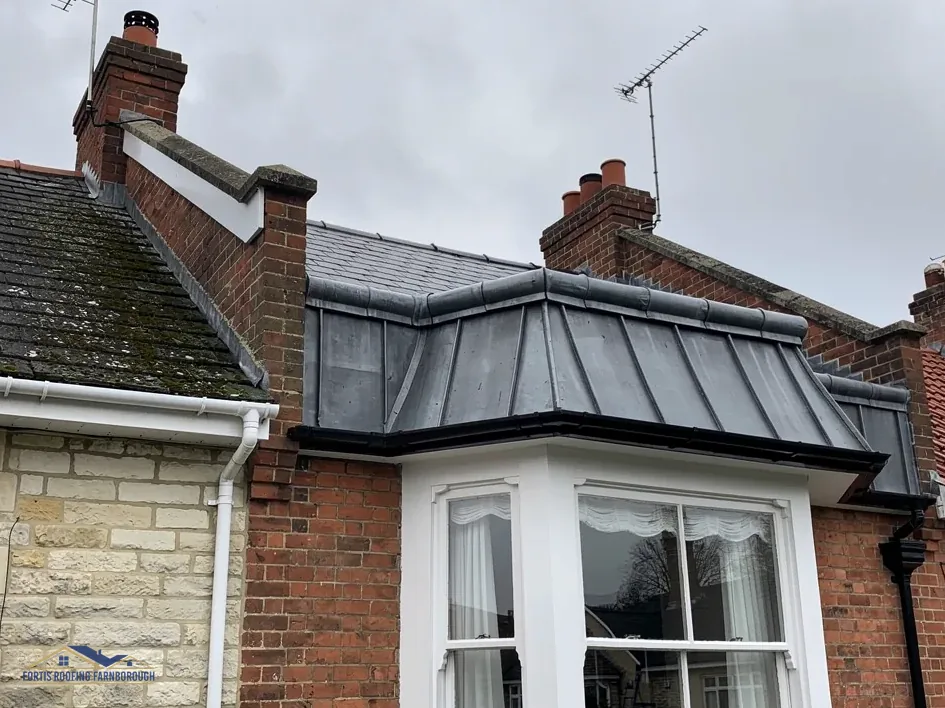
Then we look at the load on each detail. Is it a short flashing under a bay roof, or a long gutter between two slopes? Is it sheltered by a parapet, or open to every shower? Those questions set the code before any price does.
The written quote then names the code for each detail on the roof. You get one total price, and you can ask us why a gutter is specified in a heavier code than the flashings beside it.
Lead sheet roofs are tied to BS 6915 through Approved Document C of the Building Regulations, which deals with site preparation and resistance to contaminants and moisture. We work to that standard and will talk through any point you would like checked, with the code written beside it. The lead roofing hub explains the full range of leadwork we carry out around Farnborough, Aldershot and Fleet.