The short answer
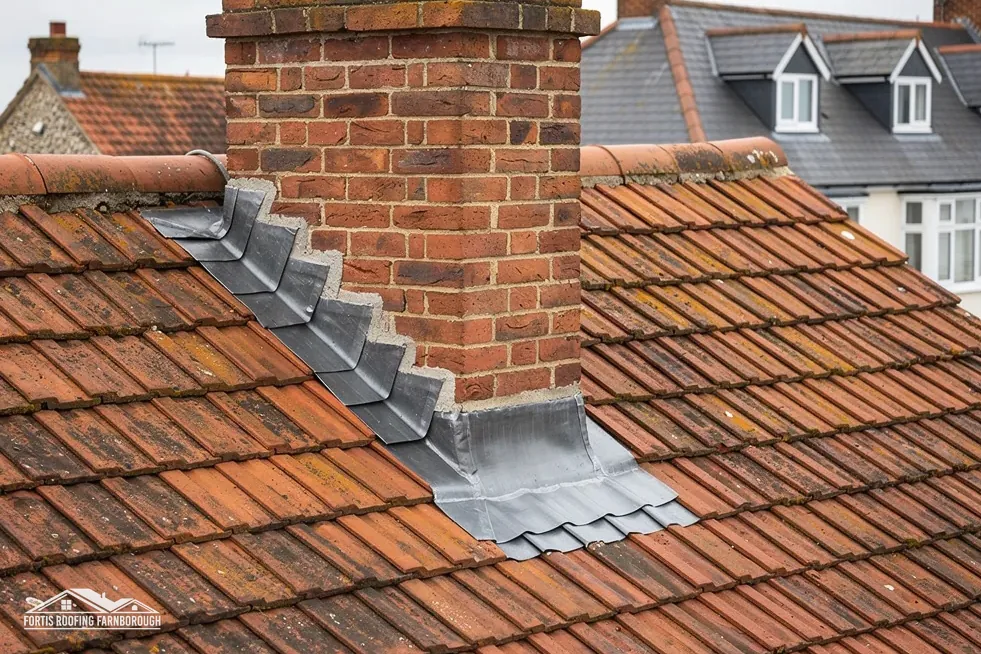
A lead apron flashing is a single sheet of lead that covers the joint at the bottom of an upstanding wall, most often the downhill face of a chimney. Its top edge is let into the brickwork and its lower edge hangs over the tiles or slates below, so rain runs down the wall, across the lead and onto the roof. Royston lists Codes 4 to 6 for flashings.
Where an apron goes
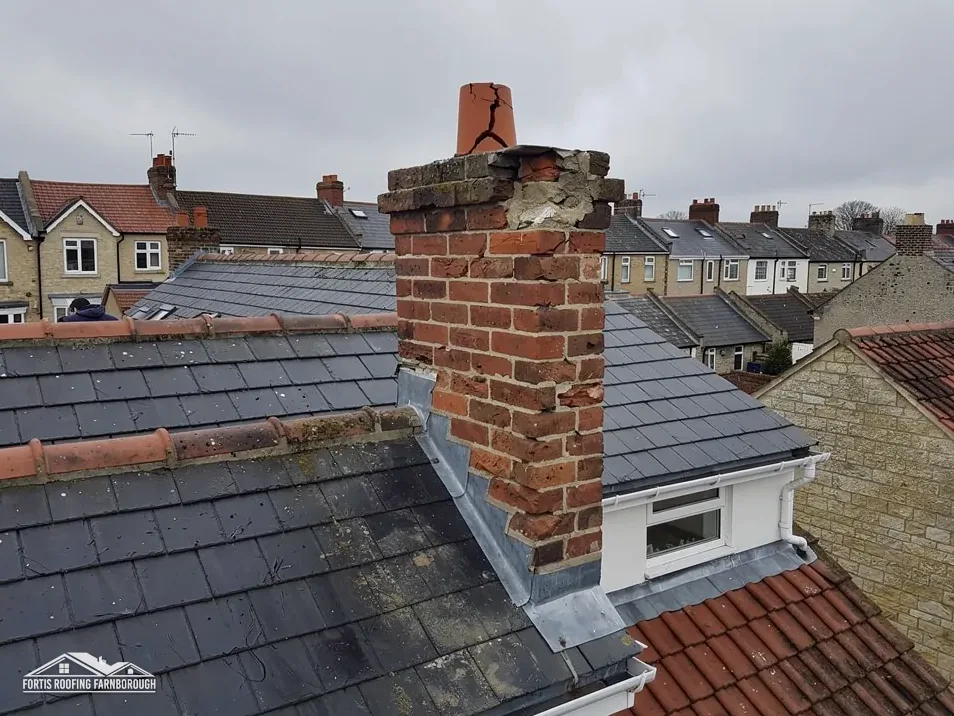
A chimney stack rising through a sloping roof has four faces, and each needs its own piece of lead. The face looking down the slope gets the apron. It is the easiest of the four to picture: a flat strip, as wide as the stack, that lies against the brick at the bottom of the chimney and spreads out over the roof covering in front of it.
Aprons are not limited to chimneys. The same detail turns up beneath a wall that rises above a lean-to roof, below a dormer window that stands proud of the slope and under a skylight frame. Wherever a roof runs towards the foot of a wall, water arrives at that joint and has to be carried across it.
At the top, the lead is tucked into a chase in the brickwork, held by wedges and pointed. At the bottom it overlaps the covering by enough that wind-blown rain cannot get under its edge. Our page on how lead flashing is fixed describes the chase and wedge method in full.
On a tiled roof the lower edge is dressed to follow the profile of the tiles, so a roll in the tile shows as a gentle wave in the lead, which is normal.
The lead code for an apron
An apron is a type of flashing, so the codes follow those for flashings. In Royston Lead's cast-lead brochure, use B (flashings) is shown against Codes 4, 5 and 6. Those are 1.80 mm, 2.24 mm and 2.65 mm thick, weighing 20.41, 25.40 and 30.05 kg per square metre.
On a normal house chimney, any of the three can do the job, and the choice rests on how exposed the stack is and what is already there. Replacing lead with a lighter code than the original is something to ask about, as a thinner sheet has less metal to lose.
One detail matters more than the code: the apron should be a single piece across the face of the stack, with its sides turned up where they meet the neighbouring flashings. A patchwork of offcuts is not a repair.
Lead sheet work links to BS 6915, the lead sheet standard cited by Approved Document C. Our page on how thick roofing lead is sets out every code in one table, from Code 3 to Code 8.
How an apron fails
Aprons fail in a handful of recognisable ways, and most can be spotted from the ground with a phone zoom or binoculars.
- The top edge comes away from the brick, leaving a dark gap where water gets behind.
- The lead buckles or ripples across its width, often because it was fixed too rigidly to move with the weather.
- A crack opens along a fold, usually at the corners where the lead is bent tightest.
- The lower edge lifts in the wind and no longer lies flat on the covering.
- Pointing above the lead crumbles and drops away.
Any of these lets water in at the foot of a chimney, and that is a bad place to leak because the water runs down inside the stack and the chimney breast. Stains on the chimney breast in the room below, or on the ceiling near it, are the sign from inside.
A small gap at the top can sometimes be made good by re-pointing. A split or a buckled sheet cannot, because the lead has already failed. Our page on lead flashing repair covers where patching ends.
What we do at the survey
At the survey we check the apron from the roof or with a camera, then the chimney itself, because a flashing is only as good as the brickwork it is fixed to. A crumbling stack makes a poor home for new lead, and re-pointing or repair there often has to come first. Our chimney repairs hub explains that side of the job.
You see photographs of the apron, the chase, the top edge and the lower lap, along with a plain explanation of what each one shows. If a repair will keep the water out, you hear that first. If the lead has failed, we tell you that as well, and explain which code we would use and why.
You get a single total in writing, and old lead leaves with us. Apron work is a small, well-defined job, wherever the stack is, from a Farnborough semi to a Fleet terrace, and it rarely needs more than safe access to the chimney.
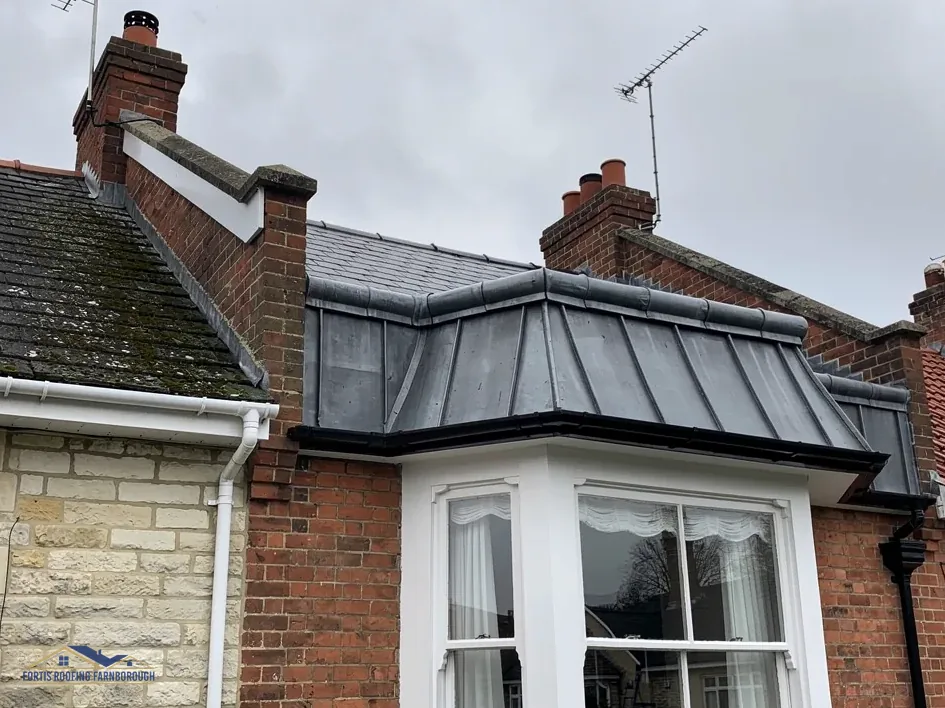
The lead roofing hub lists the other leadwork details we cover, from soakers and valleys to porch and dormer roofs.