The short answer
Four things set the price: how big the damaged area is, how hard the roof is to reach, whether the deck beneath is sound, and what the covering is. For national context, MyJobQuote's average roof repair is about £650 (Oct 2026). Your own figure follows a survey and comes as one written total.
Size and the nature of the damage
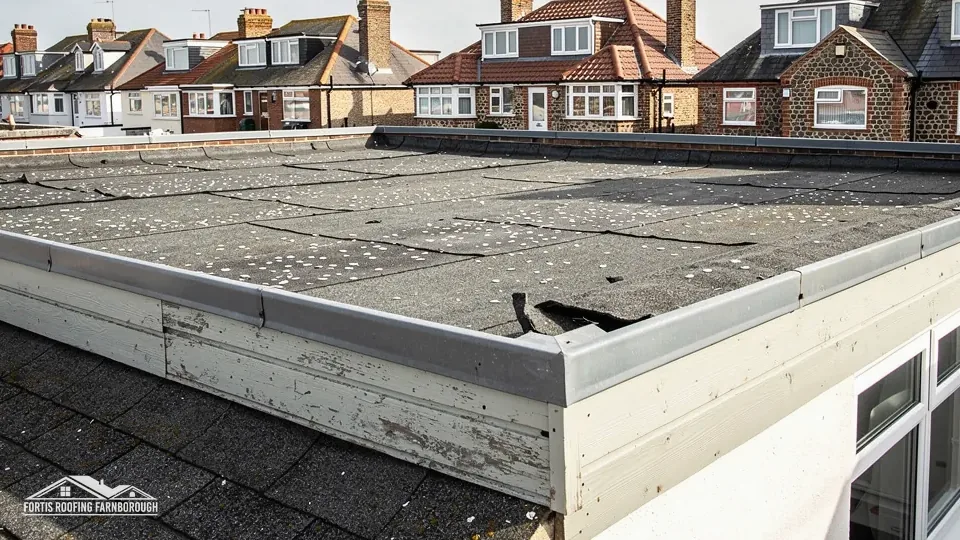
The first driver is the area that has to be put right. A single split seam or a hole where something struck the roof is a small job. A roof with several areas of damage, or a long failed upstand where the covering meets a wall, takes more time and more material.
The cause matters as much as the size. A puncture is simple to patch. A leak from a poorly formed junction at a wall may need the junction rebuilt, with new flashing or a new upstand, and that is more involved than a patch.
Hidden damage is the great unknown. A leak that has run for a while may have soaked insulation, wet the deck and started rot in the boards. Opening up often reveals more than the surface showed, and a quote can only be firm after the survey and, where needed, a test cut.
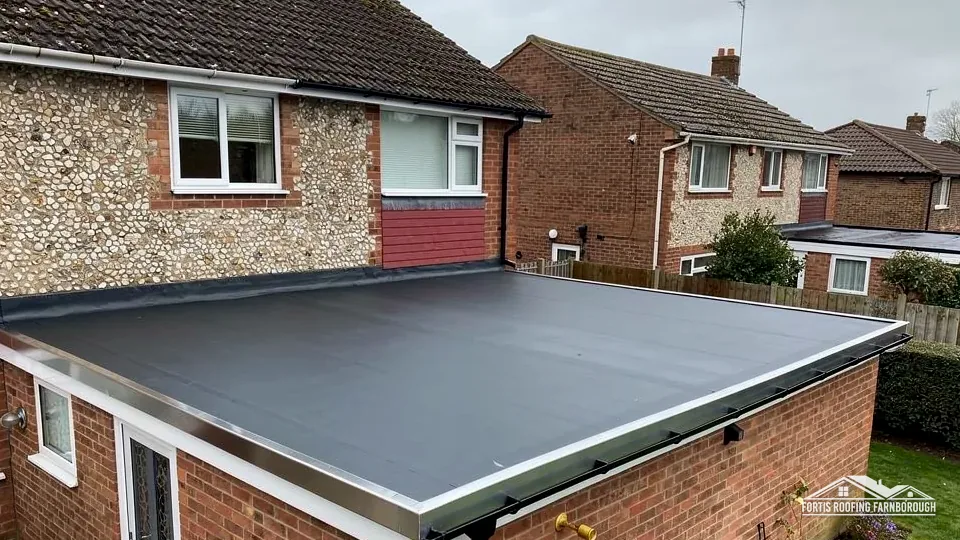
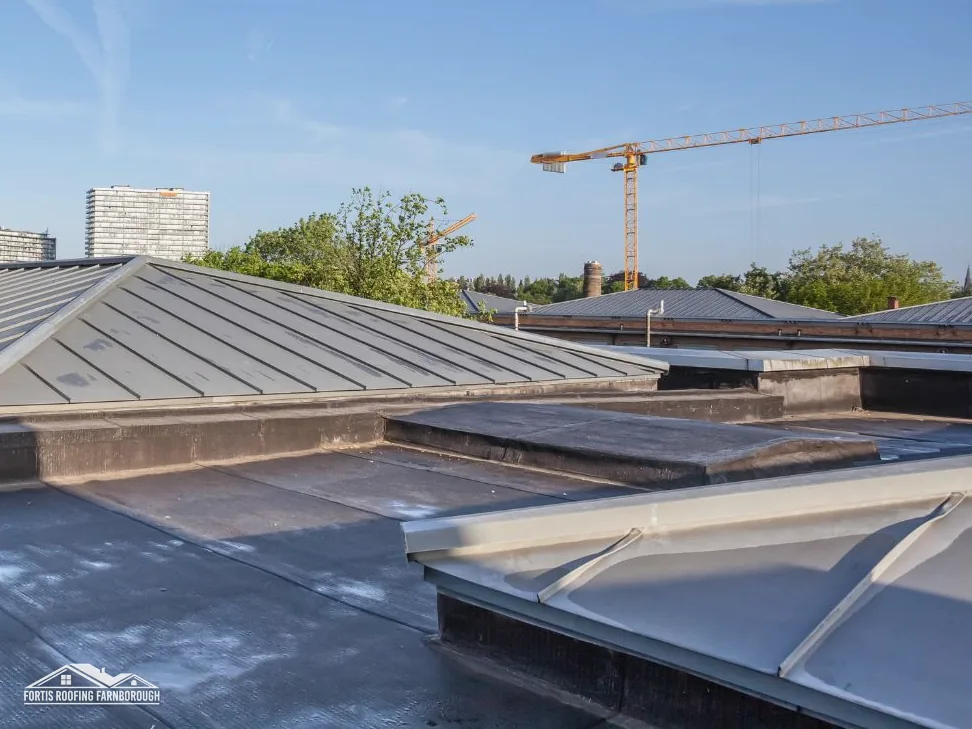
The covering sets the method. A felt repair, a rubber repair and a fibreglass repair use different materials and skills. Lead, if present, is repaired by a different route again.
For national context only, MyJobQuote's 2026 figures are around £650 for an average roof repair, £150 to £300 for an emergency call-out and £1,200 or more for extensive storm repairs (MyJobQuote, Oct 2026). Those are typical UK ranges across all roof types and say little about any one flat roof.
Access, scaffold and the working day
The route up to the roof can weigh more in the price than the repair itself. A garage roof reached from the ground with a ladder needs very little set-up. A flat roof over a first-floor extension, behind a house with no side access, may need a tower or scaffold.
Scaffold brings its own costs and lead time. Where it stands on the footway or carriageway, it needs a licence from the council that manages the road, and that council wants warning before the start. Hampshire County Council, for example, charges £211.90 for the first 2 weeks and £72 for each further 2-week period, and ten clear working days must pass between application and start. Private ground is different, and needs no licence.
Where the scaffold is going up for the repair alone, its cost is shared across a small job and can dominate it. That is a reason to combine work: if guttering, a chimney or a fascia also needs attention, doing it in one visit spreads the access cost.
Other factors include distance, parking for the van, the need to carry materials through the house, and whether the roof can safely take foot traffic.
Our page on whether roof repairs need scaffolding explains how access is chosen.
Repair, partial re-cover or replacement
Sometimes the best answer to a repair price is a bigger job. If a covering has nearly run its course, patches leave you with a bill and an ageing roof. Typical lifespans, as published, are felt 10-15 years (HomeBuilding) or 10 to 20 years (Less), EPDM 25-30 years or 30 to 50 years, and GRP 25-30 years or 25 to 40 years. They are typical, not guaranteed.
For the scale of a full replacement, Which? (Nov 2025) puts a new felt covering on a 6 m by 3 m single garage at £1,400 to £3,500, and PVC or EPDM with new boards at £1,950 to £4,000, both ex VAT. MyJobQuote gives flat roof replacement as between £1,500 and £6,000 (MyJobQuote, Oct 2026).
The line between repair and replacement is drawn by condition, not price alone. A sound roof with one fault is a repair. A roof with widespread cracking, wet deck and repeated earlier patches is a replacement, and spending on it in small pieces costs more over the years.
Our page on whether a flat roof can be patch repaired sets out the signs to look for.
How we arrive at a price
We start with a survey. We measure the damaged area, photograph the covering, seams, upstands and outlets, check the fall, and look at the ceiling and loft or void beneath for signs of wet. Where needed, we cut a small test section to see the deck.
The price follows from what we find: materials, time, access and any deck or insulation repair. It reaches you as a single written total with VAT stated, and with the photographs behind it so you can see how it was reached.
Where scaffold is needed, we say whether it is included and who arranges any licence. We recommend the smallest repair that will hold, and we say when a bigger job is the better buy.
A figure given blind for a roof nobody has seen is a guess, so the price waits for the visit. Citizens Advice recommends collecting written quotes from 3 or more traders, and shared photographs make them easy to set side by side.
The flat roofing hub covers the coverings we repair and replace.