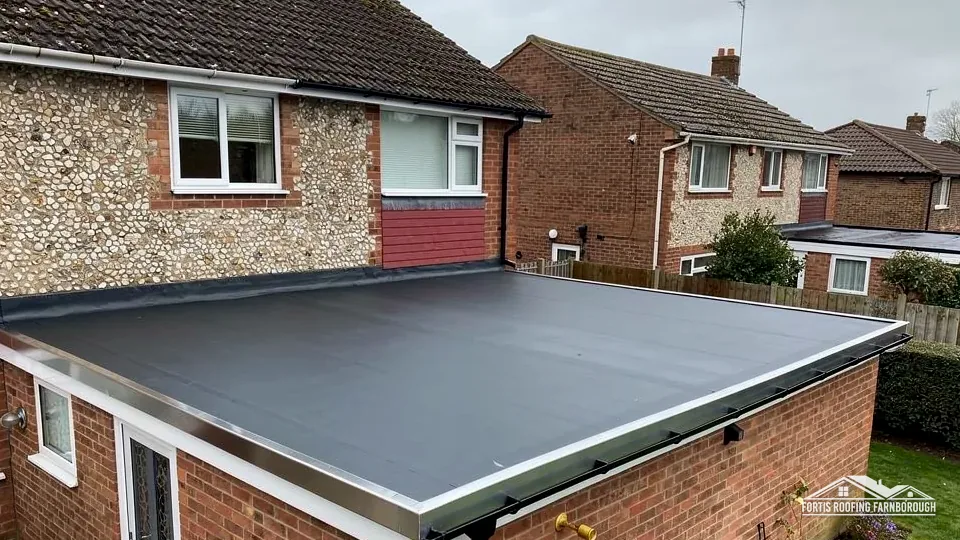
EPDM is a synthetic rubber sheet used on flat roofs. It arrives as one large piece and is glued to the deck, which leaves few seams for water to find, and that has made it a popular covering for garages, extensions and dormers. The question that follows is how much it costs, and the plain position is that published guides give different answers for good reasons.
Below are the figures from four national guides, each with its date, and an explanation of why they do not line up. After that comes what actually moves the price of an EPDM roof, so that you can read a quote and put sharper questions to the person who wrote it. Nothing here is a Fortis Roofing Farnborough price. Ours is written after a survey of your roof, as one total.
This post belongs to a small cluster on flat roofs. For EPDM set against felt, GRP and lead on cost, see whether a flat roof is cheaper than a pitched roof. For a worked small job, our post on garage roof replacement in Farnborough goes further.
The flat roofing page sets out our approach to flat roofs of every size.
The published figures in one table
Four guides have figures that bear on the price of an EPDM roof. They come from outside firms and describe typical UK jobs, so none can stand in for a quote on your own roof.
| Source and date | Figure as published |
|---|---|
| MyJobQuote, 9 October 2026 | Around £60 per square metre; average rubber roof around £1,050 |
| Which?, November 2025, ex VAT | £1,950 to £4,000 for PVC or EPDM, or new boards, on a typical single garage |
| HomeBuilding, 30 September 2025 | Supply-only EPDM £105 per square metre |
| Less, 27 October 2026 | Garage of 15 square metres £1,200 to £2,500 |
What each figure describes
MyJobQuote gives a rubber roof twice over: a rate for each square metre, and a figure for an average job. Which? gives a range for a garage measuring 6 m by 3 m, covering labour and materials, before VAT. HomeBuilding's number is supply-only, which means the cost of the sheet and nothing for the fitter. Less offers a range for a garage of 15 square metres.
Reading across the rows
The rows sit side by side, but they should never be added or averaged. They differ in date, in what they include and in the size of roof behind them. The figure that finally counts is the one on your own written quote, after a survey has measured your roof.
Why the guides do not agree
Anyone looking at the table will want one number to carry away. The reason you cannot have one is that each figure measures a different thing.
A rate and a total
A price per square metre and the price of a whole job are different animals. A rate speaks to the area of covering. A total also carries the fixed parts of any job: reaching the roof, preparing the deck, finishing the edges and clearing away. On a small roof the fixed parts weigh heavily, so the cost per square metre rises as the roof shrinks.
Supply-only or fitted
HomeBuilding's £105 is for materials alone. It tells you what the rubber costs, not what it costs to lay. Labour, adhesive, edge trims and waste all sit on top of that number.
Different dates
The guides were written between September 2025 and October 2026. Prices move over a year, so an older figure may not match the present market.
Garage or house
Which? and Less describe garages, small plain jobs. MyJobQuote speaks of rubber roofs more generally. A house extension with several upstands, a rooflight and a step is a different task from a rectangle over a single garage.
VAT
The Which? figures are before VAT, so VAT at the standard 20% would be added to them. MyJobQuote does not state its basis, so ask whether any quote you receive includes VAT.
The width of the spread is the message in itself: a quote for an EPDM roof cannot be judged against one figure. It can be judged against its own scope.
What moves the price of a rubber roof
With a sense of the range, the question becomes where your own roof falls inside it. Six things decide that.
Area and shape
More square metres means more sheet, but the relationship is not a straight line. A bigger roof spreads the fixed costs and often works out cheaper per square metre. A roof with many corners, steps and penetrations works out dearer than a plain rectangle of the same area.
The deck beneath
The sheet is bonded to the deck, so the deck has to be sound, dry and smooth. Boards that are rotten or an uneven surface must be repaired or replaced first. Which? lifts its range once new boards enter the picture, which shows how far the deck can change the total.
Detailing
Where the roof meets a wall, around outlets, at edge trims, past rooflights and pipes, the work is slow and has to be exact. These junctions are where flat roofs fail, so time spent on them is time well spent.
Insulation
Approved Document L treats laying a new waterproof layer over a flat roof as renovation, and an existing roof is then expected to reach 0.16 from a 0.35 starting threshold, subject to para 4.13's feasibility and 15-year payback test. Adding insulation raises the price, and it is a question for building control.
Access
A roof reached by ladder costs less to work on than one that needs scaffold, and scaffold across a pavement has to be licensed.
Falls
Under BS 6229:2025 the finished fall must be 1:80 or steeper, with IKO suggesting 1:40 at design stage. A roof that ponds may need the fall corrected, and that costs money too.
Rubber against the other flat coverings
EPDM is one of several coverings, and price and life taken together make the comparison. The published guides give a starting point.
Materials only
HomeBuilding's supply-only list reads felt £65, EPDM £105, GRP £110 and lead £170 for each square metre. On materials alone, felt costs least and lead costs most, with EPDM and GRP close together in the middle.
Working life
For EPDM, HomeBuilding says 25-30 years and Less says 30 to 50. For GRP the two say 25-30 and 25 to 40. For felt they say 10-15 and 10 to 20. HomeBuilding puts a lead flat roof at 60-100 years.
What the two lists suggest
A covering that costs more per square metre but lasts longer can cost less for each year of service. A felt roof that has to be renewed twice while an EPDM roof is still going may end up the dearer choice over a lifetime. Those are ranges quoted by guides, and no covering carries a promise.
Other factors
The decision also turns on roof shape, access, whether people will walk on the roof, how much disruption you can accept and your plans for the building over the coming decades. GRP, the fibreglass alternative, is built up on site in resin and suits some small roofs, though the choice depends on the details.
The separate question of which one lasts longest is taken up in the post on the longest-lasting flat roof material.
Judging a quote for a rubber roof
A fair price starts with a clear scope and ends in a single total. A few habits help when you read the quote in front of you.
Ask for the scope on paper
It should state what is being laid, on what deck, to what falls, with which edge details, and what happens to whatever is there now. If the deck is being replaced, that should be stated.
Check what the total takes in
- VAT, which is 20% at the standard rate.
- Scaffold or other access equipment.
- Removal and disposal of the old roof.
- Edge trims, outlets and any new fascia.
Put several side by side
Citizens Advice favours collecting several written quotes, three at the least. Make sure each describes the same job before you look at the totals, because a lower total for a smaller scope is not a better price.
One total from us
Our price comes as a single total, in writing, once the survey is done. The aim is a scope that is clear to both sides. Where a repair is all the roof needs, that is the job priced.
National figures as a sense-check
If a quote for an average-sized rubber roof sits far outside the published ranges, ask why. The reason may be sound, such as a weak deck or awkward access, but you are entitled to be told what it is.
MyJobQuote also gives flat roof replacement as between £1,500 and £6,000 (updated 20 October 2026), a wider range again, which shows how much the answer depends on the roof.
Laying the sheet and what a survey checks
Saying that rubber is glued to a deck hides several steps. The survey is where they get planned.
Before the sheet arrives
The old covering is stripped or, if it is sound and compatible, prepared. The deck is checked for soundness, dryness and flatness. Insulation goes down if it is part of the design, with a vapour control layer where the build-up calls for one. The fall is measured against the target.
Laying
The sheet is unrolled and bonded to the deck, with care at corners and edges. Upstands are formed, outlets are fitted and trims are fixed. The aim is to keep joins to a minimum and to leave each one accessible for checking.
What the survey records
Before any of that, the surveyor looks at the covering, the deck, the upstands, the outlets and the fall, from the outside and from underneath where possible. Problems are photographed and the area is measured, so that the quote rests on figures and not on guesses.
What comes back to you
You receive the findings, a recommendation and one written price that covers the whole job. Where the roof can be repaired, the repair is priced instead. Our post on garage roof replacement in Farnborough shows the same process on the commonest small job, and a survey is the next step if you have a roof in mind.