Anyone choosing a flat roof covering soon meets the question of life. A roof that has to be redone in fifteen years is a different proposition from one that is expected to last a century, and the price per square metre is only meaningful when set against how long the covering works. So the useful question is not which material is best, but which lasts longest, by what evidence, and at what trade-off.
This post ranks the main flat roof coverings by the lifespans given in published guides. For two of them the guides disagree, so we show both figures with their sources rather than pick one. It is one of the flat roof cluster of posts, and its job is the lifespan ranking. For the build cost of a flat roof against a pitched one, see whether a flat roof is cheaper than a pitched roof, and for rubber roofing prices, our EPDM cost post.
A published lifespan is a range quoted by a guide, not a promise, and a warranty is a separate thing. The real life of a particular roof depends on the deck beneath it, the falls, the details at the edges and the care it receives. Our flat roofing page explains how we survey flat roofs and what we look for.
The ranking at a glance
The table sets out the typical life each guide gives for each flat roof covering. Where two sources give different figures, both appear.
| Covering | HomeBuilding (30 Sep 2025) | Other source |
|---|---|---|
| Zinc | Not listed | 100 years (BRE Environmental Product Declaration, as stated by VMZinc) |
| Lead | 60-100 years | Lead flashing: over 80 years (MyJobQuote) |
| EPDM | 25-30 years | 30 to 50 years (Less, 27 Oct 2026) |
| GRP | 25-30 years | 25 to 40 years (Less) |
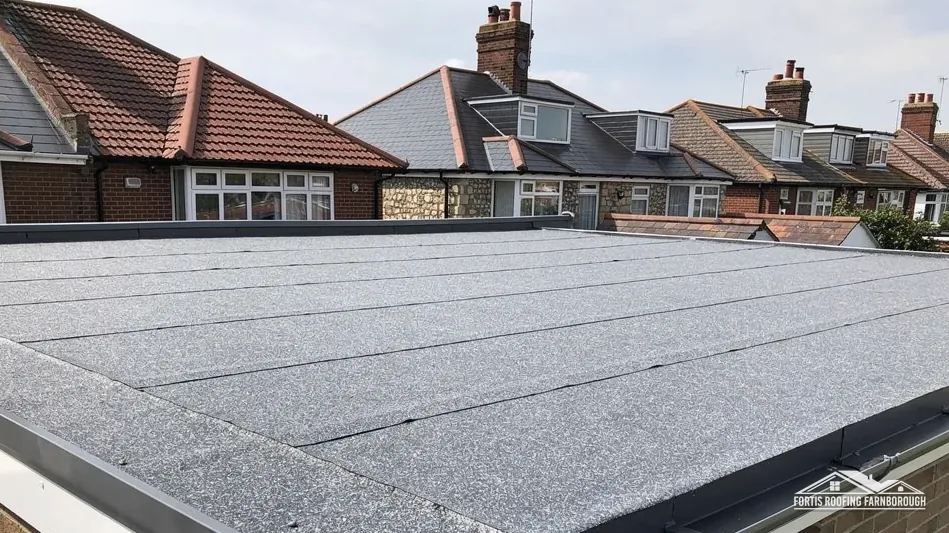
| Felt | 10-15 years | 10 to 20 years (Less) |
Reading the order
By these figures the order from longest to shortest is zinc, lead, EPDM, GRP and felt, though the ranges for EPDM and GRP overlap. Where the two sources differ, the Less figures run higher than HomeBuilding's. That gap is a reason to treat each as a range and not as a number to plan a budget around.
What the table does not say
It does not say that the longest-lasting covering is the right one. Price, weight, shape, access and the building all matter, and the next sections go through each covering in turn.
How the figures are used
Planners use ranges like these to set a replacement budget, and owners use them to decide whether to repair or renew. A roof near the bottom of its range is worth a survey, and a roof near the top is worth watching. Neither is a verdict, since the condition of the roof in front of you is what counts, and a roof outside its range can still be sound while one well inside it can fail.
When a source gives only a single figure, as the BRE declaration does for zinc, treat it as the manufacturer's headline rather than a typical result, and ask what conditions it assumes.
Zinc and lead: the long-life metals
The two metal coverings top the published ranges, and both are used on flat roofs where a long life is worth paying for.
Zinc
VMZinc states that the BRE Environmental Product Declaration gives zinc a life of 100 years. That is the manufacturer quoting an independent declaration, so it is worth reading as a published claim and not as a guarantee. Zinc is a sheet metal roof, formed and joined by specialist methods.
Lead
HomeBuilding gives a lead flat roof 60-100 years. MyJobQuote's figure for lead flashing is over 80 years as a minimum, which is a different component but a useful pointer to the material. Lead flat roofs are not covered by BS 6229, which is for flexible membranes. They follow BS 6915, which Approved Document C cites for lead sheet.
The trade-off
HomeBuilding's supply-only price for lead is £170 per square metre, the highest of the coverings it lists, against £65 for felt, £105 for EPDM and £110 for GRP. A long life costs more at the start, and across decades the yearly cost of the metal can come out lower.
Where metals suit
Lead is common on small roofs, bays and dormers, and on listed and period buildings, where its appearance and workability suit. Our guide to lead flat roofs explains how one is built.
Metals need skilled workmanship, and the life depends on the details being right. Joints, fixings and the allowance for movement all affect how a metal roof ages, and a roof of the longest-lasting material can fail early if those are wrong. Ask who will form the details and what experience they have of the material.
EPDM and GRP: the middle of the range
EPDM and GRP sit in the middle, and they are the two coverings where the published sources disagree most.
EPDM
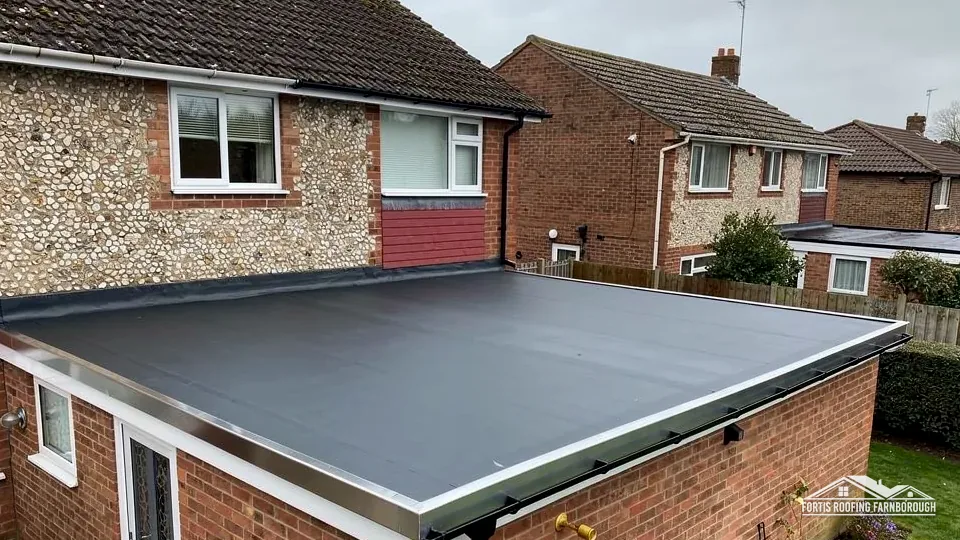
This is a rubber sheet, laid whole and glued down to the deck. HomeBuilding gives it 25-30 years, and Less gives 30 to 50. The two ranges overlap at 30. Taking both, a sensible planning figure is somewhere in the range from 25 up towards 50, with the top end needing good conditions and good workmanship.
GRP
GRP is glass-reinforced plastic, fibreglass mat laid in resin to form a single skin. HomeBuilding gives 25-30 years and Less gives 25 to 40. The ranges again overlap. Our flat roofing page covers how it is laid.
Cost
HomeBuilding's supply-only prices are £105 per square metre for EPDM and £110 for GRP, which is close. The choice often turns on the shape of the roof, the details and who will lay it, not on price alone.
Why the sources differ
The guides were compiled at different times and for different audiences. One may reflect manufacturers' stated lives, another what installers report. Neither is wrong, and the spread tells you that the life of any single roof is uncertain.
What moves a roof within its range
Deck quality, the falls, the care taken at corners and upstands and whether outlets are kept clear all push a roof up or down inside its range.
Felt: the shortest published life
Bitumen felt is the most familiar flat roof covering and the one with the shortest published life.
The figures
HomeBuilding gives felt 10-15 years, and Less gives 10 to 20. Both put it at the bottom of the table. The sources agree on the order even though they disagree on the numbers.
Why people still choose it
Felt has the lowest supply-only price on HomeBuilding's list, £65 per square metre. On a small garage or a shed, that can make it a sensible choice, particularly if the building is not intended to last for decades. Where a roof is expected to be replaced anyway, a short-lived covering is not a problem.
The cost over time
A covering that must be renewed two or three times in the life of a lead roof will cost more in total, even though each renewal is cheap. If you plan to keep a building for a long time, the lower price can be a false economy. If you plan to sell or rebuild soon, it can be the right call.
Quality matters
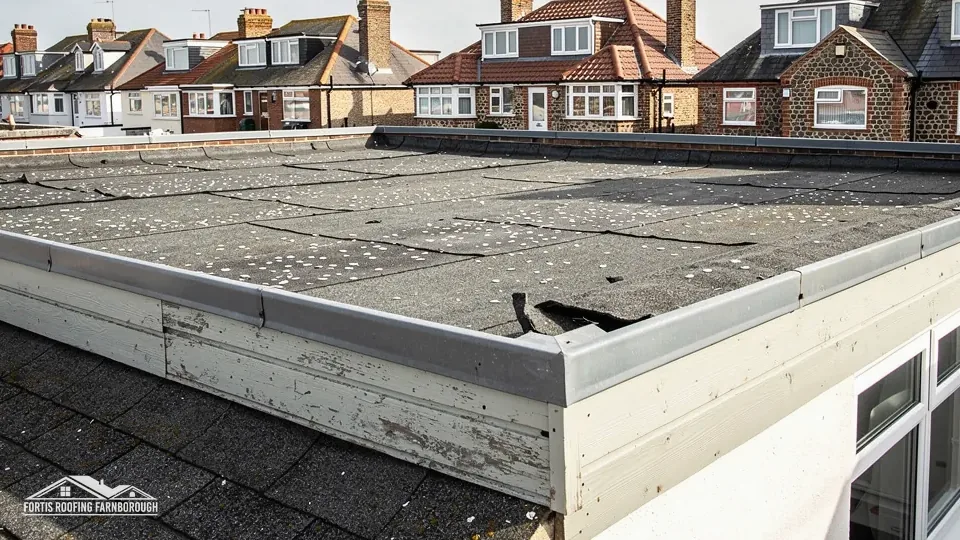
Felt roofs vary in specification, and a cheap job and a careful one are not the same product, and the life depends on the number of layers, the quality of the laps and how the details are formed. A felt roof that is well made can outlast a poorly made roof of a better material.
The cost question for felt and the other coverings has its own post, on the lowest-cost flat roof material.
What shortens the life of any flat roof
Published ranges assume a roof that is built and kept properly. Several things cut a roof short of its range.
Standing water
A roof that holds water ages faster and puts extra load on the structure. BS 6229:2025 keeps a minimum finished fall of 1:80 for flexible membranes, and IKO advises designing for a fall of 1:40, which allows for the finished roof being flatter than intended. A roof without that fall will pond.
Details
Upstands, edges, outlets and penetrations are where leaks begin. The covering may be sound across the field of the roof and fail at the junctions.
The deck
A covering is only as good as what it is fixed to. A soft or uneven deck shortens the life of any membrane. Approved Document C asks for roofs that condensation within the build-up cannot damage, so ventilation or the vapour control layer matters.
Neglect
Blocked outlets, debris and unattended damage turn small defects into large ones. A look at the roof after storms and in autumn costs little.
Foot traffic and added loads
Walking on a roof, fitting plant or fixing solar panels can damage the covering if the roof is not built for it.
The post on the main drawbacks of a flat roof covers the weak points in more detail.
Choosing, and what a survey tells you
The longest-lasting covering is not always the right one, and the right one is not always the lowest-priced. A sensible choice weighs five things.
Five questions
- How long do you expect to own the building?
- What does the roof need to carry, and will people walk on it?
- What shape is it, and how many details does it have?
- What is the deck, and what condition is it in?
- What is the upfront cost against the cost per year?
The survey
A survey records the fall and the outlets first, then the upstands, the deck and the covering. It photographs what it finds and measures the area. The findings tell you whether a repair is enough, whether a re-cover over the existing deck will do, or whether the deck needs replacing as well.
Repair first
If the existing covering is sound apart from a local defect, a repair beats a new roof on value, and a repair is what gets priced. A new roof is priced when the evidence supports it.
One price
A single written total covers the scope agreed. When comparing offers, put the same scope to every firm, and bear in mind that Citizens Advice favours gathering at least three written quotes first.
For a garage roof in particular, our garage roof replacement post sets out the options and the typical costs.