The short answer
It depends on why the roof leaks. Buildings insurance can respond to damage from an insured event such as a storm, but many policies leave out slow deterioration, which is how a lot of flat roof leaks begin. Your own policy decides, and the insurer alone rules on a claim. Protect the roof, keep your pictures and receipts and report early.
Where insurers draw the line
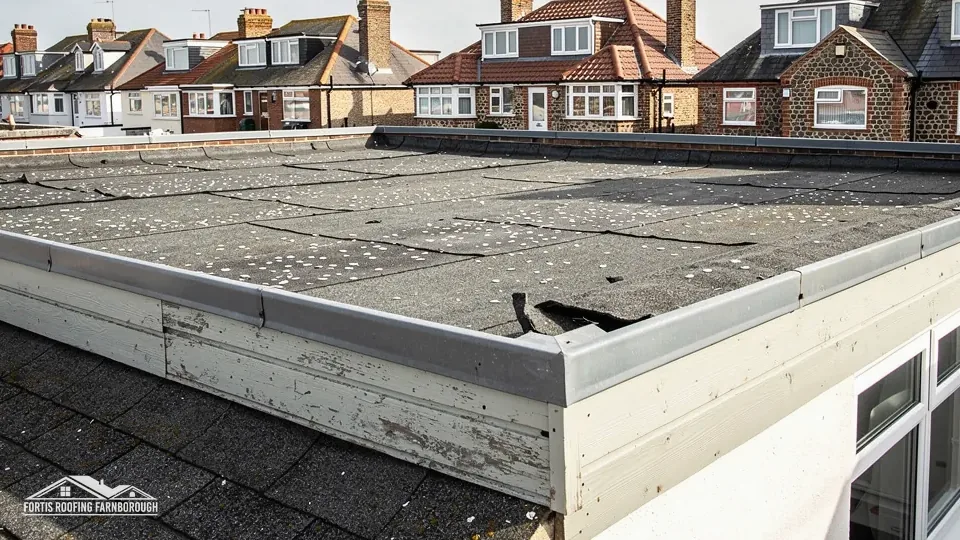
Insurers pay for sudden events they have agreed to cover and generally not for the slow decline of a building. A flat roof sits awkwardly between the two. A membrane splits in a gale, or a falling branch punctures it, and the cause is clear. More often a covering simply ages: seams open, the surface cracks, ponds develop and moisture works through over months.
The Financial Ombudsman Service publishes how it looks at storm complaints, and the questions it asks are a useful checklist: whether a storm happened, whether the damage matches one, and whether the weather caused the harm or only revealed it. Exclusions for gradual damage and for wear are among those it mentions.
A complaint goes nowhere when the roof was already poor and you knew it, or when the weather simply showed up a fault that was there already. Flat roof coverings have limited lives, with HomeBuilding giving felt 10-15 years and Less 10 to 20 years, so an insurer will ask about age and upkeep.
That is not a reason to give up. A flat roof damaged by a clear, recent event is a genuine claim, and records of the roof's condition before it help.
Storm definitions and your policy
No single definition of a storm binds every insurer. The Ombudsman's own description starts with violent wind, but it allows that exceptional rain, hail or snow can count even in the absence of wind, and it looks at the Beaufort scale because some insurers write a wind threshold into their terms.
Because of this, your own policy's definition is the one that counts. Read it, and the sections on escape of water, accidental damage and exclusions. Look at any condition about maintaining the property in good repair, as insurers may rely on it if a roof has been neglected.
A wind speed quoted online may belong to a different policy, so use the one in your own documents.
Which? reported that only 32% of storm-related claims made in 2024 resulted in a payout (Which?, storm claims report). That is a reason to prepare carefully and not a forecast for your claim.
If a clause is unclear, raise it with the insurer or a broker before you arrange repairs assuming cover.
Steps that protect a claim
Report to the insurer at the outset. If water is entering, protect the roof with a temporary measure, and hold on to photographs and receipts. Leave permanent work until the insurer has given a view, unless the weather leaves no choice.
Gather evidence from the ground and from inside. Photograph the stained ceiling, the room, the roof edge and any debris on the ground, with dates. If you can safely see the roof surface from a window or neighbouring higher point, photograph splits, ponds and damaged seams. Never climb up yourself, as flat roofs can be fragile.
Write down the date and time you first noticed the leak and the weather at the time. If a storm was named or reported, note it. Keep any damaged material if you can.
A roofer's report helps. It should name the cause, show the damage in pictures with measurements, and describe the rest of the roof, which helps the insurer judge whether the damage was sudden.
If the claim is refused and you disagree, start with the insurer's complaints procedure. After its final answer, or after eight weeks without one, you can go to the Financial Ombudsman Service, whose helpline is 0800 023 4567. You have 6 months from the final response.
If the claim fails, or there is no claim
Many flat roof leaks end up paid for by the owner, and the sensible aim is to get the right repair at the right size. A short-lived patch repeated every winter costs more than a sound repair or a new covering.
Our visit takes in the membrane, its seams, the upstands and the outlets, with pictures and measurements of the damage. You are told whether a repair should hold or whether the membrane has aged out, and the work is quoted as one total in writing.
If a storm caused the damage, our pictures and findings can go to your insurer. The claim remains yours to run, and the outcome is the insurer's to decide. The roof is made safe straight away so that further damage does not complicate things.
For the general position on leaks and cover, see whether a roof leak is covered by home insurance. The flat roofing hub covers the repair and replacement options, and patch repair explains when a local fix is enough.