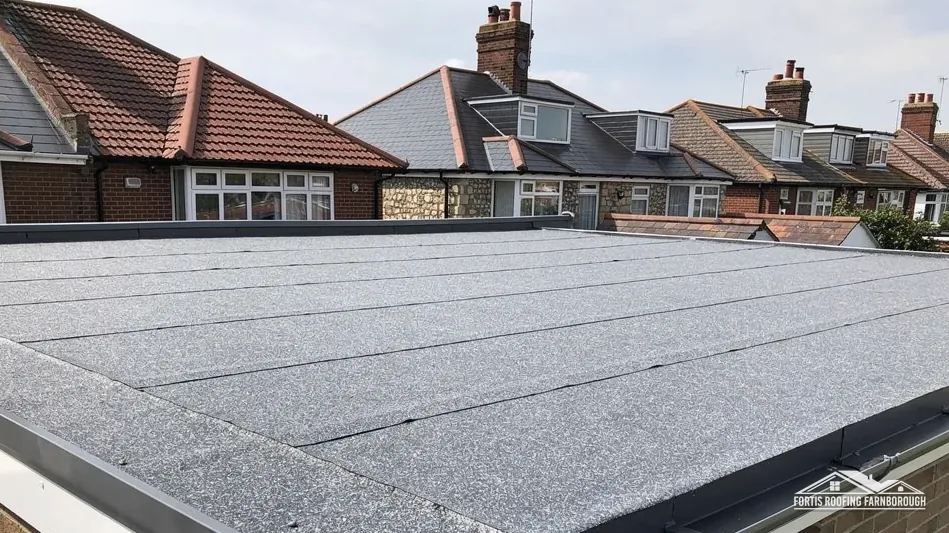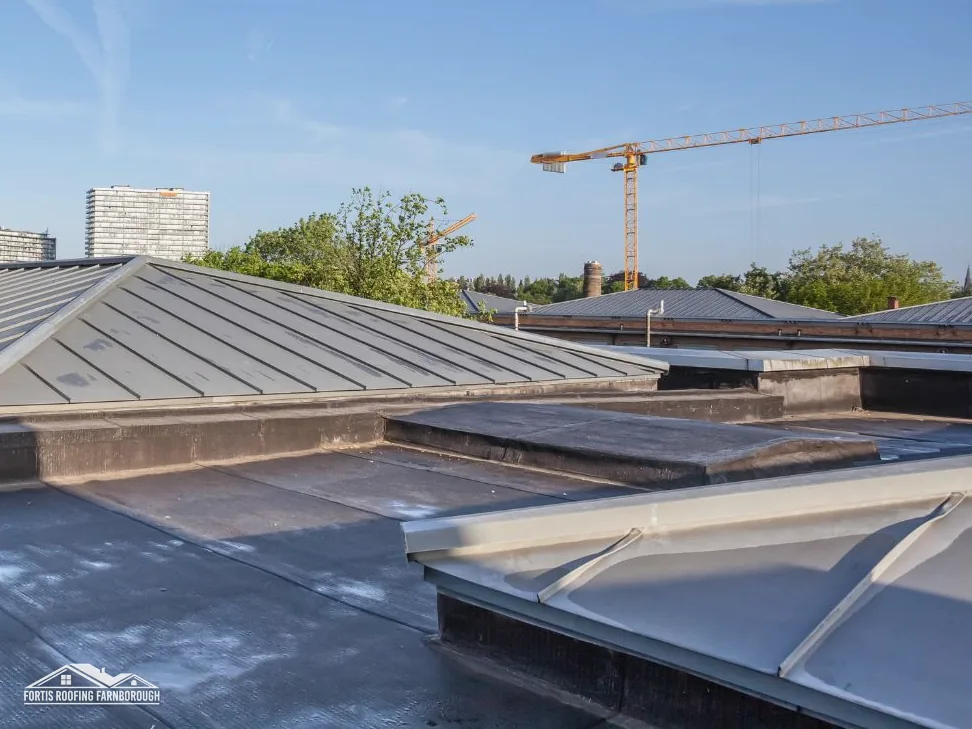
GRP stands for glass-reinforced plastic, and in roofing it means fibreglass. A GRP roof is made on site by laying glass-fibre matting onto the deck, saturating it with resin and finishing with a coloured topcoat. The resin sets hard and forms a single continuous skin, which is why the finished roof has no joints for water to find, unlike felt or single-ply membranes that depend on laps and welds.
That one-piece quality is the main reason people choose it for garage roofs, extensions, porches and dormers, and for small awkward shapes where a membrane would need many cuts. It is also the reason GRP has a weakness. A rigid skin does not stretch, so if the deck moves or the roof flexes, the skin can crack. Whether GRP is the right choice depends heavily on the deck beneath it and on the shape and use of the roof.
This guide explains how GRP roofs are built, what the published lifespans and material costs are, where GRP suits and where it does not, why it cracks and what the Building Regulations say when a GRP roof is renewed. It is general information, and your own roof needs a survey.
How a GRP roof is built
A GRP roof is a layered job, and the quality of each layer shows in how long the roof lasts. The order is straightforward.
The deck
GRP needs a firm, dry, smooth deck, most often exterior-grade plywood or oriented strand board laid to a fall. The boards are fixed so that their edges do not move, because any movement under a rigid skin pulls at it. A roof with a weak or bouncing deck is not ready for GRP, however good the resin. Fixings should be corrosion-resistant, boards should be laid with staggered joints and the fall should be built into the structure, not formed in the resin.
Trims and edges
Before the resin goes on, edge trims are fitted. They finish the roof where it meets the gutter, and form the drip that throws water clear. Upstands at walls are formed so that the skin can turn up and be sealed.
Matting and resin
Glass-fibre matting is laid over the deck and wetted out with resin. Done in one pass, the layers bond into a continuous sheet that carries over joints and corners. Temperature and damp matter at this stage, since resin cures chemically and does not like cold, wet or humid conditions.
The topcoat
A pigmented topcoat, often called a gelcoat, seals and colours the surface and protects the layers beneath from sunlight. It is the part you see, and it is also the first part to show wear, chalking and fading as the years pass. A topcoat can be renewed over sound laminate, which is one reason a GRP roof can outlast its first colour.
Because the whole roof is formed in place, the finish depends on the people doing it as well as the products. Our guide to warm and cold flat roofs explains how insulation can be added to the build-up beneath a GRP skin.
How long a GRP roof lasts
Published lifespans for GRP are a range, and two of the main sources give different ones. That is normal for flat roof coverings, because quality, deck and detail vary so much.
| Source | Typical life |
|---|---|
| HomeBuilding (30 Sep 2025) | 25-30 years |
| Less (27 Oct 2026) | 25 to 40 years |
Reading the two together
Both sources agree on a floor of 25 years. They differ on the ceiling, 30 or 40, and the sensible reading is that a well-laid GRP roof on a sound deck should reach at least the lower figure, and may go further. Both are typical ranges as published, and neither is a promise or a warranty.
What shortens it
- A deck that flexes or whose joints open as timber moves.
- Foot traffic and heavy loads on the surface.
- Poor trims and upstands, where leaks often begin.
- Resin laid in cold or damp conditions, or in too thin a coat.
- Ponding water that sits for long periods, wearing at the topcoat.
How it compares
Other flat roof coverings have published lives too. HomeBuilding gives EPDM 25-30 years, and Less gives 30 to 50. Felt has 10-15 from HomeBuilding and 10 to 20 from Less. Which suits you depends on the roof, as our guide to the flat roof Building Regulations explains for the regulations side.
What GRP costs: published figures
Cost guides give GRP figures in two forms: the supply-only price of the material, and the price of complete work. It matters which one you are reading.
Supply-only, per square metre
HomeBuilding's supply-only table (30 September 2025) gives GRP at £110 per square metre, against £65 for felt, £105 for EPDM and £170 for lead. Supply-only means the materials, not the labour, access or waste, so £110 is not the price of a roof. It is a way to compare the materials, and the difference between GRP and EPDM is small compared with the cost of getting the deck and details right.
| Covering | Cost per m² |
|---|---|
| Felt | £65 |
| EPDM | £105 |
| GRP | £110 |
| Lead | £170 |
Whole-job guides
For flat roofs as a whole, guides give wider ranges. MyJobQuote gives flat roof replacement at £1,500 to £6,000 (Oct 2026), and Less gives a 15 square metre garage roof at £1,200 to £2,500 (Oct 2026). Which? gives other materials, such as PVC or EPDM, at £1,950 to £4,000, ex VAT, for a typical single garage (Nov 2025). None of these is a GRP-only figure, and none is a Fortis Roofing Farnborough price. The nearest guide to GRP itself is the supply-only table above, so keep the labour, access and waste in mind when you read it.
What moves the price
Roof area, the state of the deck, access, any insulation, the edge details and whether the roof has upstands or rooflights all change the figure. A small roof with a lot of detail can cost more per square metre than a large plain one. The quote that follows a survey is one written total.
The price you pay depends on your roof, so treat the published figures as context only.
Where GRP suits, and where it does not
GRP is a good answer to some flat roof problems and a poor one to others. Matching the covering to the roof is most of the job.
Where it suits
- Small roofs of simple or awkward shape, such as porches, bay roofs, dormers and garage roofs, where a one-piece skin avoids many joints.
- Roofs with a solid, stable deck laid to a good fall.
- Balconies and roofs that are walked on, provided the detail and surface are designed for it.
- Roofs where a hard, smooth finish is wanted.
Where it is less suitable
- Large roofs, where thermal expansion across a wide deck puts stress on a rigid skin.
- Roofs on decks that move, such as old boards that flex, or structures that are still settling.
- Roofs where the deck is wet or cannot be dried, since resin needs a dry base.
- Roofs that will see heavy, constant foot traffic without a proper walkway.
The deck is the deciding factor
A good GRP roof begins with a good deck. If the boards are tired, they are renewed first. That is why a survey looks at the underside, from the room below or the loft, before suggesting GRP.
Where a roof is better served by a flexible membrane, we tell you, because the right covering is the one that suits the structure. Our answer on GRP roof cracking explains what happens when the match is wrong.
Why GRP cracks and what to do
A cracked GRP roof is the commonest complaint, and the cause usually lies beneath the skin, not in the resin itself.
The usual causes
Structural movement is the main one. Timber decks swell and shrink with moisture, boards shift at their joints and the building settles. A rigid skin on a moving base will eventually crack along the line of movement. Thermal expansion adds to it on large roofs. Impact, such as a dropped tool or a falling branch, can also crack the surface locally.
Hairline or serious
A hairline crack in the topcoat may be cosmetic. A crack that goes through to the matting is a path for water, and one that follows a deck joint suggests movement that will return. Damp patches inside, soft decking at the crack and staining below are signs the water has got in.
Repair or renew
A local crack can be cut out, ground back and laminated with new matting and resin, then recoated. That works if the cause is local and the deck is sound. A roof with many cracks, or a deck that is failing, needs more. The survey photographs show which case you have, so the choice is made on evidence.
What to avoid
Painting over a crack with sealant or bitumen hides it for a season. It does not fix the movement or the resin, and it can trap water. Ask what caused the crack and what the repair changes about it.
Once repairs mount towards the cost of a re-cover, a different covering on a re-laid deck may be the better buy. See our flat roofing page for the options.
Insulation, regulations and replacing a GRP roof
When a GRP roof is replaced, it is a flat roof renovation, and the Building Regulations apply in the same way as for any other flat roof membrane.
Part L and insulation
Approved Document L Volume 1 treats a new top layer on a flat roof as renovation. For an existing roof, Table 4.3 sets a 0.35 threshold and 0.16 as the improved figure, with a relaxation under paragraph 4.13 where full improvement is not feasible or would not pay back within 15 years. The 2026 edition takes effect on 24 March 2027 with renumbered tables. Until then the 2021 tables apply. Your building control body confirms which route applies.
Warm roof or cold roof
A GRP roof over a heated room is usually built as a warm roof, insulated on top of the deck, so the deck stays warm and dry and no ventilated void is needed. Insulation placed between joists, in a cold deck, needs ventilation to avoid condensation, as Approved Document C paragraph 6.11 sets out for cold deck roofs.
The 25 per cent and 50 per cent test
The Planning Portal's test sets a 25 per cent limit on the building envelope affected and a 50 per cent limit on the roof. Renewing the whole of a GRP roof normally goes past the second.
Waste and access
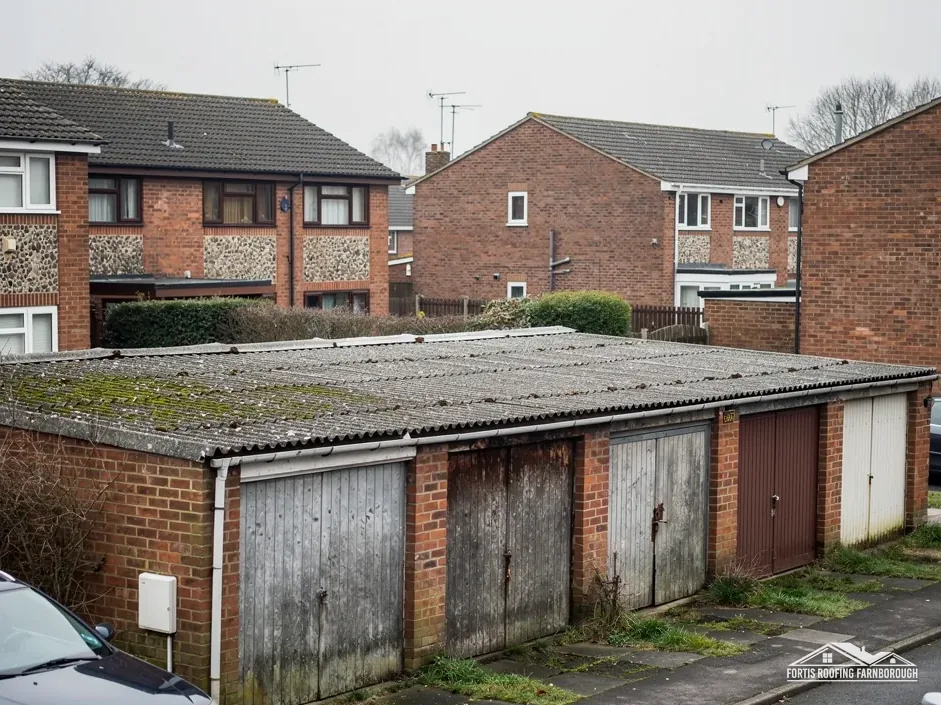
Old GRP is bulky, so it leaves with a waste carrier and not in a skip beside the house. If a roof is old, we check for asbestos in any sheeting beneath before work starts.