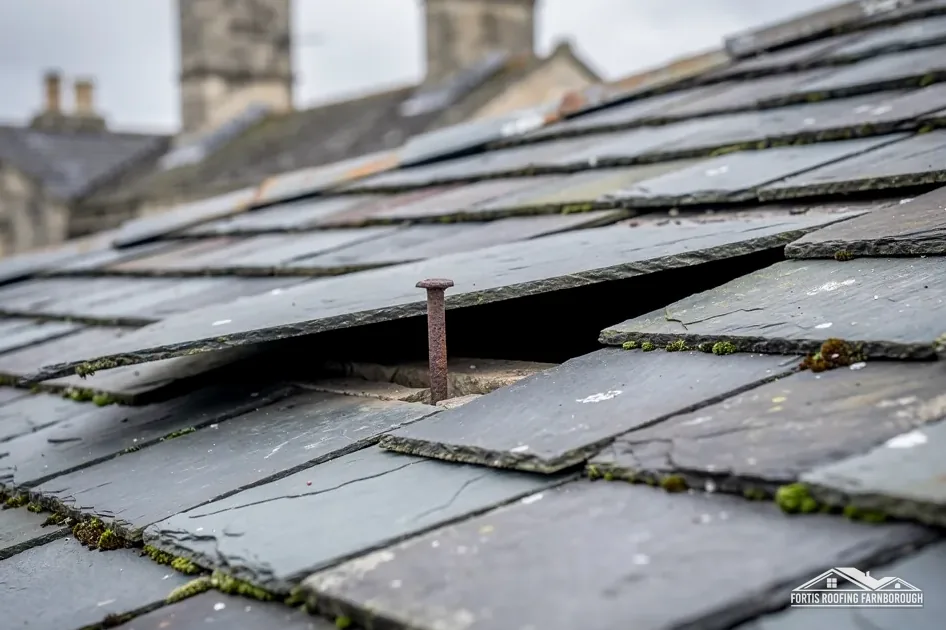
Steep clay tile roofs
The conservation area appraisal describes older properties in red or blue brick with steeply pitched clay tile roofs.
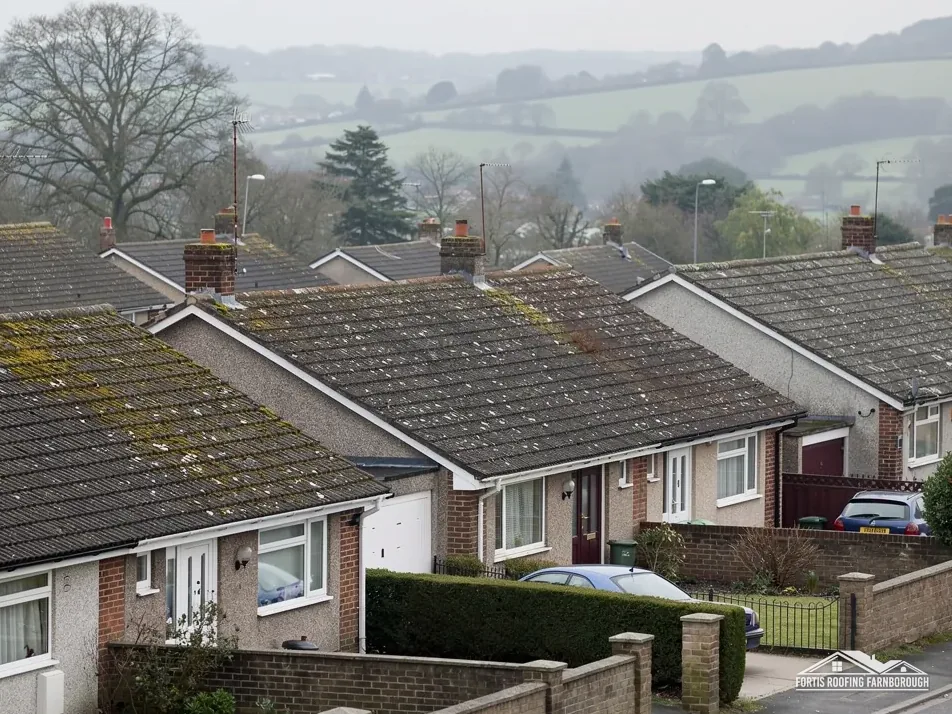
Roofs around Yateley Green, from steep clay tile to shallow slate
Yateley is a large village in the Blackwater valley between the river and Yateley Common, with a green, a hall and a church. Every roof is quoted once.
The conservation area appraisal describes older properties in red or blue brick with steeply pitched clay tile roofs.
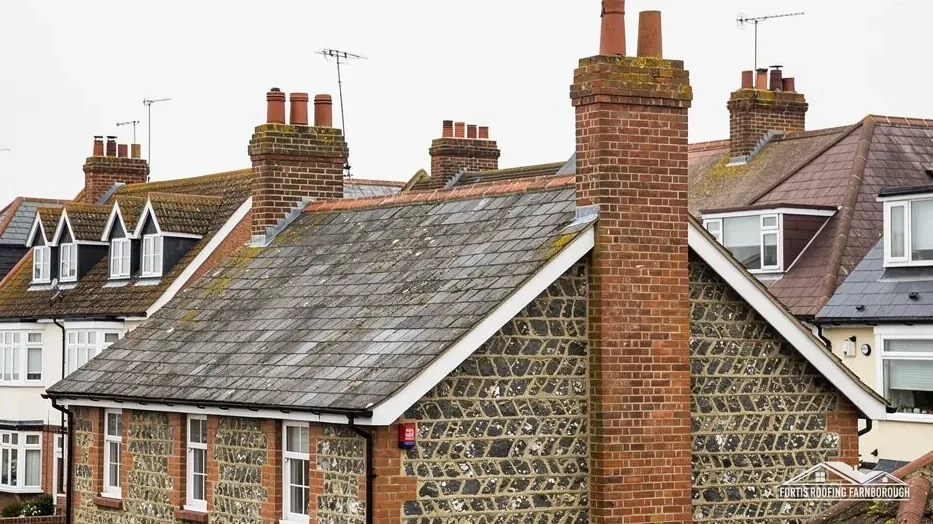
The same appraisal pairs 19th-century buildings in London stock brick with shallow-pitched slate roofs.

Yateley's historic core is almost surrounded by post-war housing, largely built in the 1960s and 1970s.
Map of Yateley with Finchampstead, Blackwater, Sandhurst, Owlsmoor marked around it.
Map data © OpenStreetMap contributors. Loads only when you ask for it.
Blackwater lies to the east, Sandhurst beyond it, Hawley to the south-east, Crowthorne and Owlsmoor to the north-east, and Finchampstead and Eversley to the north-west and west.
About 6.9 road miles north-west of Farnborough · Hart District Council and Hampshire County Council.
Yateley, green and hall
What Hart's appraisal records about clay tile and slate roofs on Yateley Green, which ten listings and which hamlet conservation areas shape a repair, and who is responsible for inspection and scaffold licences.

| No. | Chapter | The figure it turns on |
|---|---|---|
| 01 | Steep clay tile, shallow slate and a post-war ring | Clay tile steep; slate shallow; post-war ring |
| 02 | Yateley Hall Grade II*, St Peter's and Green listings | Ten Green listings; Hall Grade II* |
| 03 | Article 4, Hart's inspectors, scaffold and Flood Zone 3 | Two 1998 directions; Flood Zone 3 |
Chapter 01 of 03
| Period | Walls and roofs the appraisal names | What we check |
|---|---|---|
| Older properties | Red or blue brick, steeply pitched clay tile roofs | Tile condition, nibs and battens |
| 19th-century buildings | London stock brick, shallow-pitched slate roofs | Slipped slates, nails and valleys |
| Post-war housing | Built largely in the 1960s and 1970s round the historic core | Fixings, ridge and verge details |
Hart's appraisal of the Yateley Green conservation area gives a rare, specific account of its roofs. It says the older properties are in red or blue brick with steeply pitched clay tile roofs, whereas the 19th-century buildings use London stock brick with shallow-pitched slate roofs. It adds that Yateley's historic core is almost surrounded by post-war housing, largely built in the 1960s and 1970s, and that Cricket Hill and Darby Green are historic hamlets largely absorbed by late 20th-century development.
A steep clay roof sheds water fast and fails at its fixings: nibs that have snapped, tiles that have slipped, mortar that has cracked at the ridge. A shallow slate roof sheds water more slowly and is less forgiving, since slates must lap more generously and nails rust. So when the appraisal describes both, it describes two quite different repair jobs, and we treat them as such.
On a steep clay roof we run a hand along each course to find loose tiles, record broken or missing ones, and check the ridge bedding. On a shallow slate roof we look for slipped and cracked slates, rusting nail heads and worn valley linings, and we look inside for stained boarding. The report keeps each in its own section with photographs and a measurement.
Pitch decides what a roof can be covered with, and it matters whenever a covering changes. Minimum pitches in Marley's data sheets run from 12.5 degrees for its Mendip 12.5 concrete tile to 40 degrees for its Canterbury clay, with plain concrete at 35 degrees. For natural slate, BS 5534 indicates a minimum of 20 degrees, while a Cupa data sheet counsels against hook fixings on any pitch under 25 degrees. A shallow slate roof therefore cannot always take the tile that a steep clay one can, which is why the pitch is measured before any covering is suggested.

These are the council's descriptions of buildings in one conservation area, and we use them that way. Houses in the post-war ring were built later and differently, and we do not assume what they carry; each is read on its own evidence, with the same care. Our slate roofing page covers repair and re-fixing of slates, and our pitched roofing page covers tiled roofs in general.
Chapter 02 of 03
Yateley's listings and size in published records

Yateley Green conservation area has ten listed buildings, all Grade II except Yateley Hall, which is Grade II*. Further listings include the Church of St Peter, Grade II, first listed on 24 November 1961, together with Barclay House and Brookfield House, both Grade II. Yateley Hall itself was first listed on 8 July 1952, and Yateley's record also notes the post-war ring that surrounds these older buildings, which helps to explain why the old core feels like an island. In all, 15 listed buildings stand within 900 m of Yateley's centre. St Peter's, which Hart's appraisal says was substantially rebuilt after a fire in 1979, still serves as an Anglican church, which brings the ecclesiastical exemption and the faculty system for its roof, while the houses and the Hall need listed building consent.
On a listed building, a repair has to follow the existing roof in material, detail and method, and the evidence for that comes from the survey. We record the pitch, the tile or slate, the ridge, the eaves and every junction, and we salvage the sound tiles and slates. Large roofs call for patience. A hall-sized roof has long gutters, many valleys and several chimneys, and measuring it takes time, so we plan access first, by scaffold or mobile platform, and say how long it will add to the programme. A listed roof near a green is seen by many people, so a poor match is conspicuous and a good one disappears. A repair that has been properly matched should be difficult to find from the road, and that is the test we set ourselves.
The consent application is for the owner or their agent, and we supply what it needs: measurements, dated photographs and a clear description of the faults, in a form an architect can attach to a drawing. Our lead roofing and lead work page explains the flashings and valleys that listed roofs often rely on.
Not every house near the Green is protected, and an unlisted one is outside these listings. Equally, a house that looks old is not necessarily listed. The National Heritage List answers the question, and every Yateley address is looked up before a survey, with the answer noted in the report.
Chapter 03 of 03
| Item | What the record says | For the roof |
|---|---|---|
| Yateley Green Article 4 direction (1998) | Frontage alterations incl. a frontage roof slope; chimneys; unlisted dwellings | Ask Hart before changing a front slope |
| Cricket Hill Article 4 direction (1998) | The same frontage works, in the Cricket Hill area | Ask Hart before changing a stack |
| Flood Map for Planning | Flood Zone 3 within about 250 m of the centre | Follow roof water to the ground |
| Scaffold licence | Hampshire County Council; 10 clear working days | Plan dates for the full job |
Hart's Article 4 list includes directions of 1998 for both the Yateley Green and the Cricket Hill conservation areas. Each covers changes to the front of an unlisted house: a front-facing roof slope, porches, gates and boundary walls, painting, and chimneys. Inside an area where one operates, an alteration to a front slope or a stack can need an application that would be unnecessary elsewhere. We check Hart's map for every Yateley address and keep the answer with the survey.
Hart's building control comes from Rushmoor, so inspection is by the Hart and Rushmoor Building Control Partnership, or by a private registered approver if you prefer. The Planning Portal sets the no-application limits at 25 per cent of the building envelope and 50 per cent of the roof. Scaffold on a Hampshire road needs a licence from Hampshire County Council, whose rule is that scaffolding firms apply for their customers, and which wants 10 clear working days of notice, charges £211.90 for the first 2 weeks and £72 for each further 2 weeks, and never extends a licence.
The Environment Agency's mapping puts land within about 250 m of Yateley's centre in Flood Zone 3, and Yateley lies in the Blackwater valley. That layer ignores tiles altogether. What it prompts is a check on where roof water finally goes, with a photograph of every outlet and discharge point.
A large village has many jobs at once, and delays in one place can push another. We give you a programme with dates for the survey, the licence, the scaffold and the work, and we explain what each step depends on, so that a delay in one place is understood before it arises.
Weather matters to every step. The Met Office's South Farnborough averages for 1991 to 2020 show 118 wet days a year and about 53 days of air frost, which means a long job will see wet weather and frost both, and the dates carry spare days. The roof stays weatherproof overnight, the site is cleared each evening, and waste is taken away rather than left to build up beside a green that many people use.
Yes, in principle. Hart's appraisal describes older properties there with steeply pitched clay tile roofs. Each course is felt by hand for loose tiles, the sound ones are saved, and candidate replacements are held up to the roof before anything is ordered, so you judge the match yourself on your own house.
In the Yateley Green and Cricket Hill conservation areas, Hart's 1998 directions cover chimneys on unlisted dwellings, along with works involving a frontage roof slope. Hart's map shows which side of the line your address sits on, and we check it ahead of any quote for a changed stack or front slope.
Because shallow slate roofs shed water more slowly, and a worn valley lining is one of the places where it gets in. We photograph each valley along its full length, note its lining and its condition, and report whether it needs repair or renewal, to pin down where a leak starts.
Only indirectly. The flood layer describes land, not coverings, and Yateley lies in the Blackwater valley, so roof water matters. Every survey follows rainwater from gutter to ground, with photographs of outlets and discharge points, and the report flags any run that holds water or any wall being soaked, with a photograph of each.
Get your free roof quote
Tell us your Yateley road and what has gone wrong. We fix a visit date, and one price follows in writing.
10-year workmanship guarantee, in writing.