Darby Green and Frogmore
Hart's 2010 character study dates most historic buildings there to between 1890 and 1910.
Roofs where Hampshire, Surrey and Berkshire meet on the old coaching road
Blackwater is a town on the River Blackwater and the A30, where Hampshire, Surrey and Berkshire meet. Every roof is measured, photographed and priced in one written figure.
Hart's 2010 character study dates most historic buildings there to between 1890 and 1910.

The same study says such estates now make up about 80% of north Blackwater.

Holy Trinity Church and Henry Randell's Almshouses are both listed Grade II.
Map of Blackwater with Hawley, Sandhurst, Camberley, Owlsmoor, Farnborough marked around it.
Map data © OpenStreetMap contributors. Loads only when you ask for it.
Hawley lies just to the south, Sandhurst to the north, Camberley to the north-east, Frimley to the south-east, Cove to the south, and Yateley to the west.
About 3.3 road miles north-west of Farnborough · Hart District Council and Hampshire County Council.
Blackwater, fair and estates
What Hart's 2010 character study and the county histories say about Blackwater, which listed buildings and conservation areas shape a repair, and who inspects work and licenses scaffold here.

| No. | Chapter | The figure it turns on |
|---|---|---|
| 01 | A coaching-road village with a November cattle fair | Houses 1890 to 1910; estates about 80% |
| 02 | Listed almshouses, a college farm and two conservation areas | Six listed buildings within 900 m |
| 03 | Flood Zone 3, Hart's inspectors and Hampshire's scaffold | Flood Zone 3; Rushmoor team inspects |
Chapter 01 of 03
Blackwater by date and share, from Hart's records
The Victoria County History of 1911 describes Blackwater as a large village on the old Western coaching road, where Hampshire, Surrey and Berkshire meet, with an annual cattle and sheep fair on Blackwater Green each November. Hart's character study of 2010 adds two dated layers. It places most of the historic buildings around Darby Green and Frogmore between 1890 and 1910, and says estates of the 1960s, 1970s and, to a lesser extent, the 1980s now make up about 80% of north Blackwater.
That one sentence from Hart describes a split personality. On one side are Victorian and Edwardian buildings, now over a century old; on the other is a large area of estates built in three decades. Each kind of roof tends to ask different questions of a survey. An older roof deserves a hard look at flashings, valleys, chimneys and the condition of timbers beneath the covering. An estate roof deserves a hard look at fixings, ridge and verge details and the underlay.
Neither description replaces the evidence. Houses of any age are re-roofed, extended and patched, and a Victorian house can carry a covering laid in the 1990s while an estate house still has its first tiles. So we start at the ridge, work downhill with a tape and a camera, and write down what each slope is and what shape it is in. The report is organised by slope, with every photograph linked to a measurement.
Our pitched roofing page explains how faults are repaired on tiled and slated roofs. For a flat extension or garage, our flat roofing page covers coverings, falls and outlets. Whichever you have, the price follows the evidence, and you see that evidence first.
From inside the roof space we check the underside of the covering with a torch: stained timbers, damp insulation, pinpoints of light at joints and any place where the felt has torn. Those pictures sit with the outdoor set in the report, so the slope that needs work is identified from both sides, and a repair can be aimed at it precisely. A Victorian roof and a 1970s roof may also be ventilated quite differently, so the loft check looks for condensation as well as for leaks.
Chapter 02 of 03
| Entry | Status | Route for roof work |
|---|---|---|
| Holy Trinity Church | Grade II, NHLE 1092278 | Church of England faculty system |
| College Farm, Attached Stable and Store, Royal Military Academy | Grade II, NHLE 1390367 | Listed building consent |
| Henry Randell's Almshouses | Grade II, NHLE 1259779 | Listed building consent |
| The Terrace | Grade II, NHLE 1030039 | Listed building consent |
| Hawley Park and Green; Royal Military Academy | Conservation areas within about 0.75 km | Check your address with Hart or Surrey Heath |
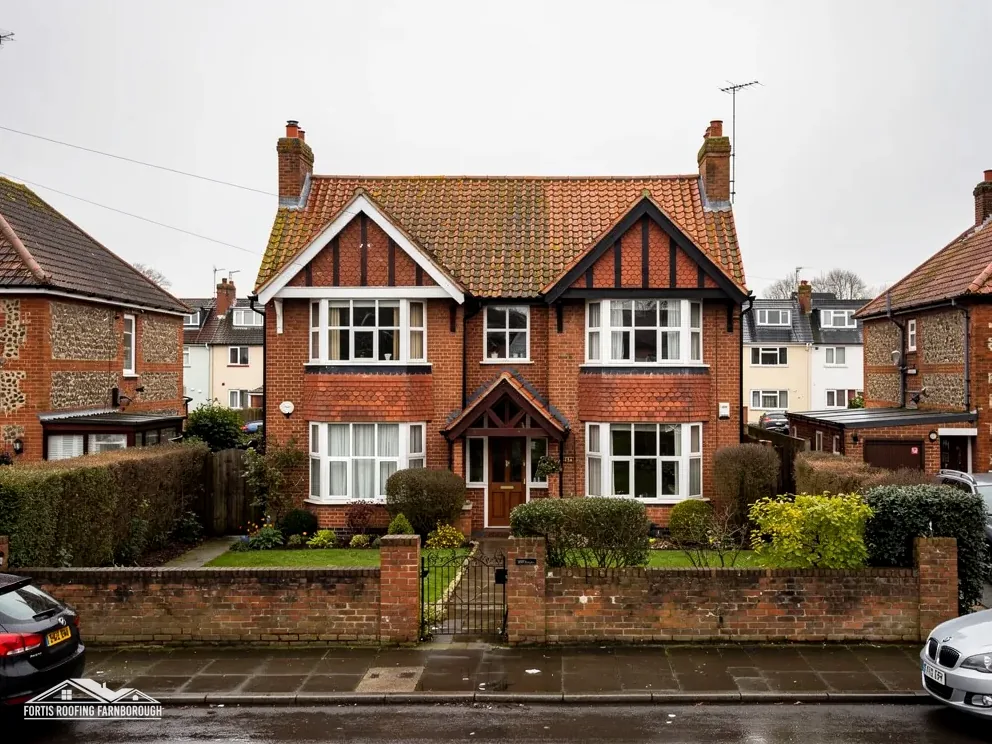
Blackwater's record shows six listed buildings within 900 m of the centre. Holy Trinity Church carries a Grade II listing and is in use as an Anglican place of worship, so roof work on it follows the faculty route under the ecclesiastical exemption. The other entries need listed building consent for work that alters their character: College Farm's attached stable and store at the Royal Military Academy, Henry Randell's Almshouses, and The Terrace. Each is Grade II.
The national dataset places two conservation areas within about 0.75 km of the centre: Hawley Park and Green, designated by Hart in January 1989, and the Royal Military Academy area, which is a Surrey Heath designation covering the former Staff College across the county boundary in Camberley. Whether your house stands inside either is answered by Hart's map, or Surrey Heath's for land on its side of the line, and each Blackwater address is checked before we price any change to a covering, ridge or chimney. Hart's own advice on repairs is reassuring: work on an unlisted building that follows the original in detail and in material needs no planning permission, which suits the careful, matched repairs we aim to make.
An Article 4 direction covers the Hawley Park and Green area, but Hart's list does not name Blackwater itself, so we do not assume one applies. Instead we ask Hart's planning team where the line runs, and we write the answer into the report.
It helps to know what an Article 4 direction is. It withdraws specified permitted development rights across a defined area, so work that would normally need no application can need one there. Hart's 1998 directions concern the frontage of a dwelling, including a frontage roof slope, and chimneys, which is why we photograph front slopes and stacks with particular care. Where a direction applies, the report becomes a record the planning team can use, and the photographs are yours to keep.
Listed or not, the same discipline applies to the survey. Before any work, we record the ridge, eaves, chimney stacks and junctions in photographs, because a repair has to match what is there and the record proves that it does. Our chimney repairs page explains how stacks are mended, from flaunching to flashing, and why a stack is often the part of a roof that needs the most careful matching.
Chapter 03 of 03
Four facts that shape a Blackwater roof job
On the Environment Agency's Flood Map for Planning, land within about 250 m of Blackwater's centre falls in Flood Zone 3. A flood layer says nothing about nails or battens, but it is a good prompt to follow rainwater all the way from the roof to the ground. A blocked outlet or sagging gutter sends water down a wall, and that dampness is often blamed on the roof. Our survey traces each run and photographs weeping joints. Our gutters, soffits and fascias page explains repairs and replacements.
Hart does not run building control itself. The Hart and Rushmoor Building Control Partnership supplies it from Rushmoor Borough Council's offices in Farnborough, on 01252 398715, and a registered building control approver is the private alternative. The Planning Portal puts the re-roofing test at under 25 per cent of the building envelope and under 50 per cent of the roof; approval and a structural check are needed once a covering is 15 per cent or more heavier. Our guide to building control in Farnborough explains who to ask.
Hampshire County Council, the highway authority for Blackwater, licenses scaffold on its roads under section 169 of the Highways Act 1980. Under Hampshire County Council's rule the scaffolding company must apply for the customer, and the council wants 10 clear working days before the start, and charges £211.90 for the first 2 weeks and £72 for each further 2 weeks, with no extensions. A scaffold that sits only on private ground is outside the scheme.
Because a licence cannot be stretched, the scaffold dates are agreed at the survey and given some margin for weather. A long re-roof is licensed for its whole length from the start, so the poles never stand on an expired licence while the last courses go on, and the licence dates sit in the programme you receive.

Weather matters to the dates. The Met Office's South Farnborough averages for 1991 to 2020 give 118 wet days a year and around 53 days of air frost, so a longer job will meet both. The programme we give you allows for that, with spare days built in instead of promised, and you are told early if the forecast changes the plan.
The decade does not decide it; the roof's condition does. Hart's study dates the estates and the historic houses, and the covering on your own house is checked on the roof itself. We survey each slope on its own evidence and recommend a repair when a repair will do, whatever year the house was built, and a re-roof only when the evidence demands it.
Hart's building control is supplied by Rushmoor, so it is the Hart and Rushmoor Building Control Partnership, working from Rushmoor Borough Council's Farnborough offices on 01252 398715. A registered building control approver is the private route. Neither is needed while a job stays inside the Planning Portal's limits, and the survey tells you where yours falls.
Not about the roof itself. The flood layer describes land, so tiles and flashings are repaired exactly as they would be anywhere else. It is a reason to check that gutters and downpipes carry rain away properly, since overflow down a wall can look like a roof leak. We trace the water on every survey.
No. Holy Trinity is listed Grade II and in Anglican use, so roof work on the church follows the faculty system. An unlisted house nearby is not covered by that listing. The National Heritage List and Hart's conservation map show whether your own address needs any consent route, and we check both for you.
Get your free roof quote
Tell us your Blackwater road and the symptom. We book a survey, and a single written price follows it.
10-year workmanship guarantee, in writing.