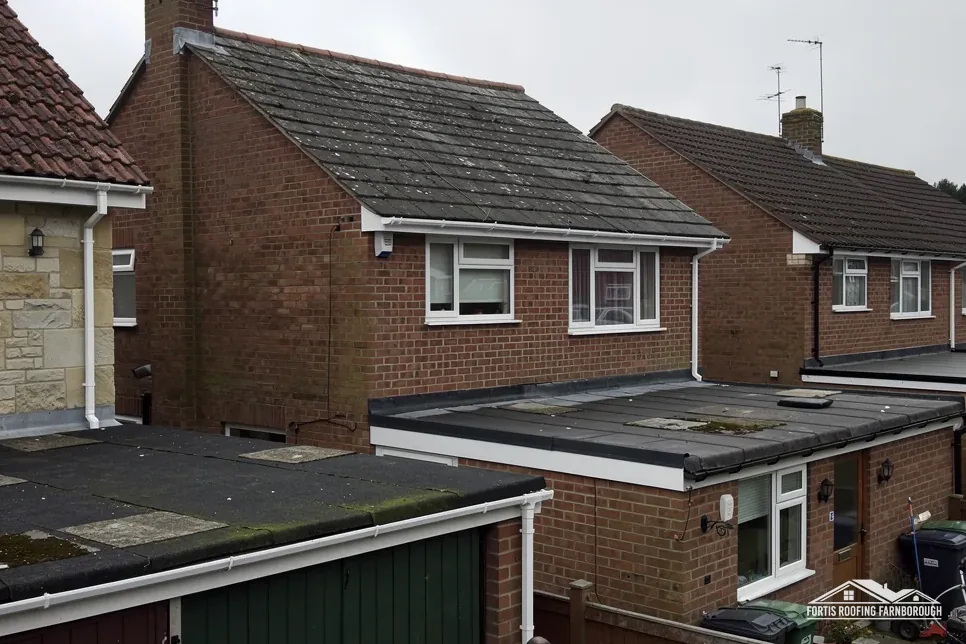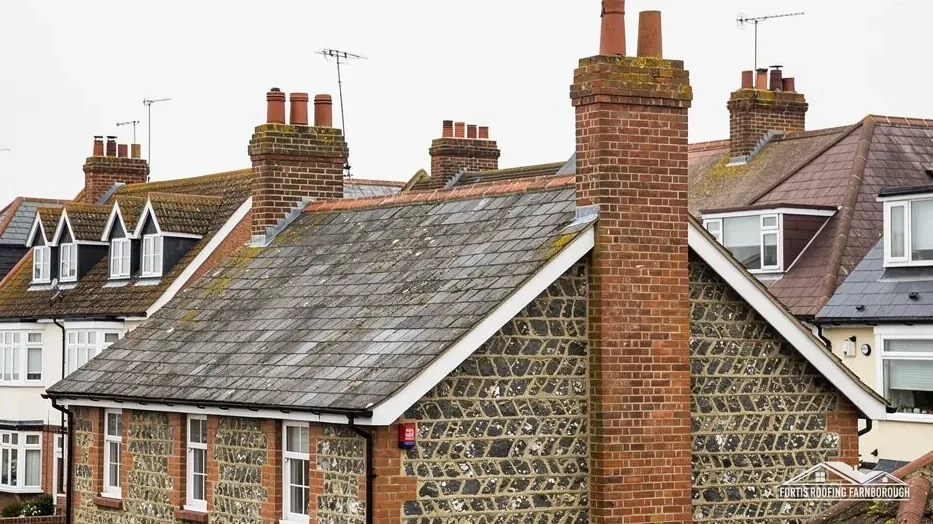
Hamlet with a mission church
In 1923 the county history described Owlsmoor as a hamlet with an iron mission church.
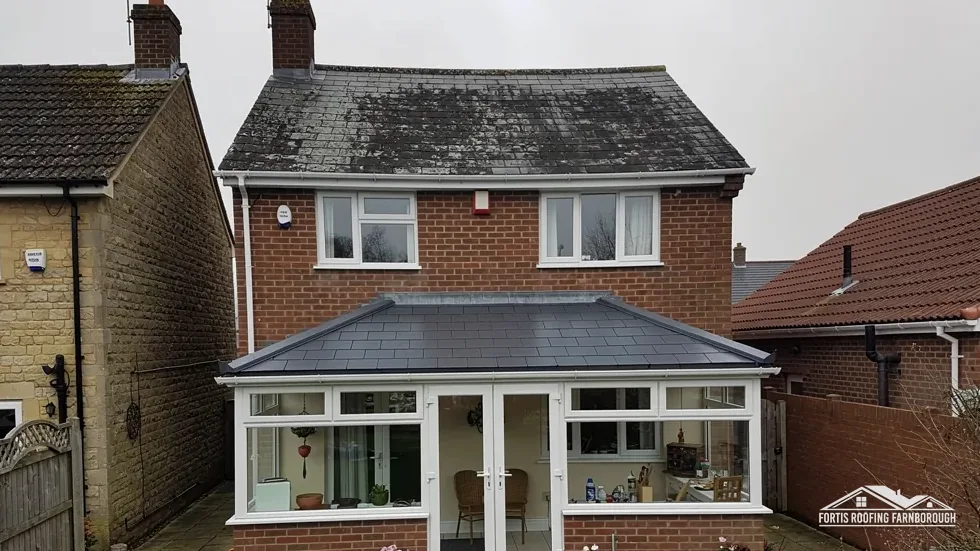
Roofs on the edge of Wildmoor Heath, north-east of Sandhurst
Owlsmoor is a Bracknell Forest suburb, north-east of Sandhurst, beside Wildmoor Heath. Every Owlsmoor roof is photographed and given one price.
In 1923 the county history described Owlsmoor as a hamlet with an iron mission church.

Heathland borders the suburb, which puts trees, leaves and moss close to gutters and valleys.

Owlsmoor lies in Sandhurst civil parish, which had 20,373 residents at the 2021 Census.
Map of Owlsmoor with Sandhurst, Crowthorne, Blackwater, Camberley marked around it.
Map data © OpenStreetMap contributors. Loads only when you ask for it.
Sandhurst lies to the south, Crowthorne to the north-west, Camberley to the south-east, Blackwater and Hawley further south, and Yateley to the south-west.
About 5.2 road miles north of Farnborough · Bracknell Forest Council (unitary).
Owlsmoor, heath and hamlet
What the county history says about Owlsmoor, which conservation areas lie within reach of it, and why heathland, rainfall and frost matter more to a roof here than any date. All figures are sourced.

| No. | Chapter | The figure it turns on |
|---|---|---|
| 01 | A hamlet with an iron mission church | Hamlet 1923; parish of 20,373 |
| 02 | Three conservation areas within 2.5 kilometres | Three conservation areas within 2.5 km |
| 03 | Wildmoor Heath, rainfall and frost on an Owlsmoor roof | Rainfall about 715 mm; 53 frost days |
Chapter 01 of 03
What the records give for Owlsmoor's place and size
The Victoria County History of 1923 gives Owlsmoor a single line, describing it as a hamlet on the south of Crowthorne parish with an iron mission church. Today it is a suburb north-east of Sandhurst, inside Sandhurst civil parish, where the 2021 Census found 20,373 residents. The homes here were built and altered over many decades, and the age of a street says little about the state of any one roof on it. The 2021 Census figure belongs to the whole parish, not to Owlsmoor alone, and we use it only to show the scale of the area it sits in.
Each roof is read on its own evidence. Ours is a plain routine, repeated on every Owlsmoor job. We measure each slope. We test whether the covering is holding, by hand and by eye, at several points. We follow every junction between roof and wall. The rainwater is followed from eaves to drain. And we look from inside the roof space for signs that water or condensation has got in.
Each of those steps produces measurements or photographs, and the report puts them in the same order every time, so that two Owlsmoor roofs can be compared with each other and with ours at the next visit. Where the roof is sound, the report says so. Where it is failing in one place, it says which place, and what a repair there would involve.
The point of working this way is that you can judge our advice for yourself. If we recommend replacing the covering, you will have seen the failed fixings, the broken tiles and the worn felt that justify it. If we recommend a repair, you will have seen why the rest of the roof can stay. Our pitched roofing page explains the repairs we make most often.
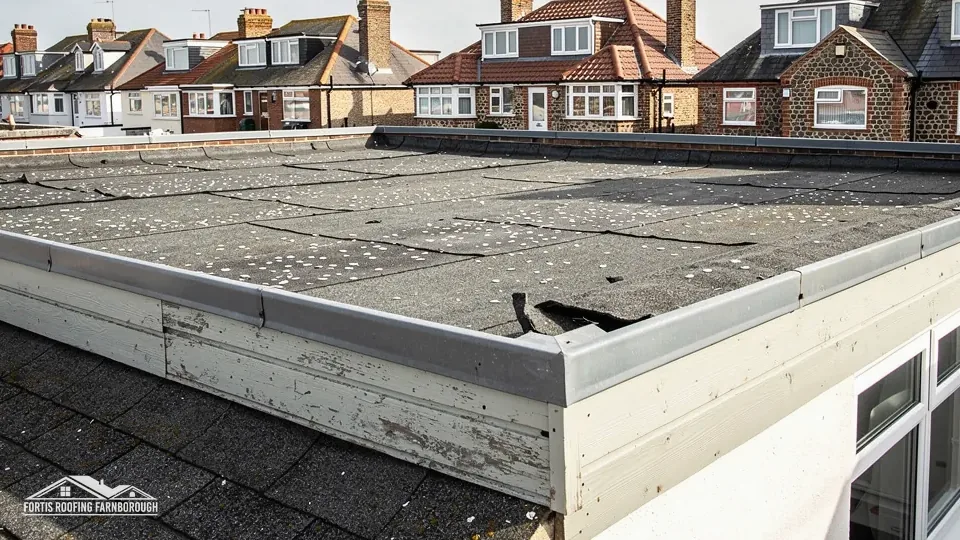
An iron mission church is a reminder that a place can start small and grow in unplanned ways. Owlsmoor's homes have been added, extended and altered over decades, so a house and its garage, porch or rear extension may carry different coverings of different ages. We survey each part separately. A house and its garage can be a few metres apart and a few decades apart in age, and the evidence on one says nothing about the other.
Chapter 02 of 03
| Area | Distance from Owlsmoor | Council to ask |
|---|---|---|
| Church Street, Crowthorne | Within about 2.5 km | Bracknell Forest Council |
| Royal Military Academy (former) Staff College | Within about 2.5 km | Surrey Heath Borough Council |
| Darby Green, Yateley | Within about 2.5 km | Hart District Council |

The national planning dataset lists three conservation areas within about 2.5 km of Owlsmoor: Church Street in Crowthorne, the Royal Military Academy (former) Staff College area, and Darby Green in Yateley. Only Church Street lies in Bracknell Forest, the unitary council that covers Owlsmoor. Surrey Heath lists the former Staff College area, in Camberley, among its nine conservation areas, and Darby Green is in Hart's area, across the county line. None of the three reached the 1.5 km box around Owlsmoor's place point, which is why they are described as nearby. Whether your house is inside any of them is a question for Bracknell Forest's planning team.
For most roof repairs it means nothing at all. Repair in matching material leaves a roof looking as it did. The question arises when a job would alter the appearance of a roof that could be seen from within a conservation area, or when your own house is inside the line. So we check the council's map at the survey for every address and put the answer into the report.
Bracknell Forest's own page names six conservation areas in the borough, Crowthorne among them, and its map is what settles the answer for your house. Where a national list and the council's map seem to differ, the council's map wins.
Bracknell Forest runs building control itself, and says building regulations approval may also be needed for jobs such as re-covering pitched and flat roofs. Those are the council's words for its own area, so every re-roof is checked and nothing is assumed. A few refixed tiles are far from that line. Our roof replacement page explains when a whole new covering is the right answer.
For scaffold, Bracknell Forest's residential licence runs for 6 weeks and costs £350, of which £100 is a non-refundable application fee. Who applies is not stated by the council, so check with the scaffolder, and we agree the arrangement with them. Private land is outside the scheme. We plan the dates so that one licence covers the whole job. If the work is small enough to do from a ladder or a tower on your own drive, no licence arises, and the report says which approach we recommend.
Chapter 03 of 03
Rain and frost at the nearest Met Office station
No Met Office station sits in Owlsmoor, so the figures here come from South Farnborough, the nearest one we cite, on 1991 to 2020 averages. They show annual rainfall of about 715 mm spread over 118 days with 1 mm or more, and around 53 days of air frost. They describe an area, not a particular street, yet they are the weather a roof here has to withstand.
Owlsmoor sits by the heathland of Wildmoor Heath. Heath and woodland near houses mean leaves, needles and moss reaching the roof, and the places they collect are the same few: gutters, valleys, behind chimneys and in the angle where a porch meets a wall. A blocked gutter is not a defect in itself, but it sends water where it should not go, and rotted fascia boards and damp walls follow quickly.
So a survey here pays attention to the whole rainwater route. We photograph each gutter run, its joints and brackets, the outlets and the downpipes, and note where debris has built up and where water stands. If a clean-out is all that is needed, the report says so and you are not asked to pay for more. Our gutters, soffits and fascias page covers repairs and replacements.
Rain gets into a roof through a small gap: a cracked tile, a gap in pointing, a lifted flashing. In a frost, water in that gap freezes and widens it. Frost days come every year, so small defects that look harmless from the ground are photographed, and we suggest dealing with them before a winter and not after one. That advice costs nothing to follow, and it often saves a larger repair.
Moss deserves its own mention. It holds water against tiles, lifts edges as it grows and blocks gutters when it falls. We avoid jet-washing, as Marley warns it can damage the surface and cut the covering's life. Gentle removal and, where needed, cleaning by a specialist is the better course, and the survey notes where moss has taken hold.
In a wet year an overlooked valley can do more damage than a cracked tile. Valleys collect water from two slopes at once, so they carry the most flow, and any debris there acts as a dam. Each valley is given a photograph of its own, with a note on lining and condition, so you can judge for yourself whether it needs attention.
It makes drainage matter more. Heath and woodland nearby bring leaves, needles and moss that collect in gutters, valleys and behind chimneys. A blocked gutter sends water down walls and into fascias. The whole rainwater route is photographed at every survey, and the report marks the occasions when a clean-out alone will do.
Bracknell Forest Council, as the planning authority. The national dataset names Church Street in Crowthorne, the Royal Military Academy area and Darby Green in Yateley within about 2.5 km, but the council's own map settles your address. We check it at the survey, record the answer in the report, and tell you what it means for the job.
Bracknell Forest says building regulations approval may also be needed for jobs such as re-covering pitched and flat roofs. The council uses that wording for its own addresses, so every re-roof is checked. A few refixed tiles sit well inside the Planning Portal's limits.
A residential licence covers 6 weeks and costs £350, including a £100 application fee that is not refunded. After 6 weeks a new licence is needed. The council's page leaves open who applies, so put the question to the scaffolder before agreeing anything. We plan the job so that one licence covers it, and tell you early if weather might stretch it past the 6 weeks.
Get your free roof quote
Send your Owlsmoor road and what has gone wrong. We arrange the survey, then one price follows.
10-year workmanship guarantee, in writing.