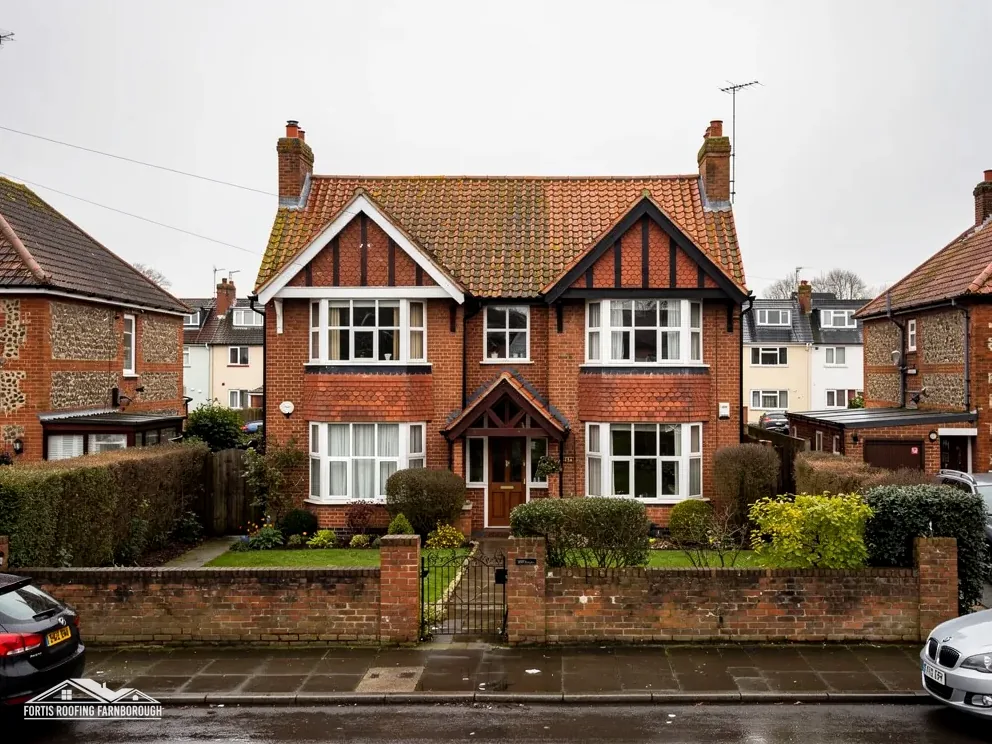
Handmade clay tile, earliest
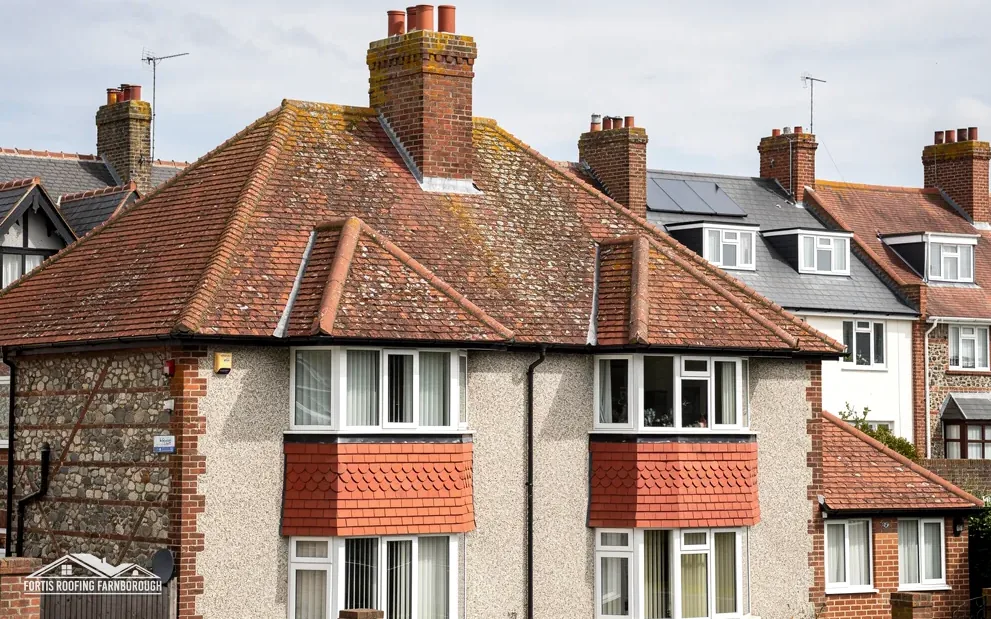
Elmbridge's appraisal lists handmade clay tile roofs, tile hanging and rendered timber frames among the oldest buildings.
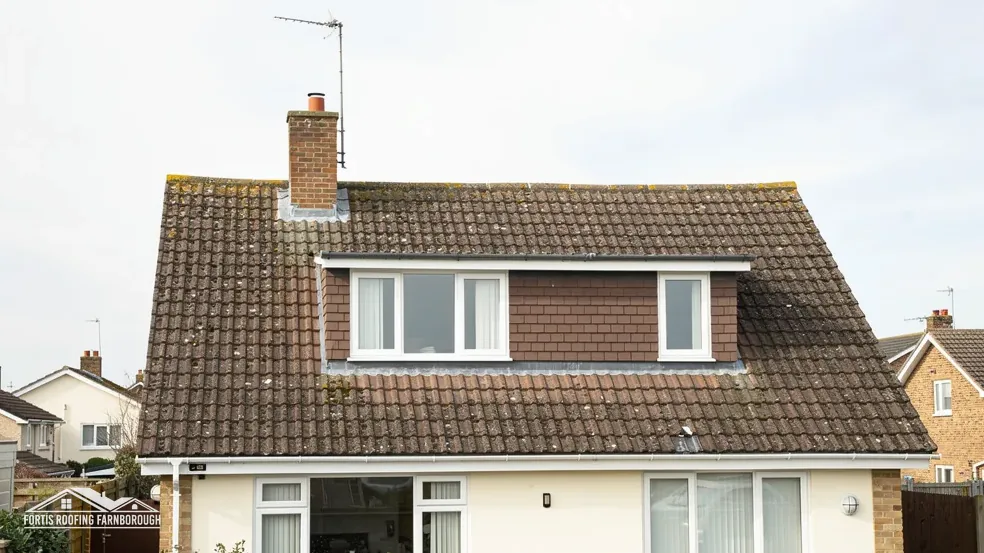
Roofs from Weybridge's clay-tiled cottages to low-pitched Victorian slate
Weybridge's town centre appraisal records handmade clay tile, low-pitched hipped slate and machine-made tile from successive periods. We survey each slope and put the evidence in writing.
Elmbridge's appraisal lists handmade clay tile roofs, tile hanging and rendered timber frames among the oldest buildings.
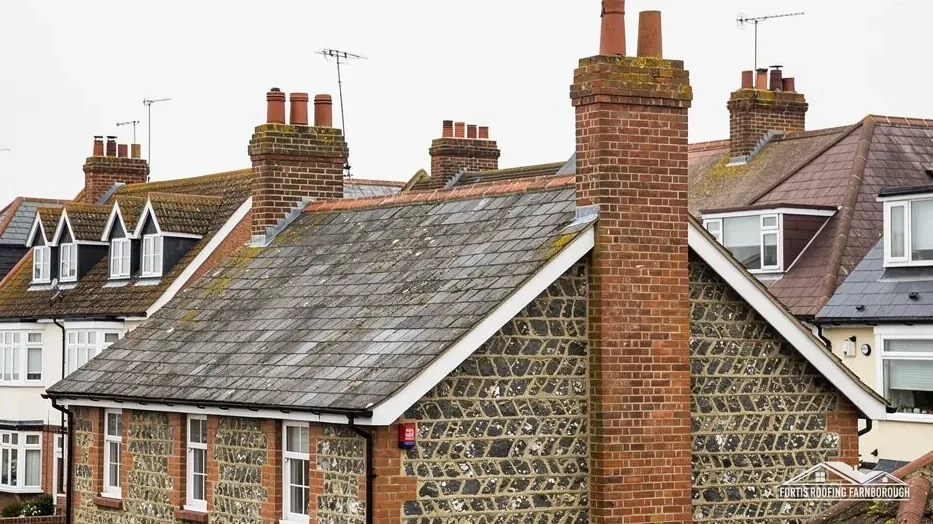
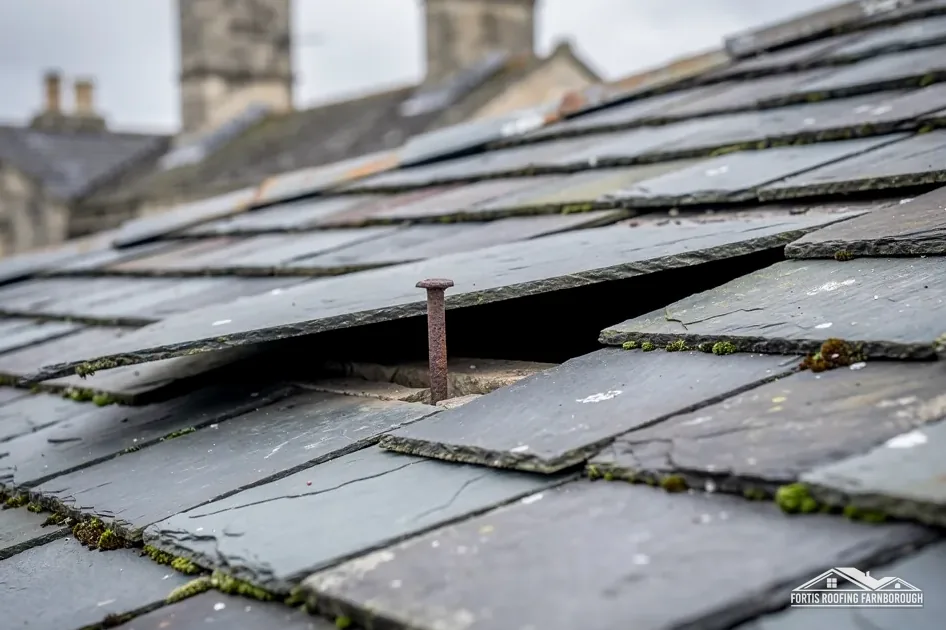
Early and mid-19th-century buildings have low-pitched hipped slate roofs, with slate dominant by the late Victorian period.

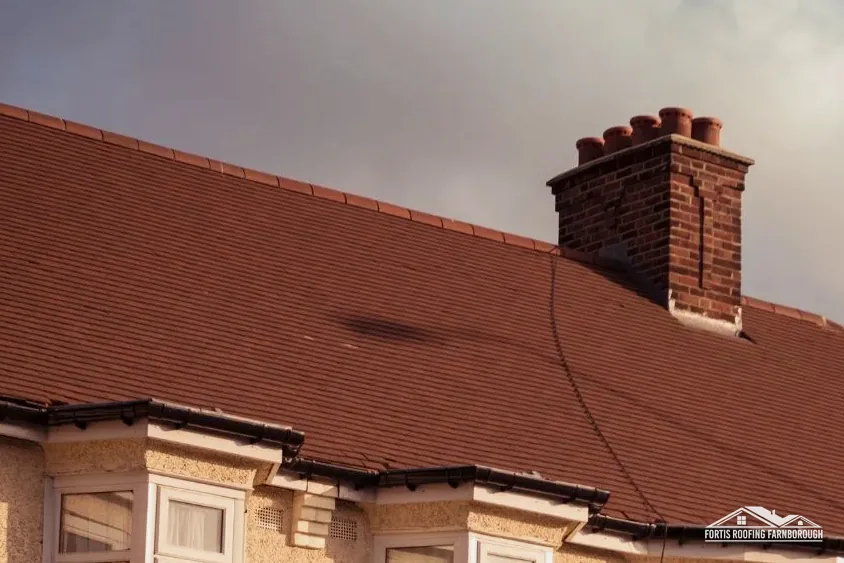
Early-20th-century houses and shop parades brought back machine-made clay tiles, tile-hung bays and half-timbered gablets.
Map of Weybridge with Shepperton, Addlestone, Walton-on-Thames, Upper Halliford marked around it.
Map data © OpenStreetMap contributors. Loads only when you ask for it.
Shepperton is the neighbour just north, with Addlestone and New Haw on the west side, Walton-on-Thames and Hersham towards the east, and Byfleet a short way south.
About 18.5 road miles east of Farnborough · Elmbridge Borough Council and Surrey County Council.
Weybridge, tile and slate by period
Which councils sit behind a Weybridge roof job, how Oatlands and the Duke of York shaped the town, and what Elmbridge's conservation area appraisal records about its tile and slate roofs, with each figure sourced.

| No. | Chapter | The figure it turns on |
|---|---|---|
| 01 | Elmbridge, Surrey and East Surrey from 2027 | East Surrey Council from 1 April 2027 |
| 02 | Oatlands, a duke and a palace site built over | Oatlands Palace, 1537 to 1545 |
| 03 | Tile, slate and tile again: the appraisal's periods | Slate dominant from the late Victorian period |
Chapter 01 of 03
| Role | Body for Weybridge addresses |
|---|---|
| District council and planning authority | Elmbridge Borough Council |
| Building control | Elmbridge Building Control Services (EBCS) |
| Highway authority | Surrey County Council (until 31 March 2027) |
| Scaffold licence on the highway | Surrey County Council |
| From 1 April 2027 | East Surrey Council replaces both councils |
Weybridge is 18.5 road miles east of Farnborough, with the distance taken from the A325 Farnborough Road. Elmbridge decides planning matters for the town, while the highway outside each house belongs to Surrey County Council. Building control is delivered by Elmbridge Building Control Services, known as EBCS, which the council's page describes as providing the service on its behalf, so the people checking a re-roof are separate from the people who grant planning permission.
Surrey's reorganisation page lists which new authority each district joins. On 1 April 2027 Elmbridge residents become part of East Surrey Council, whereas Runnymede and Spelthorne go to West Surrey Council, so the river towns either side of the Thames fall on opposite sides of the new line. Until then day-to-day services continue as now, and read everything below as current only until 31 March 2027.
Elmbridge publishes no re-roofing figure for its area. The Planning Portal's test is therefore our yardstick, and it asks about two things, the building envelope and the roof. Our survey measures the area and puts the figure in your notes.
Poles on a Weybridge pavement or carriageway must be licensed under section 169 of the Highways Act 1980, and the licensing body is Surrey County Council, which holds the highway powers. The council wants applications at least 10 working days ahead and charges £208 for each 28-day period, renewals included. Nothing on Surrey's page names the party that files for the licence, so the scaffolders and we settle that between us before a date is fixed.
Town-centre streets have their own wrinkle. A narrow pavement beside shops or a bus route leaves little room for poles, and the plan has to show where pedestrians walk. The frontage is surveyed and the footway measured, and the layout is agreed with the scaffolders ahead of the application.
The page also describes a fast route for emergencies: where a structure has become unsafe or the danger is serious and a licence cannot wait 10 days, the council is to be telephoned. For a roof that is already unsafe we make it safe first, using ladder or tower access where that is possible, and the scaffold question follows from what the survey finds. Our pitched roofing page explains how those repairs are carried out.
Chapter 02 of 03
Weybridge's published history in four numbers
The county history's Surrey volume credits the Duke of York's home at Oatlands, from 1791, with making the neighbourhood fashionable, and Weybridge settled into its modern character as a large residential area of sizeable houses. Elmbridge's appraisal adds that Oatlands Palace was built for Henry the Eighth mainly between 1537 and 1545. Only boundary walls and parts of gateways remain, and new housing was built over much of the site between the 1930s and the 1980s. The 2021 Census counted 15,927 residents in the Weybridge built-up area.
The town sits where two rivers meet, with the Wey joining the Thames and the ground rising south to St George's Hill on Bagshot sand. For a roofer the interest is the scale of the houses. Sizeable houses mean large roofs, and large roofs mean more hips, valleys, chimneys and dormers than a modest semi.
A hip is the sloping ridge where two roof planes meet at a corner, and a valley is the internal angle where they meet inwards. Each carries its own water and each depends on lead, tile or slate cut to fit. On a big house the sums multiply: ten valleys give ten places for a failure, and one blocked gutter can overwhelm a whole elevation.
We therefore survey a large roof in sections, working elevation by elevation and photographing every valley, abutment and stack, with a count of what is sound and what is failing on each. The photographs are numbered, so when we say valley six needs new lead, you can see valley six.
A house of this scale may have been altered, extended or partly re-covered over the years, so we record the covering separately on each slope and never assume one roof means one material. Our lead roofing and leadwork page covers relaying valleys and flashings, and chimney stacks are part of the same survey.
Oatlands dates
Gutters matter too. A long run of gutter on a large elevation collects a great deal of water, and one blocked outlet can send it behind the fascia. We trace each downpipe to its drain and photograph each outlet from the ladder or scaffold.
Chapter 03 of 03
| Period | What the appraisal records |
|---|---|
| Earliest buildings | Rendered timber frames, tile hanging, handmade clay tile roofs |
| Early and mid-19th century | Low-pitched hipped slate roofs |
| Late Victorian, as at 26 to 34 Church Street | Slate becomes the dominant roofing material |
| Early 20th century | Machine-made clay tiles, tile-hung bays, half-timbered gablets |
The appraisal covers the town centre conservation area, designated on 25 April 1977 and extended on 6 December 2006, and reads the roofs by period. The earliest buildings are what it calls Surrey vernacular: rendered timber frames, handmade brick in Flemish and English bond, tile hanging and handmade clay tile roofs. Early and mid-19th-century buildings have low-pitched hipped slate roofs. Slate became the dominant roofing material with late-Victorian buildings such as 26 to 34 Church Street. Early-20th-century houses and shop parades brought back machine-made clay tiles, with tile-hung bays and half-timbered gablets.
That list is for the conservation area, and the appraisal does not say what any house outside it is roofed with. Treat it as a guide to what a town centre repair has to match, and not as a claim about every roof in Weybridge.
Handmade clay tiles vary in size and colour, which is part of their look, and a repair needs tiles that sit in that variation. Machine-made tiles are uniform, and a mismatched patch shows. A slate repair must get size, thickness and fixing right, and on a low pitch it is the fixing that matters most. Our slate roofing page explains how slates are sorted, matched and refixed, and why a sound slate can be reused.
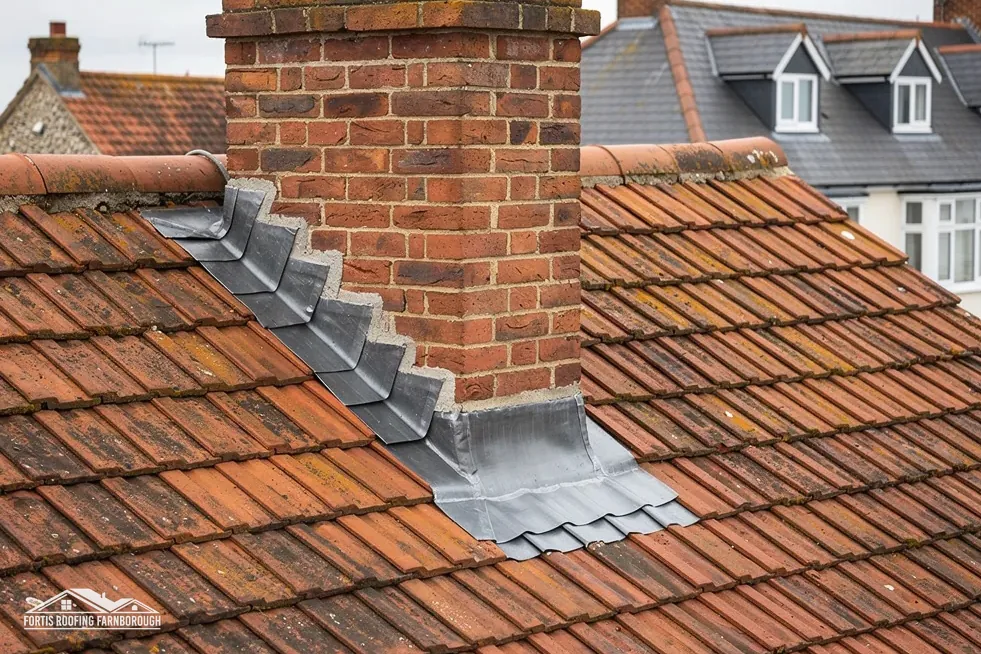
Where lead is involved, Royston's cast-lead brochure pairs code 5 with flashings, pitched valley gutters, box gutters and dormers, and code 4 with soakers, flashings and pitched valleys. We choose the code at survey from the position and the exposure of each detail, and the survey notes record the code for each flashing.
Weybridge's churches of St James and St Charles Borromeo are both listed Grade II*, the gateway to Oatlands Park is listed Grade II*, and 1 and 3 Heath Road are listed Grade II. The county history of 1911 records St Charles Borromeo as a Roman Catholic chapel, rebuilt in 1881, so while it is in Catholic use its roof work goes through that Church's own system, not council consent. For any listed house, roof work touching its character needs listed building consent as well as skill, and the consent comes before the scaffold goes up. Two separate conservation areas also reach this part of the town: Weybridge (Monument Green), designated by Elmbridge on 28 November 1990, and the Wey Navigation. Check with Elmbridge whether your own street is inside a boundary.
Not by itself. Elmbridge's appraisal records low-pitched hipped slate roofs on early and mid-19th-century buildings in the town centre. On a low pitch the fixing and the lap between slates matter most, so we measure the pitch, lift a sample and photograph the underside before telling you whether a repair will last or the slope needs more.
Not for a job booked now. Surrey's reorganisation page expects day-to-day services to continue as now until the new councils begin on 1 April 2027, when Weybridge joins East Surrey Council. A licence applied for this winter is issued by Surrey County Council, and we give you dates and licence terms in writing so you can plan around them.
Elmbridge Building Control Services, which provides the service for Elmbridge Borough Council, or a registered building control approver as the private route. Elmbridge sets no percentage, which leaves the Planning Portal test to apply, and the survey measures your slopes to show which side of the limits your job falls.
No. The licence comes from Surrey County Council, which holds the highway powers, at £208 for each 28-day period and with 10 working days' notice. Surrey is silent on who files, so the licence is arranged jointly with the scaffolding firm and read by us before your start date is fixed.
Get your free roof quote
Tell us your Weybridge road and the fault you noticed, and we will photograph each valley and slope.
10-year workmanship guarantee, in writing.