A Gilbert Scott church
Gilbert Scott built the stone church of 1842 in 13th-century style, enlarged in 1879 and 1883.
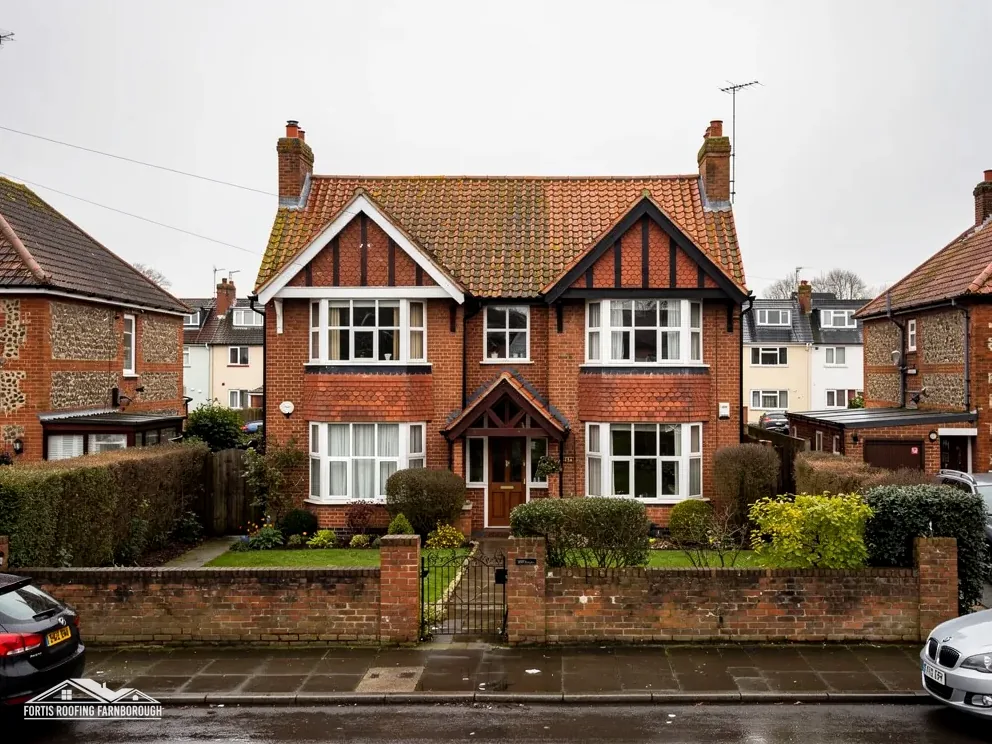
Roofs beside the canal, from the 1842 church to the 1870 school
St John's grew beside the Basingstoke Canal west of Woking, around a church of 1842 and a school of 1870. Older roofs here are surveyed slope by slope.
Gilbert Scott built the stone church of 1842 in 13th-century style, enlarged in 1879 and 1883.
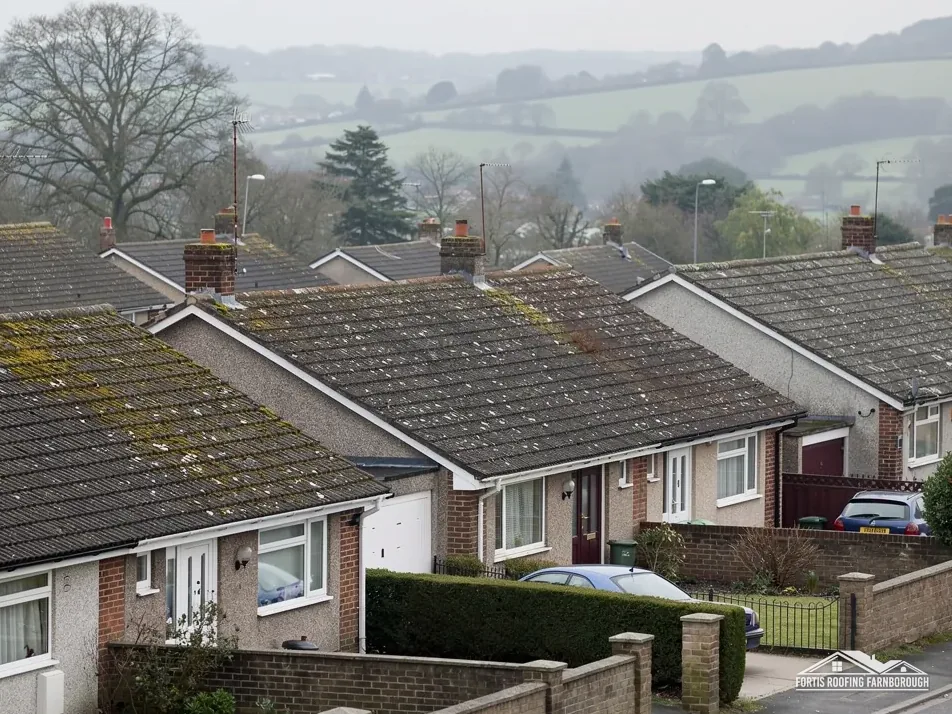
St John's school was built as a Church school in 1870 and enlarged in 1876.
Langmans has been Grade II listed since 29 September 1975, one of three listed buildings within 500 m.
Map of St John's with Horsell, Knaphill, Mayford, Woking marked around it.
Map data © OpenStreetMap contributors. Loads only when you ask for it.
Knaphill lies to the west, Horsell to the north-east, Mayford to the south-east, Woking and Old Woking to the east, Brookwood to the west, and Bisley to the north-west.
About 9.3 road miles east of Farnborough · Woking Borough Council and Surrey County Council.
St John's, canal, church and school
Which councils regulate a St John's roof, what the county history says of its church and school, and how the conservation areas along the canal and nearby listings shape a repair.

| No. | Chapter | The figure it turns on |
|---|---|---|
| 01 | Woking's own inspectors and Surrey's licence | Woking inspects; Surrey licenses scaffold |
| 02 | A church, a school and a new parish | Church built 1842, parish formed 1884 |
| 03 | Four conservation areas around the canal | 3 listed buildings within 500 m |
Chapter 01 of 03
| Role | Body for St John's addresses |
|---|---|
| Planning authority | Woking Borough Council |
| Highway authority | Surrey County Council (until 31 March 2027) |
| Building control | Woking Borough Council, its own service |
| Scaffold licence on the highway | Surrey County Council, 28 day periods |
Counting from the A325 Farnborough Road, St John's lies 9.3 road miles out, due east. Woking Borough Council handles planning and building control from its own offices, and Surrey County Council runs the roads until 1 April 2027, when West Surrey Council takes over.
The Planning Portal's yardstick keeps small jobs out of building control: under 25 per cent of the building envelope and under 50 per cent of the roof. Woking's own service applies when a job outgrows it, such as a whole-house re-cover or a flat roof with a new waterproof layer. For a canal-side house with a rear flat section, the survey measures both the pitched and the flat areas, because each counts towards the figures.
Part L treats renewing the waterproofing of a flat roof as renovation, so the insulation question comes up before the new layer goes down. On weight, the Planning Portal's trigger is a covering 15 per cent or more above the existing load; beyond it the job needs Building Regulations approval, and the Portal advises an engineer or surveyor looks at the timbers first.
Many older roofs come down to a choice between repairing and re-covering. The survey sets out the evidence: how many tiles are damaged, whether battens are sound, how the flashings look, and what each option would cover. A repair is recommended when it will hold, a re-cover when it will not, and the photographs show why.
For a scaffold over a road or pavement, Surrey County Council charges £208 per 28 day period, charges it again for each renewal, and asks for applications 10 working days before the scaffold is due. The page is silent on the applicant, so our scaffold firm settles that with us ahead of booking. Poles kept on a private frontage are outside the scheme.
We agree the layout, the skip and the waste route before dates are booked, so the people next door are forewarned and the drive is swept clear every evening. A short note follows each visit, and at the end of the job you are shown the finished roof and the clear site.
Chapter 02 of 03
St John's in dates from the Victoria County History
The 1911 Victoria County History records that St John the Baptist's Church was built in stone in 13th-century style by Gilbert Scott in 1842 at Goldsworth, and enlarged in 1879 and 1883. The parish was formed from Woking in 1884. St John's school was built as a Church school in 1870 and enlarged in 1876.
Those dates describe a place built and extended in stages across forty years, and its houses are likely to have grown the same way, with rear additions, later porches and altered roof lines. We never assume that one slope matches another. Each is lifted, photographed and named at the survey, and the findings are set out slope by slope, with a note of any later addition we can date from the way it was built.
A house beside a canal has its own concerns. Mature trees often line the water, and where they overhang a roof, leaves and moss add to the load on gutters and valleys. Our gutters, soffits and fascias page describes how a run of gutter is read, and the same eye is turned on the valley gutters between slopes.
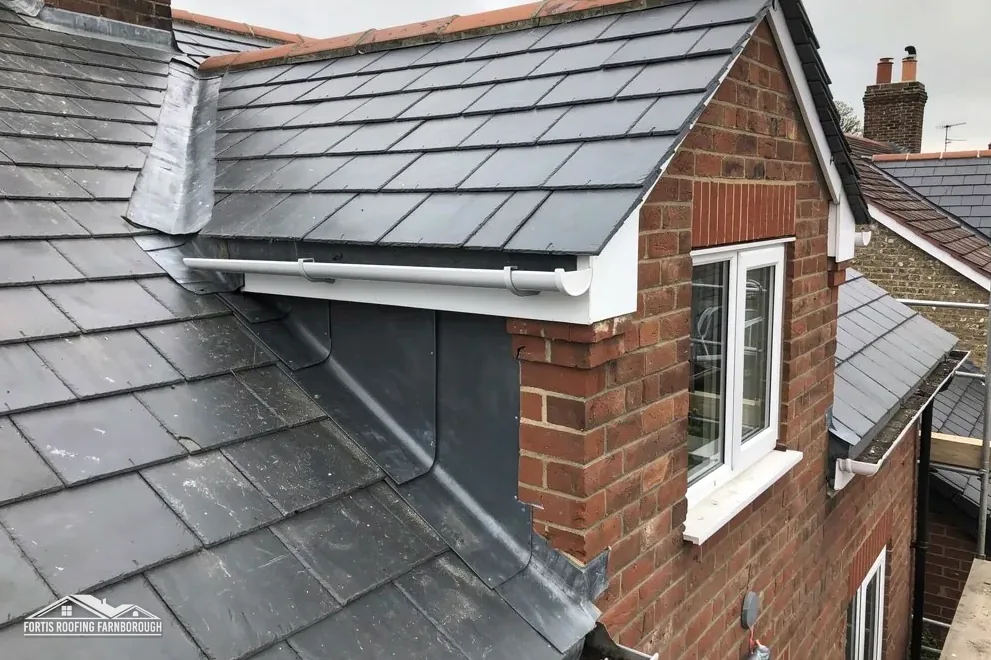
Wherever an addition was built onto an older roof, trouble tends to start at the seam: a valley, an abutment, a step flashing. We open each join enough to see whether the flashing is sound, photograph what we find and say which parts need work. A roof window or skylight set into an old slope gets the same treatment, since its flashing is a join in its own right, and our roof window and skylight page explains how it is checked.
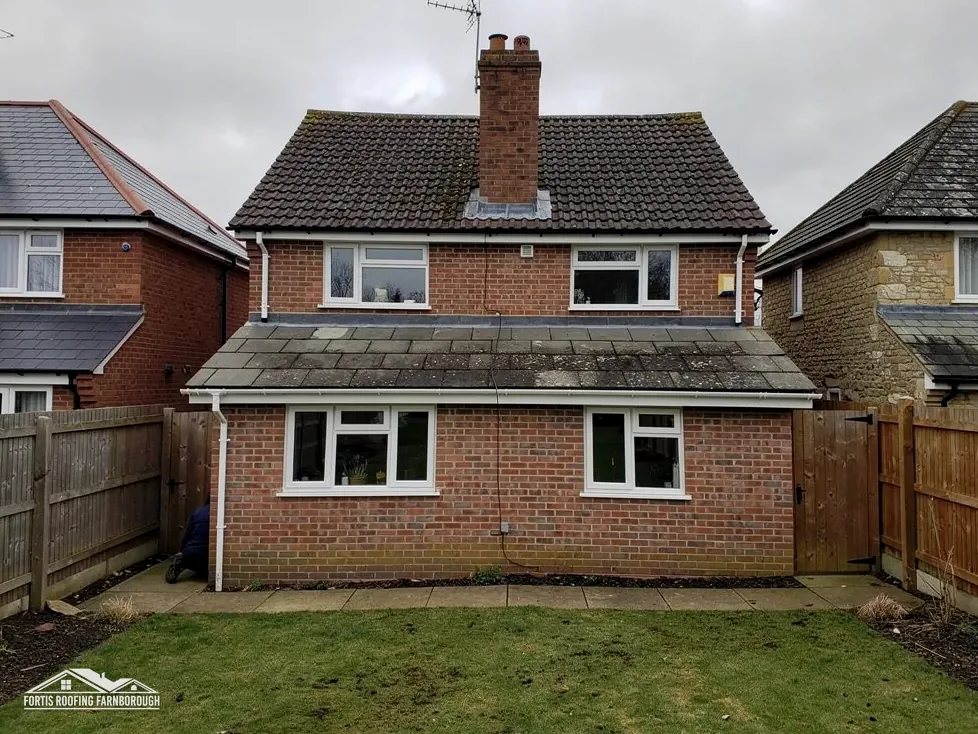
For a flat roof over a rear extension, BS 6229:2025 keeps a minimum finished fall of 1:80 for general roof areas, and water that ponds after rain shows the fall has gone. We look for it where we can, and we record where water stands. A leaking gutter can stain a wall well before damp shows indoors, so staining is traced upward to its source. The notes you receive list each join, the material on either side of it and the condition we found.
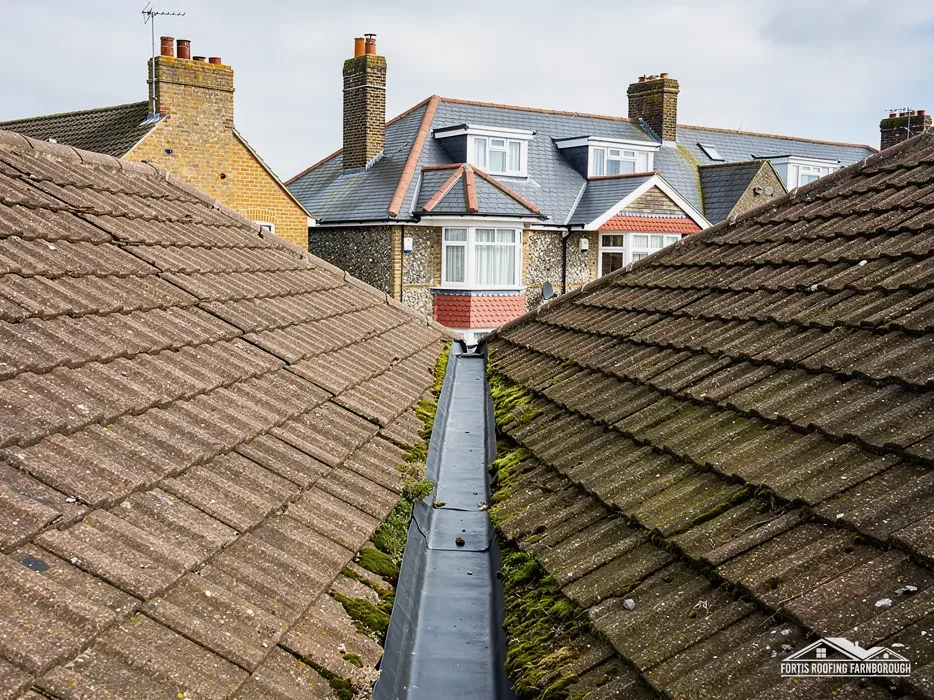
Where the house has been extended more than once, a simple sketch of the roof is drawn with each slope numbered, and the photographs are filed against those numbers. That makes a long job easy to follow, and it lets you see which slopes were repaired, which were left alone and why.
Chapter 03 of 03
| Designation | Near St John's | For roof work |
|---|---|---|
| Conservation area | St John's, Woking, within about 0.75 km | Ask Woking before changing a roof's look |
| Conservation area | Basingstoke Canal | Ask Woking before changing a roof's look |
| Conservation area | Holyoake Crescent, Horsell | Ask Woking before changing a roof's look |
| Grade II listed | Langmans (NHLE 1264515) | Listed building consent for work affecting character |
| Grade II listed | St John's Lodge (NHLE 1417070) | Listed building consent for work affecting character |
According to planning.data.gov.uk, the St John's, Woking conservation area comes within about 0.75 km of the centre, and its boundary search also catches the Basingstoke Canal and Holyoake Crescent, Horsell areas. Woking says its borough has 27 conservation areas, and it publishes constraints site by site, so that map is the place to look for your address.
A conservation area does not forbid maintenance. It asks whether the work alters how a building looks from outside, and restoring the old covering, ridge and verge leaves the look intact. Switching material, changing the ridge or rebuilding the chimney can alter it, so we raise those with Woking's planners ahead of quoting. The original is photographed first, so any comparison is easy, and the pictures are labelled by slope and date so the council or a later owner can follow them.
The canal gives St John's several areas close together, so a house near a boundary may be inside one area and outside the next. We check the address against Woking's constraints page and, where the map is unclear, ask a planning officer at the council, instead of relying on how the street looks.
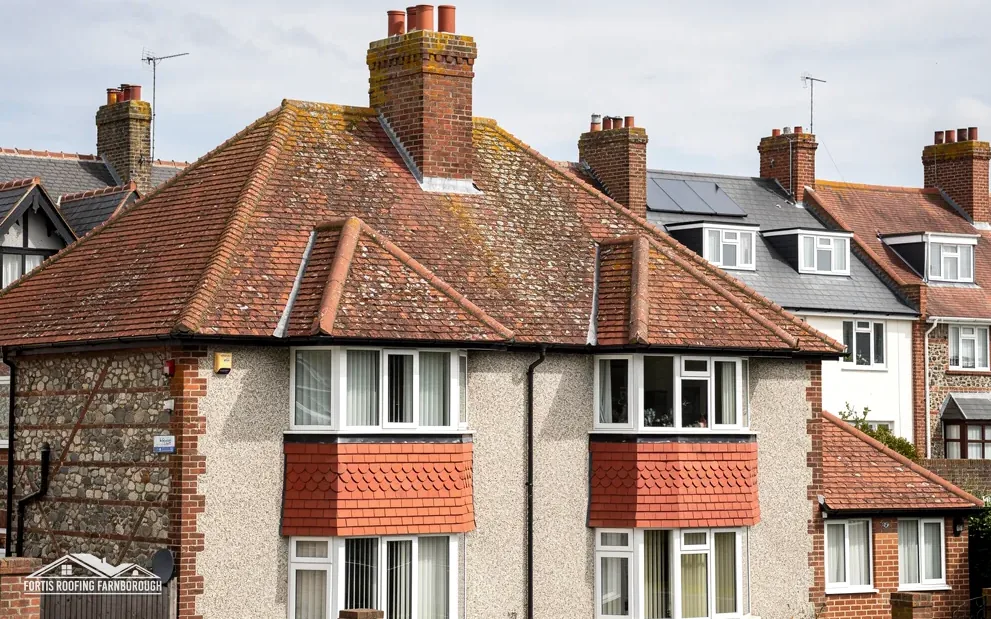
Three listed buildings stand within 500 m of the village point: Langmans, listed Grade II on 29 September 1975 (NHLE 1264515), St John's Lodge (NHLE 1417070) and the St John's war memorial (NHLE 1425790). Work that would change the character of a listed building needs listed building consent from the council first. For houses nearby that are not listed, a neighbour's listing changes nothing by itself, though each address is checked.
Any Article 4 direction on your street is a further question we put to Woking ahead of quoting. Its reply sits in your report beside the other checks, so you know which approvals apply before anything is booked.
A canal-side address may sit at the edge of more than one designation, so the report states each check separately: conservation area, listing, Article 4. Where an answer is to ask the council, the report says so and records what was asked.
Should the council need to be asked, our enquiry includes your address, our pictures and measurements, and a short note on exactly what would differ. Woking's planning team can then answer on paper, and the answer is kept with your written price.
We look at shaded faces, valleys and gutters for moss, leaf litter and slow leaks, because moisture sits longer where sun does not reach. The survey records which slopes are shaded, lifts a few tiles that hide the condition beneath, and photographs the result. The repair then follows what is found, not a guess from the street, and you see the evidence.
Not when the repair restores the same covering, ridge and verge, because the look is unchanged. A different covering, ridge profile or stack changes it, so we take those to Woking's planners beforehand, and an Article 4 query for your street goes with them.
On its own, no: changes to a listed building's character need listed building consent, but a listing on one house does not alter the rules for its neighbours. For every address we search the national list and Woking's constraints map before quoting, with the outcome recorded in your report, so the position is clear.
A scaffold over a St John's road or pavement needs Surrey County Council's licence at £208 per 28 day period, with the form 10 working days ahead. Surrey does not say who applies, so our scaffold firm and we sort that out first, and only then is a start date offered. Scaffold on private frontage needs no licence.
Get your free roof quote
Tell us your road and the sign of trouble, then we book a survey.
10-year workmanship guarantee, in writing.