Large houses on big plots
The railway and Aldershot's army growth brought wealthy businessmen and officers to build large houses in Rowledge.
Roofs on big plots along old tracks near Alice Holt
Rowledge grew from farmland and common into a village of large houses on substantial plots. We survey each roof, whatever its age or size, on the evidence.
The railway and Aldershot's army growth brought wealthy businessmen and officers to build large houses in Rowledge.

Tradesmen followed the big houses, and the village grew into a mix of homes, none above two storeys.
Rowledge's roads still follow the haphazard pattern of old tracks and footpaths from its farmland and common days.
Map of Rowledge with Wrecclesham, Frensham, Farnham, Bentley marked around it.
Map data © OpenStreetMap contributors. Loads only when you ask for it.
Rowledge lies south-west of Farnham on the Hampshire border, with Farnham to the north-east and Farnborough 12.6 road miles away to the north.
About 12.6 road miles south of Farnborough · Waverley Borough Council and Surrey County Council.
Rowledge, plots and park edge
Which council governs a Rowledge roof job, how farmland, the railway and the army shaped the village, and where the edge of the South Downs National Park actually runs.
| No. | Chapter | The figure it turns on |
|---|---|---|
| 01 | Waverley's village on Surrey's highways | Waverley plans, Surrey issues scaffold licences |
| 02 | Farmland, railway and army officers | Originally farmland and common land |
| 03 | The park edge and the nearest conservation areas | Park edge across the Hampshire border |
Chapter 01 of 03
Rowledge, a Waverley village, in four numbers
Rowledge belongs to Waverley, in Surrey, yet it stands on the Hampshire border and counts with Farnham for parish purposes. Planning sits with Waverley Borough Council, which also operates its own building control service, Waverley Building Control. Surrey County Council keeps the highways until 31 March 2027, and from the following day West Surrey Council replaces both Waverley and the county. Until then the present arrangements stand.
Waverley's pages state no re-roofing percentage, so the national guide is the one to follow. For a Rowledge house that means a re-roof is normally exempt while it involves under 25 per cent of the building envelope and under 50 per cent of the roof. If a new covering would add 15 per cent or more to the weight, approval and a structural check come into play instead. Large houses with deep roofs make that arithmetic worth doing early, because the area involved can be big even when the repair feels small.
We measure slope areas at the survey, and when a job is near the line we flag it. A registered building control approver is the private option beside Waverley's own team.
Whichever firm you choose, ask what its figure assumes about scaffold and VAT, and whether the price covers clearing away the old covering. A total price that is silent on those points is not yet a total price, and a good surveyor will want them written down.
Section 169 of the Highways Act 1980 is the rule that matters on a Rowledge lane: an obstructing scaffold is licensed by the highway authority, and here that body is Surrey County Council until April 2027, at £208 per 28-day period, and it will issue an emergency licence ahead of its usual 10 working days if you phone about an unsafe structure or a serious safety risk. Nothing on its page says who files, so raise that when you book. A scaffold kept wholly inside your boundary is outside that regime.
On a large plot there is often room to put scaffold on your own land, which removes the notice period from the plan. Where a lane runs close to the front wall, the licence is likely to matter. The frontage is looked at on the survey day, and that settles which case you are in and the dates it implies. Where scaffold is needed on the lane, we also tell you how many days the licence is likely to cover.
Chapter 02 of 03
| Stage | What the statement records |
|---|---|
| Origins | Farmland and common, large farms, scattered cottages |
| Road pattern | Haphazard, following old tracks and footpaths |
| Arrivals | Wealthy businessmen and army officers, after the railway |
| Building | Many large houses on substantial plots; tradesmen followed |
| Height | No flats and no houses of more than 2 storeys |
The draft Farnham Design Statement gives Rowledge a clear sequence. The area began as farmland and common, with several large farms and scattered cottages, and its roads still follow the haphazard pattern of old tracks and footpaths. The railway, together with the growth of Aldershot as the home of the British Army, then brought wealthy businessmen and army officers, who built many large houses on substantial plots. Tradesmen followed them, and the area also became important for hop-growing.
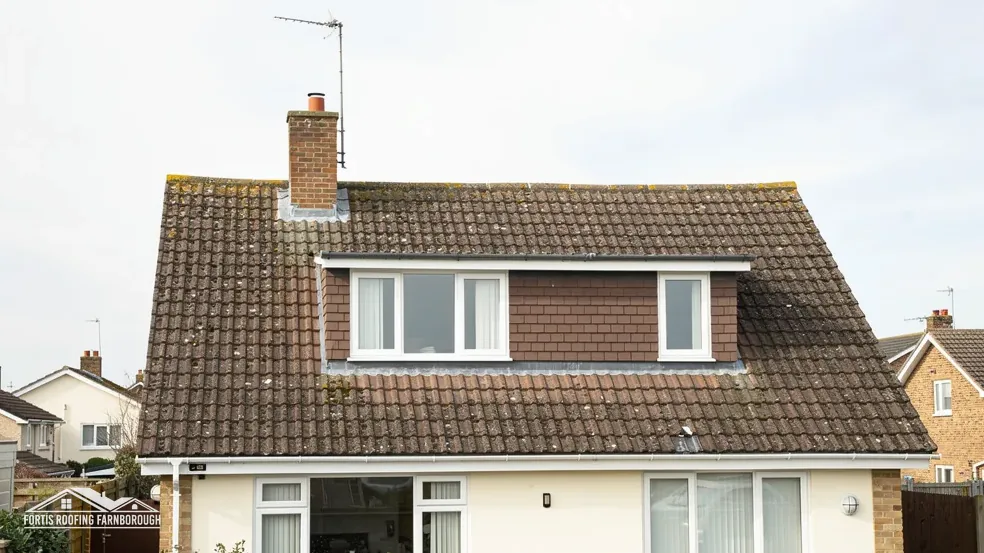
The same statement notes a wide variety of building styles in Rowledge, and records no flats and no houses of more than 2 storeys. For a roofer, those few facts matter a good deal. No flats means no block roofs shared by several owners. A cap at 2 storeys means work can be done from scaffold at a manageable height. A wide variety of styles means we cannot treat one Rowledge roof as a guide to the next.
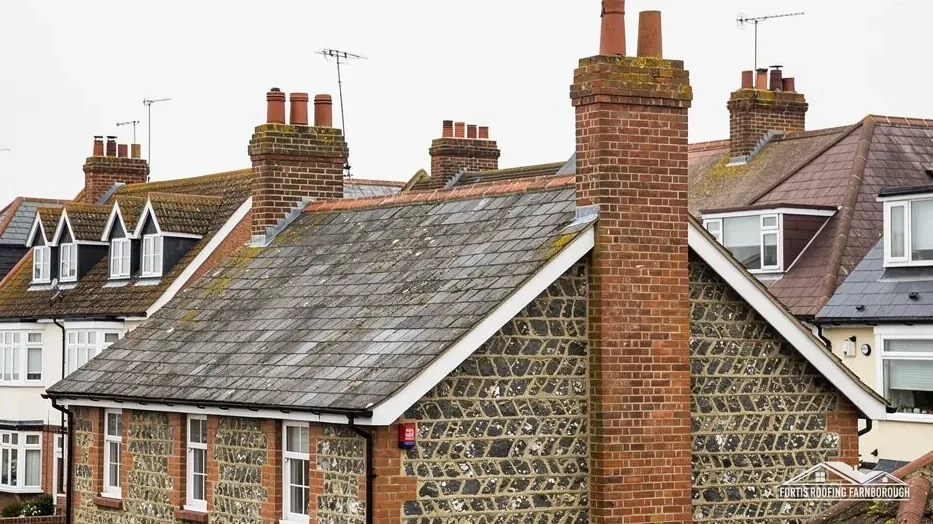
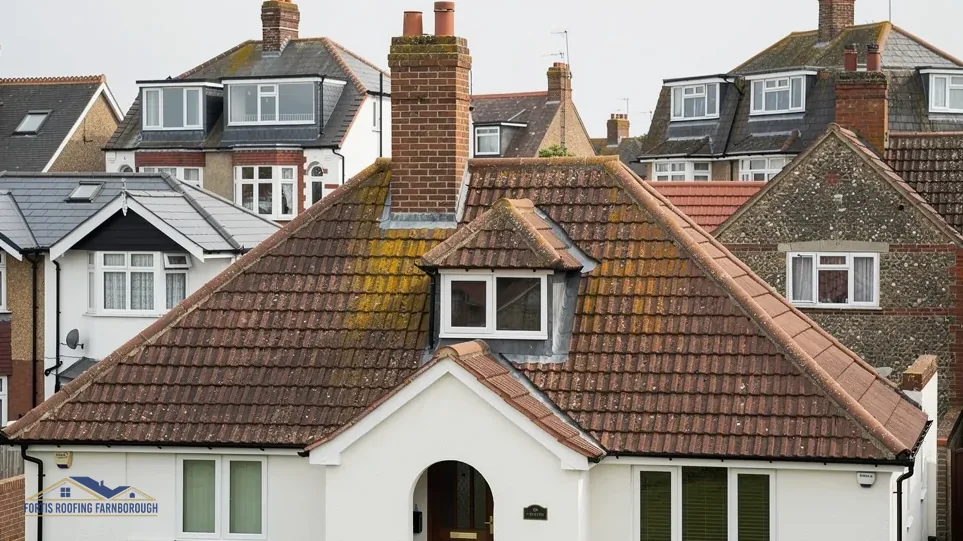
Large houses on big plots tend to have complicated roofs, with several pitches, valleys, dormer cheeks, chimneys and long runs of guttering. Complexity multiplies the places water can enter, and it makes a thorough survey more valuable. We walk the whole perimeter, photograph every junction and note which sections have been repaired before. A tradesman's house nearby may have a simple roof that needs little more than an annual check of the ridge and the gutters, and we are as happy to advise on that as on the grander house up the lane.
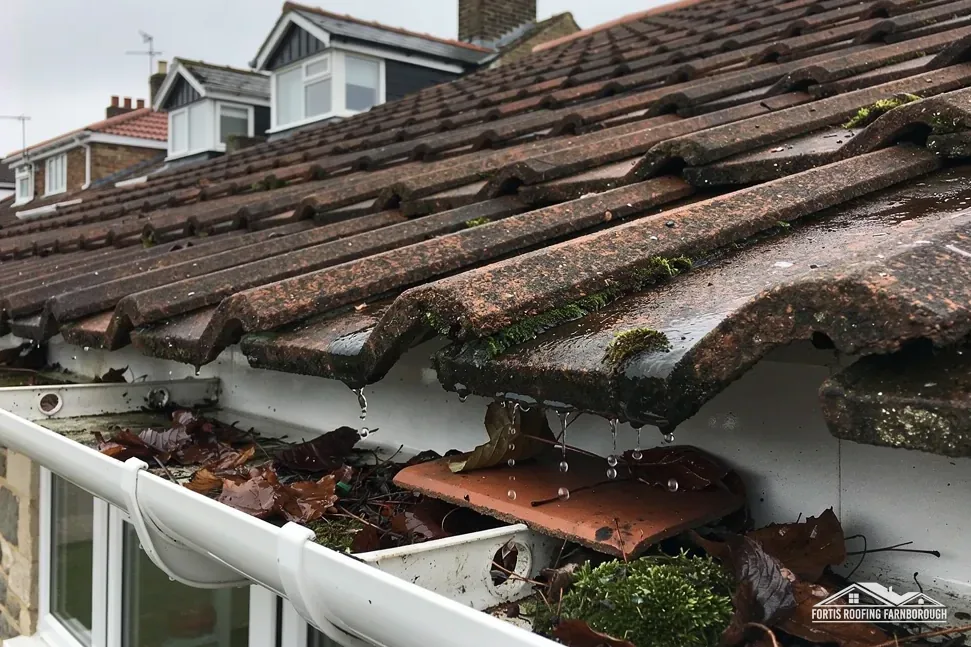
Trees are part of the setting here, with Alice Holt woodland close by and mature gardens on many plots. Mature hedges and trees along the old tracks mean gutters need checking each autumn. Leaves and moss gather in valleys and behind chimneys, and a valley that blocks can drive water beneath the tiles. Our roof cleaning and moss removal page explains how moss is treated without damaging the covering.
Height and plot
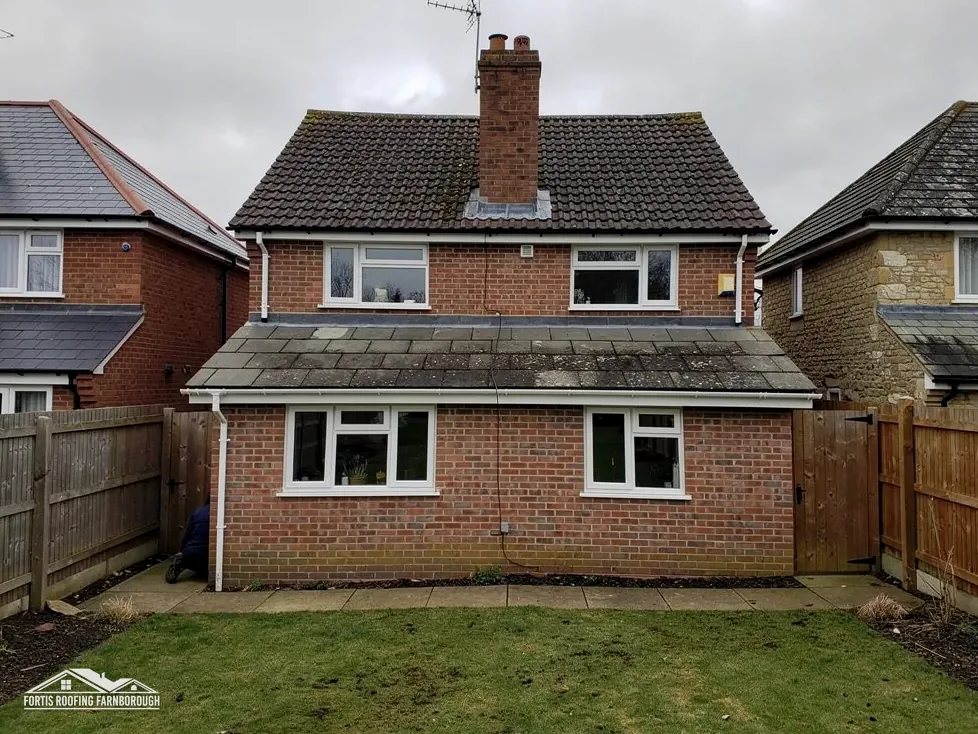
A large plot may also carry a garage, a studio or a conservatory. Each of those has a roof of its own, usually flat or low-pitched, and each needs a check of its own. We include outbuildings in the survey when you ask, and we list them separately so the report stays clear.
None of this tells us what your roof is covered with, which is why the survey names it, slope by slope, with photographs you can keep.
Chapter 03 of 03
Rowledge and its designated neighbours
Roughly 15 per cent of the 1.5 km area around Rowledge sits inside the South Downs National Park, and that part lies across the county border to the west, in East Hampshire's Binsted parish. Rowledge itself is in Waverley and in Farnham parish, and the National Park Authority lists no Surrey council among those covering its area, so a Rowledge house is outside the Park and Waverley Borough Council is its planning authority. The Park boundary is a near neighbour, not a rule that reaches your roof.
The national dataset names five conservation areas within about 2.5 km of Rowledge: Frensham, Great Austins in Farnham, Millbridge in Frensham, Old Church Lane in Farnham and Wrecclesham in Farnham. That list does not tell you whether your address is covered. It tells you the neighbourhood has several, so a quick check with Waverley is sensible for any house near the village edge.
Waverley's own Article 4 list names direction areas elsewhere in the borough. We therefore treat each house on its address and ask the council rather than assume.
Whatever the designations, the effect falls on changes, not repair. Swapping slipped tiles for matching ones keeps the roof as it was. Adding a roof extension or altering the pitch is the kind of change Waverley's planners want to see first, with drawings and a description of the materials, before they give an answer.
On the national list, no listed buildings are recorded within 500 m of the village centre. That makes Rowledge simpler in one respect: the listed building consent route is unlikely to apply. If your house turns out to be listed, the consent route shifts, so mention it at the first call, when we can also look it up.
Roof work in Rowledge comes down to good repair and correct approvals where they apply. A matching repair seldom prompts a query, and our photographs give Waverley what it needs if one comes. A new covering, a change of roofline, or an extension is where approvals matter, and we put it to Waverley before pricing anything that alters the look. Our chimney repairs page explains how stacks are repaired, an important job on large houses with several of them.
On a complicated roof the joints leak before the open slopes do: valleys, chimney flashings and the lines where one roof section meets another. Every junction is surveyed and photographed and the gutters are flushed, because a stain indoors can start at a joint some way from where it shows.
No. The Park's edge covers about 15 per cent of the 1.5 km area around the village, but that ground lies across the county border in East Hampshire. Rowledge is in Waverley, which is its planning authority, so any change of roof appearance goes to Waverley before it is priced.
The licence comes from Surrey County Council (until April 2027) at £208 for 28 days, and asks for 10 working days of notice. The page does not name the applicant, so ask who applies. Poles kept inside your own boundary stay clear of the licence, and the big plots here may allow exactly that.
Damp moss on tile sits against the surface and can block a valley or a gutter, which is why gentle removal tends to pay off. Marley advises against jet-washing tiles, which can damage them. The tiles are inspected, the moss brushed or treated gently, the gutters cleared and the result photographed.
Get your free roof quote
Pass on the Rowledge address and a word about the fault, and we will fix a date for the visit.
10-year workmanship guarantee, in writing.