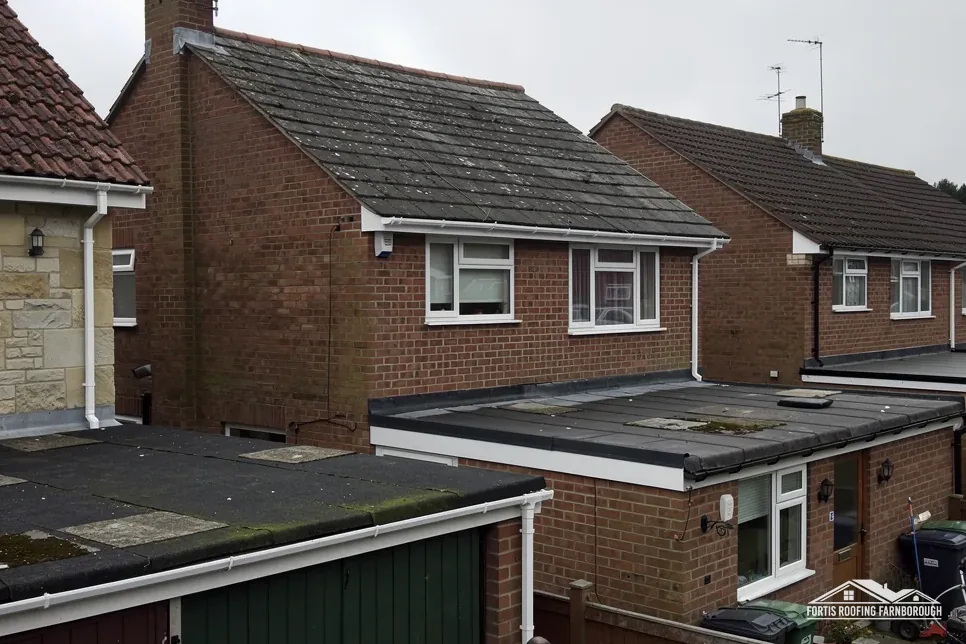
Cottages built in brick
The 1923 county history called Cranbourne's cottages modern and built of brick, scattered along four roads in a rough rectangle.

Roofs along four roads at the edge of Windsor Forest
Cranbourne is a small village north of Ascot, spread along four roads with its northern end in Windsor Forest. Each roof gets a proper survey and one written price.
The 1923 county history called Cranbourne's cottages modern and built of brick, scattered along four roads in a rough rectangle.
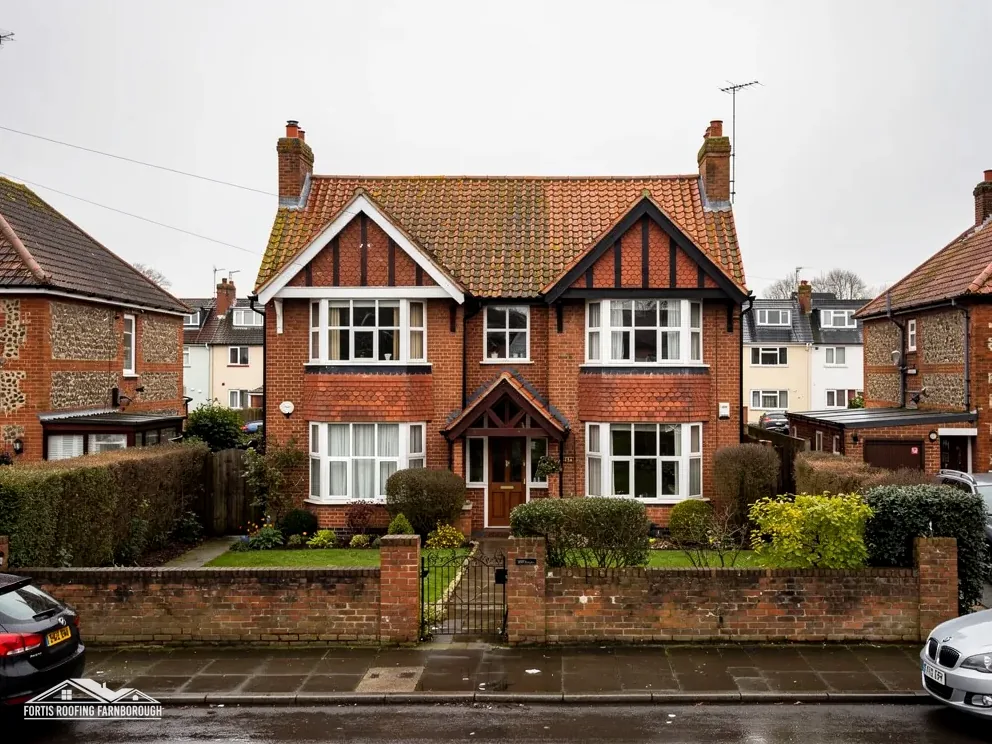
The buildings around Stable Court, east of Fernhill Park, are listed Grade II, which puts their roofs under consent rules.

A Wesleyan chapel was built in 1867, while St Peter's Church and the war memorial hold Grade II listings.
Map of Cranbourne with Winkfield, Ascot, Sunninghill, South Ascot marked around it.
Map data © OpenStreetMap contributors. Loads only when you ask for it.
Cranbourne sits north of Ascot in Winkfield parish, at the edge of Windsor Forest, with Farnborough 13.5 road miles away to the south, counted from the A325.
About 13.5 road miles north of Farnborough · Bracknell Forest Council (unitary).
Cranbourne, forest edge and listings
How Bracknell Forest's single-council system works for a Cranbourne roof, what the 1923 county history says about the village's four roads and its chapel, and which listed buildings and conservation areas lie nearby.
| No. | Chapter | The figure it turns on |
|---|---|---|
| 01 | Who signs off roof work at Cranbourne | Bracknell Forest handles it all |
| 02 | Four roads, a forest edge and a Wesleyan chapel | Scattered along four roads |
| 03 | Fernhill Park's Stable Court and the nearest conservation area | Stable Court listed 20 December 1972 |
Chapter 01 of 03
| Matter | Decided by |
|---|---|
| Planning | Bracknell Forest Council |
| Building control | Bracknell Forest Council, its own service |
| Scaffold on the highway | Bracknell Forest Council |
| Parish | Winkfield |
| Road distance from our base | 13.5 miles, measured from the A325 |
Cranbourne belongs to Bracknell Forest Council, a unitary authority, so there is a single office for planning, building control and the highways. It lies in Winkfield parish, 13.5 road miles from Farnborough, a distance taken from the A325 Farnborough Road as with every town we serve. For the owner, one council means one set of web pages and one switchboard.
On its list of jobs that may need building regulations approval, the council includes re-covering roofs, pitched or flat, with no percentage given. We read that as a cue to ask and not as a rule. Our yardstick is the Planning Portal's: a re-roof touching under a quarter of the building envelope and under half of the roof is not normally an application matter, and a new covering adding 15 per cent or more in weight is.
On a Cranbourne house, a handful of replaced tiles is a repair. A full slope or two is the case to talk through, and we do the arithmetic from the survey photographs and measurements, then tell you where the job stands.
Put the same question to every roofer: what does the price assume about VAT, scaffold and taking old material away? A figure that stays silent on those is not complete. Our written price comes after the survey, as one total for the whole job.
For a residential address, Bracknell Forest lets you apply online and lists the licence at £350, which includes a non-refundable £100 application fee. It lasts for 6 weeks, and when they run out you must apply again for a new licence. The council says structures on private land do not need one, and lists £700 as the charge where a structure stands on the highway without a licence.
The council's page does not name who completes the online form, so put that question to the scaffolder, and settle it before any date is fixed. In a village strung along four roads, a house with a front garden or a long drive may have room for scaffold off the highway. Once we have measured the frontage, we can describe the likely arrangement and give a scaffold period with room for bad weather.
Chapter 02 of 03
Cranbourne's setting and size
The 1923 county history describes Cranbourne as a village scattered along four roads, roughly forming a rectangle, with its northern end in Windsor Forest. Its cottages were then modern and built of brick, and the history records a Wesleyan chapel built there in 1867. The 2021 Census counted 789 usual residents in the Cranbourne built-up area.
Scattered is the useful word. In a compact village, a roofer can look at one street and learn something about the next. In Cranbourne, the houses sit along four separate roads with gaps between them, so each home needs its own survey. A cottage that the county history called modern in 1923 is now a century old, and may have been re-covered since. We name the covering from the roof itself.
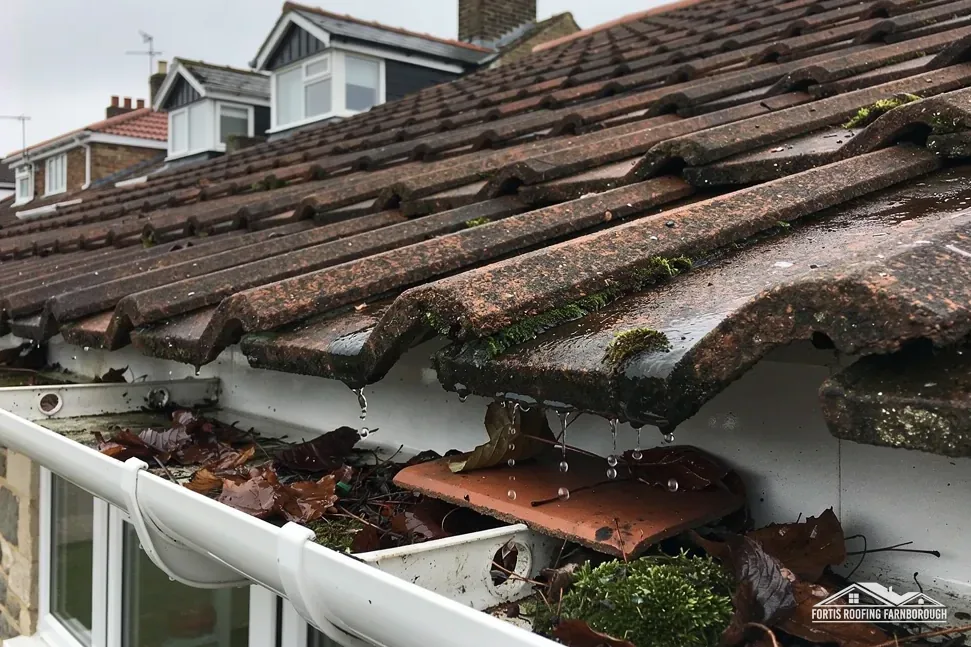
The forest edge has practical effects. Trees stand close to many houses, so leaf fall, twigs and seeds find their way into gutters and valleys, and shaded slopes grow moss. Our roof cleaning and moss removal page explains how moss is removed without harming the covering, and why we avoid high-pressure washing. The gutters get their own check, with water run through them where it is safe.
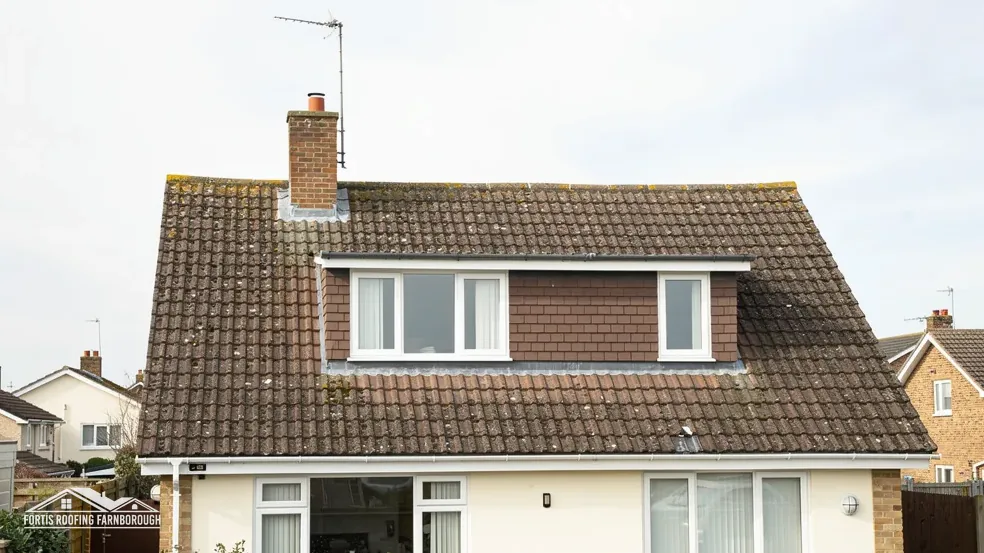
Houses built from brick, as the 1923 record describes, have chimneys and roofline details that deserve a careful look from the ladder. The stack is often the highest point of the roof and takes the full weather, and a failing flashing at its foot is a common source of damp in an upstairs bedroom. We photograph each joint and tell you what is sound and what is not.
Because the four roads are separate, access varies. A house on a main road may have a pavement and parked cars to work around, while one on a back lane may have a drive and a garden. We ask about the approach when you call, so ladders, scaffold and deliveries can be planned and neighbours are not caught out.
Chapel and census
Tall trees near a house add a second hazard, because a falling branch can damage a roof without warning. When a bough lands on a roof, our first job is to make it safe, with a temporary covering where needed, and the damage is surveyed properly afterwards. Keep photographs and tell your insurer before repairs begin.
The 1867 chapel shows the village has public buildings as well as homes. Whoever looks after one carries more duties, yet the roof questions stay the same.
Chapter 03 of 03
| Item | Near Cranbourne | For roof work |
|---|---|---|
| Grade II listed | Buildings around Stable Court, east of Fernhill Park (NHLE 1390442) | Listed building consent |
| Grade II listed | Church of St Peter (NHLE 1390455) | Church consent or listed building consent |
| Grade II listed | Cranbourne War Memorial (NHLE 1450454) | Listed building consent |
| Conservation area | Church Road, Winkfield, within about 2.5 km | Check Bracknell Forest's map |
Cranbourne has three listed places that stand out. The buildings around Stable Court, east of Fernhill Park, were listed Grade II on 20 December 1972. The Church of St Peter and Cranbourne War Memorial are listed Grade II as well; St Peter's, if in Church of England use, follows the faculty system. Five listed buildings stand within 500 m of the village centre. Listed building consent from Bracknell Forest Council is needed for work that changes the character of any of them, with the ecclesiastical exemption applying where it does.
The nearest conservation area in the national dataset is Church Road, Winkfield, within about 2.5 km of Cranbourne. That does not put a Cranbourne house inside it, and it does not rule out others. Bracknell Forest's own map is the place to check an address, and we look at it before the survey. Bracknell Forest also lists several Article 4 directions in its borough, so any change to the look of a roof is worth putting to the council before it is priced.
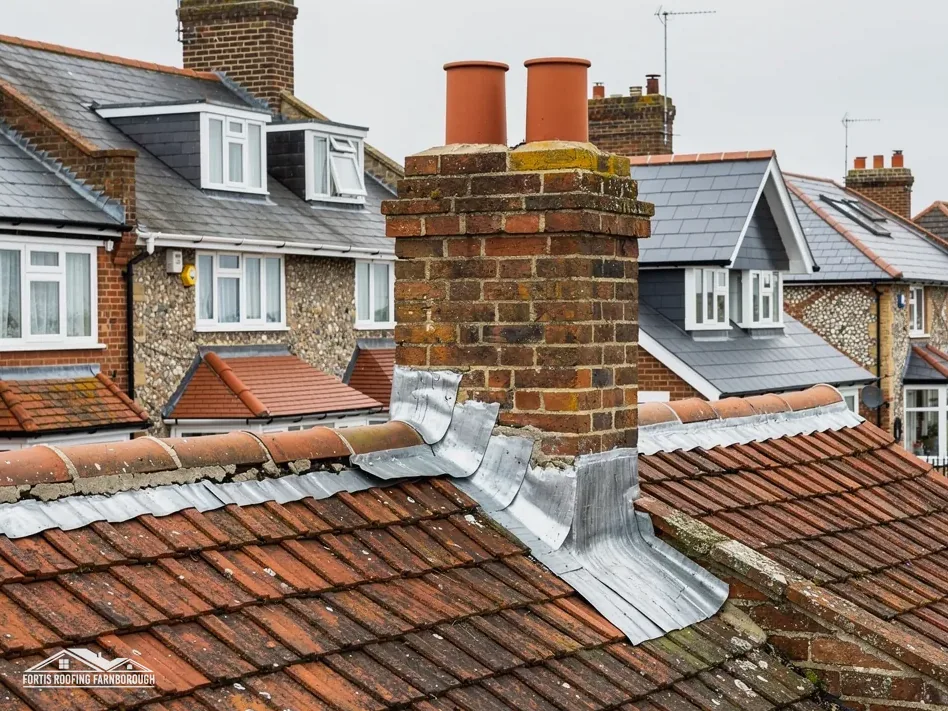
A long range of buildings has a long ridge, and every joint along a long ridge is a place for water to find its way in. That is the sort of detail a record and a ladder survey bring out, and it is why consent applications for listed roofs are best supported by close photographs.
None of this stops a house in Cranbourne being repaired. A like-for-like repair is ordinary upkeep, and most of a roof's working life is made of it. What the listings and the nearby area do is raise the importance of matching. If your house is listed or neighbours a listed building, we photograph the roof before work starts, so the repair can be compared with the original.
For an unlisted house away from the designations, a roof job is simply good repair, with the approvals that apply. Beside woodland, leaf fall wears gutters out, and our gutters, soffits and fascias page describes how the roofline is renewed once the roof above is sound.
Ask us if you are not sure which category your house is in. We look at the national list and Bracknell Forest's map before the visit, then tell you what we find in plain words.
There is no fixed interval, since it depends on the trees and the weather. We check gutters and valleys at every survey and photograph them. If leaves collect quickly, a clear in late autumn is a sensible habit. Blocked gutters overflow onto the wall and can wet the fascia and the timber behind it.
Bracknell Forest names pitched and flat re-covering among works that may call for building regulations approval, and sets no percentage. The national test looks at under 25 per cent of the envelope and under 50 per cent of the roof, plus any covering 15 per cent or more heavier. We measure your slopes against it.
The council's page offers an online application and is silent on who completes it, so ask who applies. A residential licence costs £350 including a non-refundable £100 and lasts 6 weeks. Structures on private land do not need one, so we measure your frontage first and plan the access from there.
Only if your house is part of the listed buildings. The consent rules apply to the buildings around Stable Court, not to their neighbours. If you are close, check whether yours is listed and whether any conservation area covers it. Bracknell Forest's map answers both questions, and we read it ahead of the visit.
Get your free roof quote
Tell us your road and what looks wrong, and a surveyor will photograph the whole of your Cranbourne roof.
10-year workmanship guarantee, in writing.