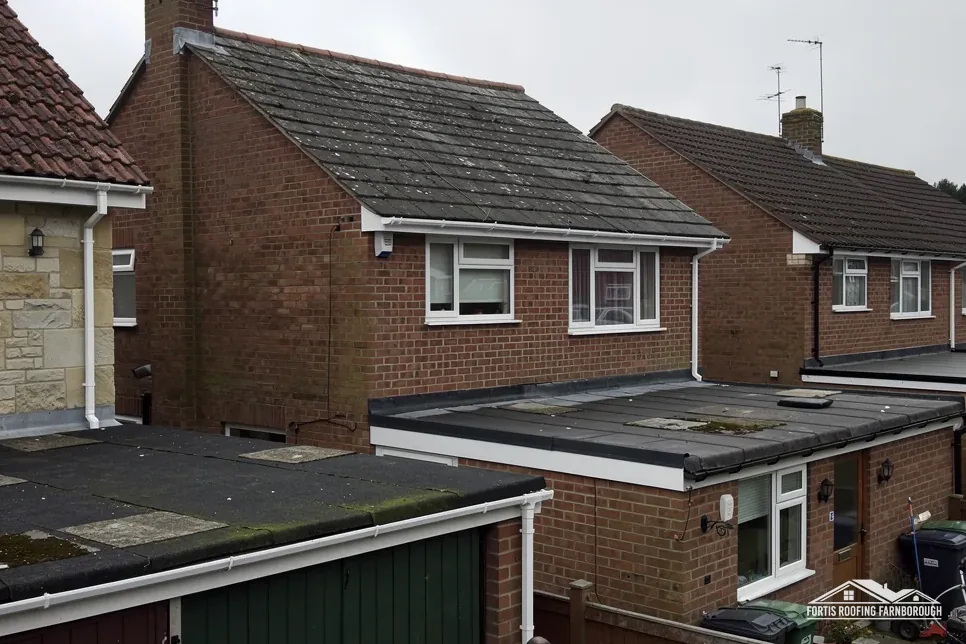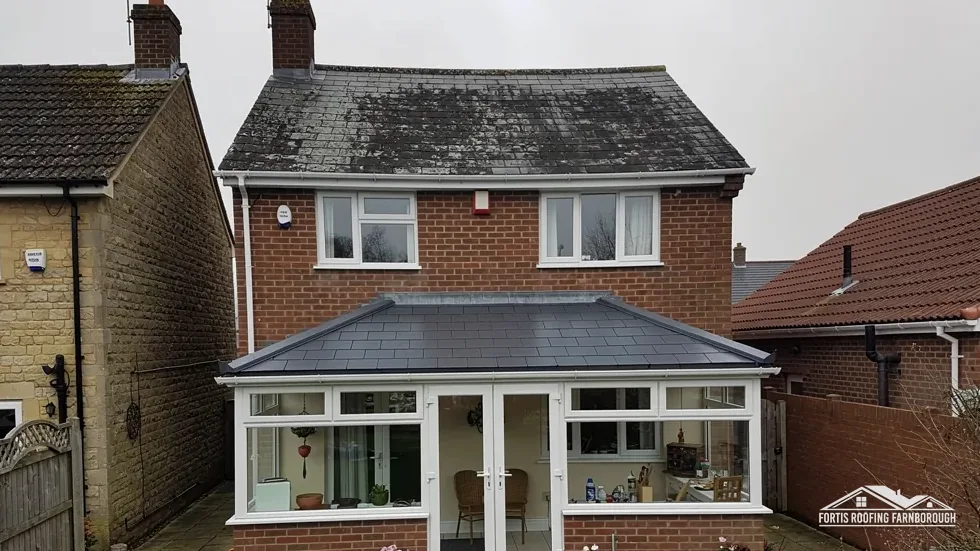
Inter-war roads
Hart's 2010 study names Courtmoor Avenue, Florence Road and Queens Road among the inter-war roads.

Roofs between canal and Ewshot, from inter-war roads to Court Moor
Church Crookham is a large village-suburb south of Fleet, between the Basingstoke Canal and farmland towards Ewshot, with a former Gurkha barracks. Each roof is photographed and priced once.
Hart's 2010 study names Courtmoor Avenue, Florence Road and Queens Road among the inter-war roads.
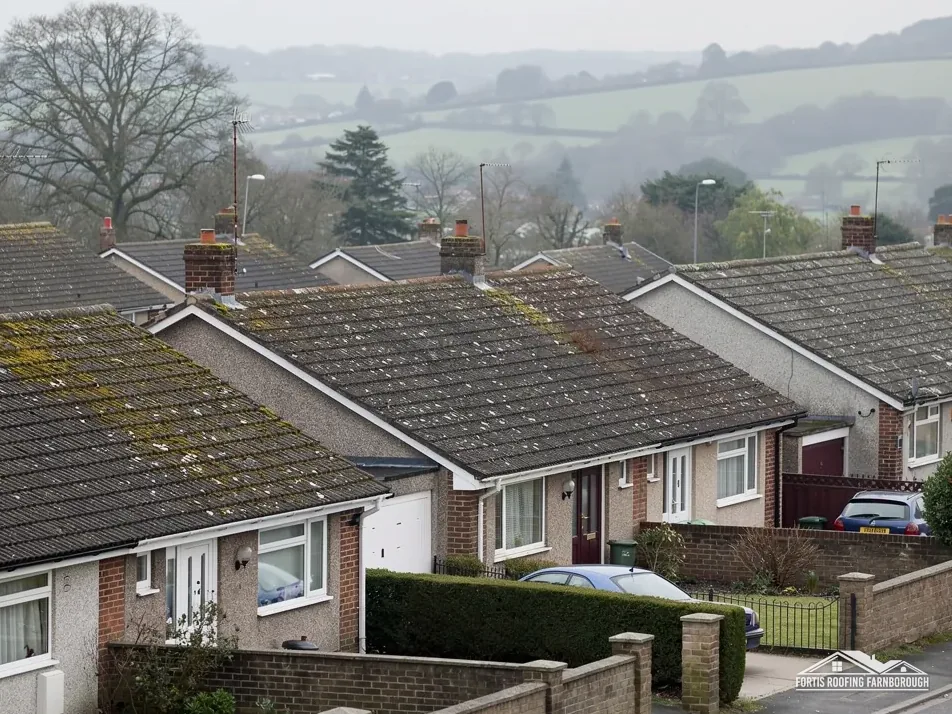
Large housing estates followed from the 1950s on land such as Court Moor Park.

Queen Elizabeth Barracks, built in 1971, had its married quarters sold as private homes after 2000.
Map of Church Crookham with Crookham Village, Fleet, Ewshot, Elvetham Heath marked around it.
Map data © OpenStreetMap contributors. Loads only when you ask for it.
Fleet lies to the north, Elvetham Heath beyond it, Crookham Village to the west, Ewshot to the south, and Crondall further south.
About 6 road miles south-west of Farnborough · Hart District Council and Hampshire County Council.
Church Crookham, canal and barracks
How a canal-side parish grew through inter-war roads, 1950s estates and a Gurkha barracks, what the canal conservation area and flood map add to a survey, and who handles inspection and scaffold. All figures are sourced.
| No. | Chapter | The figure it turns on |
|---|---|---|
| 01 | Inter-war roads, 1950s estates and a Gurkha barracks | Barracks 1971; battalion left 2000 |
| 02 | Courtmoor Avenue, Court Moor Park and the old barracks | Three named roads; one named estate |
| 03 | Canal conservation area, Flood Zone 3 and scaffold | Canal area within 0.75 km; Flood Zone 3 |
Chapter 01 of 03
Church Crookham's phases from published records
The Victoria County History of 1911 records that Crookham, formerly part of Crondall, became an ecclesiastical parish in 1842, with the Basingstoke Canal forming part of its northern boundary and separating it from Fleet. Hart's 2010 study picks up the story in the twentieth century. It says Church Crookham's inter-war roads included Courtmoor Avenue, Florence Road and Queens Road, and that large housing estates followed from the 1950s on land such as Court Moor Park.
The study also records Queen Elizabeth Barracks, built in 1971 as the headquarters of the 1st Battalion of the Gurkha Rifles. The battalion left in 2000, and the married quarters were sold as private homes. That is an unusual piece of local history, because it means a group of houses built to one military design passed to individual owners at one moment, each of whom then became responsible for a roof that had been maintained centrally, and each of whom inherited whatever that maintenance had left behind.
Nothing in these records describes a roof covering, and we do not turn them into claims about one. What they do tell us is that Church Crookham contains at least four distinct phases of building, each with its own roofs and its own likely maintenance histories. A survey cannot assume that a Courtmoor Avenue house, a Court Moor Park house and a former barracks home share any faults.
So we begin each survey with the same open question: what is on this roof and what shape is it in? We check the covering, the junctions, the drainage and the roof space, and photograph everything. For a house that has changed hands, the survey also gives the new owner a baseline. A baseline is useful whenever you buy a house, because it shows what you are taking on, and gives you a fair basis for asking the seller to deal with serious faults.

Our pitched roofing page explains how tiled roofs are repaired. Garages and extensions with flat roofs are covered by our flat roofing page. Whichever roof it is, the closing advice is the same: you are quoted for a repair if the evidence allows one, and for replacement only if it does not.
Chapter 02 of 03
| Place | What Hart records | When |
|---|---|---|
| Courtmoor Avenue | An inter-war road | Inter-war |
| Florence Road | An inter-war road | Inter-war |
| Queens Road | An inter-war road | Inter-war |
| Court Moor Park | Site of large estates | From the 1950s |
| Queen Elizabeth Barracks | Gurkha Rifles headquarters; quarters sold privately | Built 1971; sold after 2000 |
Hart's study names three inter-war roads, one estate area and one barracks, and between them they span several decades of building. That spread has a practical consequence for any roof survey: age is a poor guide to condition, because roofs that began as a group have not had a shared history since. Some will have been re-covered, others extended, others left alone.
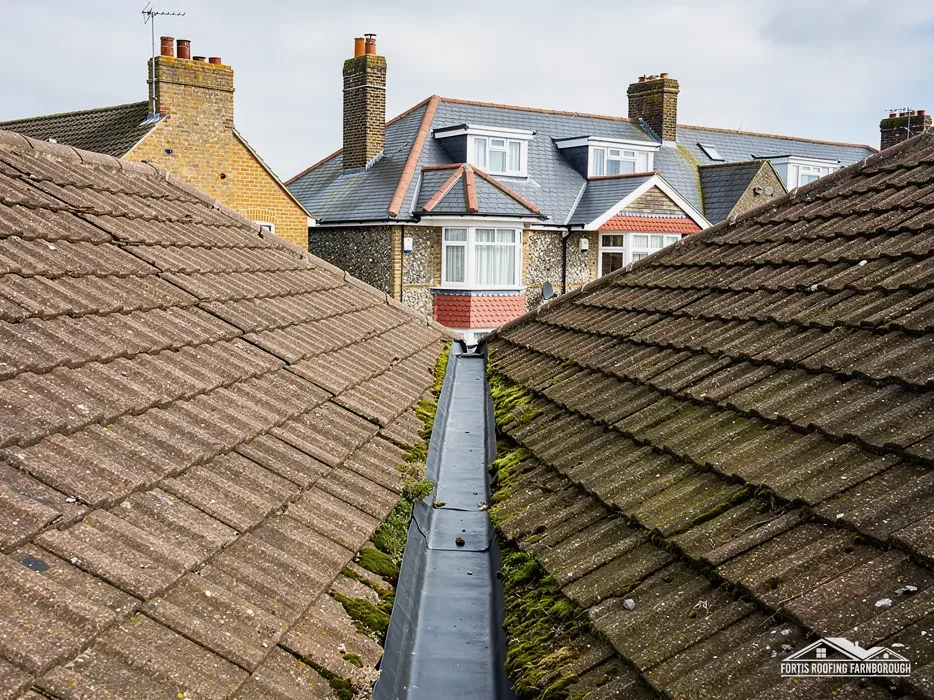
When a street of similar houses has similar roofs, it is tempting to price by the street. We do not. We compare a roof with its own earlier state wherever we can, and with a clear standard of repair where we cannot. If a ridge has been re-bedded, a valley re-lined or a slope re-covered, the join shows, and the survey records it.
The photographs make this possible. A shot of the ridge at close range tells us whether it is on its original mortar or has been mechanically fixed. A shot of a valley shows whether the lining is original lead, a later repair or a stopgap. Those details are what separate a roof that needs a patch from one that needs a plan, and they are what you pay for when you pay for a survey.
On the former barracks homes, if any original features survive, such as chimney pots or particular tile details, they are recorded before work and matched where practical. Our roof windows and skylights page explains how openings in a roof are repaired and flashed, which matters on houses that have had lofts converted or rooflights added over the years.
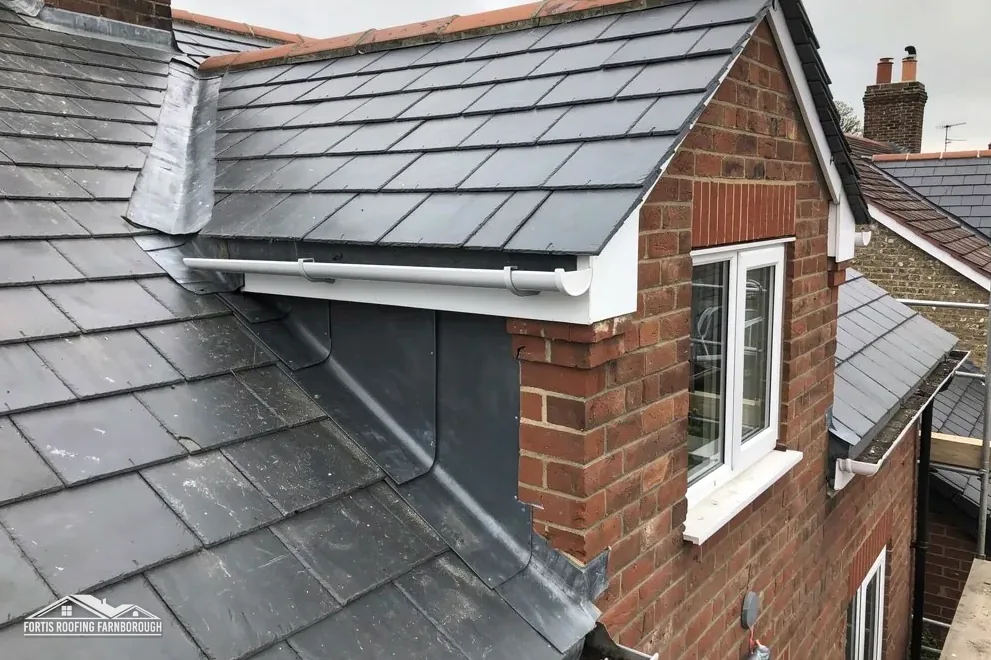
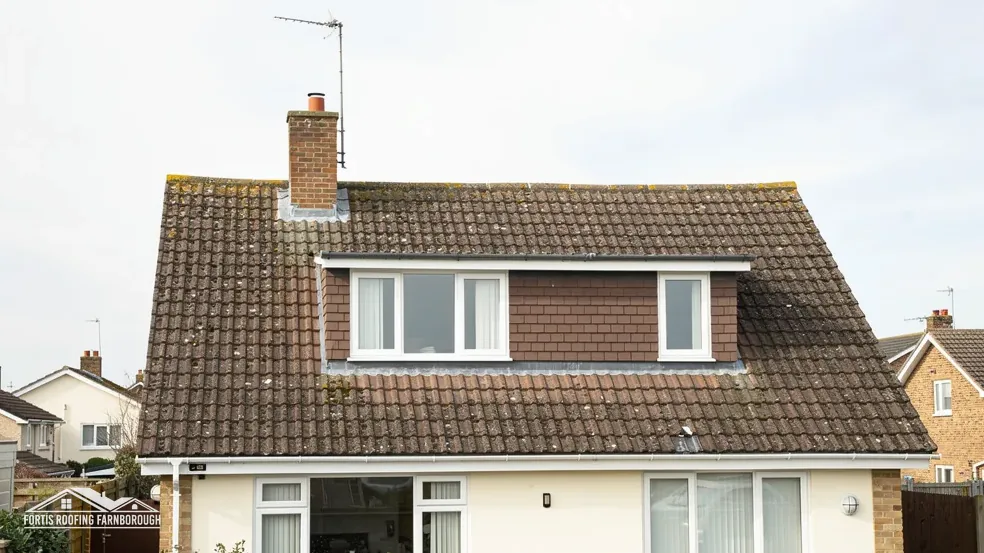
Many houses of these ages have since gained loft conversions, dormers or rooflights, and each opening is a place where a roof can leak. A window set into a slope relies on its flashing, and a dormer has valleys, cheeks and a flat or pitched top of its own. We examine each one separately, from the roof and from inside, and report on it as its own item.
It is common for owners to have inherited a roof's history without knowing it. A previous owner's patch repair, a different tile in one corner, a ridge re-bedded in a mortar that does not match: none of these is a fault, but all are clues. We note them so that the next owner, whoever that is, can read the roof's story from the report.
Chapter 03 of 03
Four facts that shape a Church Crookham roof job
The Basingstoke Canal conservation area lies within about 0.75 km of Church Crookham's centre. In the dataset's 1.5 km search box around the village centre the canal area appears. Hart's Article 4 list covers parts of the canal area, including sections at Broad Oak and Crookham Village, so we ask Hart whether a direction touches your address, because where one applies, changes that normally need no application may need one.
On the Environment Agency's mapping, land within about 250 m of the centre falls in Flood Zone 3. That is about land, not coverings, so repairs are made as they would be anywhere. It is a reason to check where roof water goes, and we follow it from slope to downpipe to ground.
Within a conservation area, the council takes an interest in how a roof appears from the public side. Repair that keeps the existing material and detail is unlikely to raise questions; a different covering, a front-slope roof window or an altered chimney is not. Whether your house sits inside the boundary is a question for Hart's map, and we ask it before quoting for a change.
Weather shapes the programme. South Farnborough averages from the Met Office, 1991 to 2020, give 118 wet days a year and roughly 53 days of air frost, and a scaffold has to stand through its share of both. The dates we give you carry spare days, and you are told early if a forecast threatens them.
A Church Crookham re-roof that needs inspection goes to the Hart and Rushmoor Building Control Partnership, which Rushmoor Borough Council runs from its Farnborough offices, on 01252 398715. A registered approver is the private choice. The Planning Portal sets under 25 per cent of the envelope and under 50 per cent of the roof as the no-application zone.
Scaffold on a Hampshire road needs Hampshire County Council's licence. Hampshire County Council's rule is that the scaffolding company applies for its customer; the council wants 10 clear working days of notice and never extends a licence. We plan the dates so one licence covers the job. Anything standing wholly on your own plot is outside the scheme.
The survey is the same: covering, junctions, drainage, roof space. Hart's study records that the married quarters were sold as private homes after the Gurkha battalion left in 2000, so each roof is now an individual owner's responsibility. A baseline survey shows what has been maintained and what has not, which helps a buyer too.
It comes to within about 0.75 km of the centre, which makes it possible. Hart's map shows the boundary. Hart's Article 4 list also takes in parts of the canal area, so Hart is asked whether a direction touches your address before any quote for a visible roof change, and the reply is recorded.
Hart keeps no building control team; Rushmoor supplies the service as the Hart and Rushmoor Building Control Partnership, on 01252 398715, and a registered approver is the private choice, should you prefer one. A job inside the Planning Portal's limits needs neither, and the survey measures where you stand, so you know before dates are fixed.
The flood layer rates land, not roofs, so tiles and flashings are fixed as normal. But water that leaves a roof has to go somewhere, and near the canal that matters. On every survey we follow rainwater from slope to downpipe to ground and photograph each joint and discharge point, so the report shows where it ends up.
Get your free roof quote
Give us your Church Crookham road and the problem. We arrange the survey, then a single written price follows.
10-year workmanship guarantee, in writing.