Brick-makers' cottages
A row of four brick-makers' cottages survives at Zephon Common near the village.
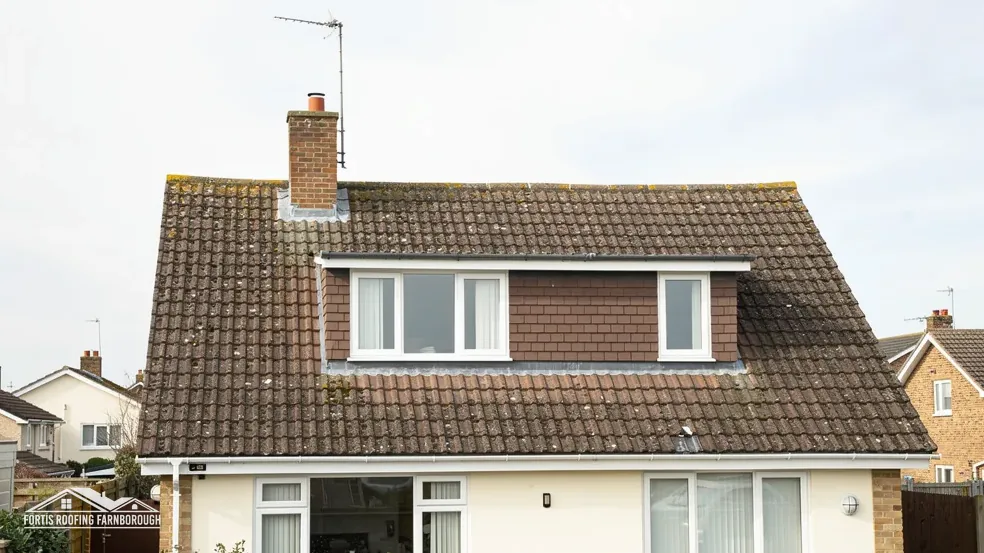
Roofs in a canal-side village of clay tiles and brick-makers' cottages
Crookham Village is a canal-side village west of Fleet, with a conservation area of 12 listed buildings. Every roof is measured, photographed and quoted as one written figure.
A row of four brick-makers' cottages survives at Zephon Common near the village.

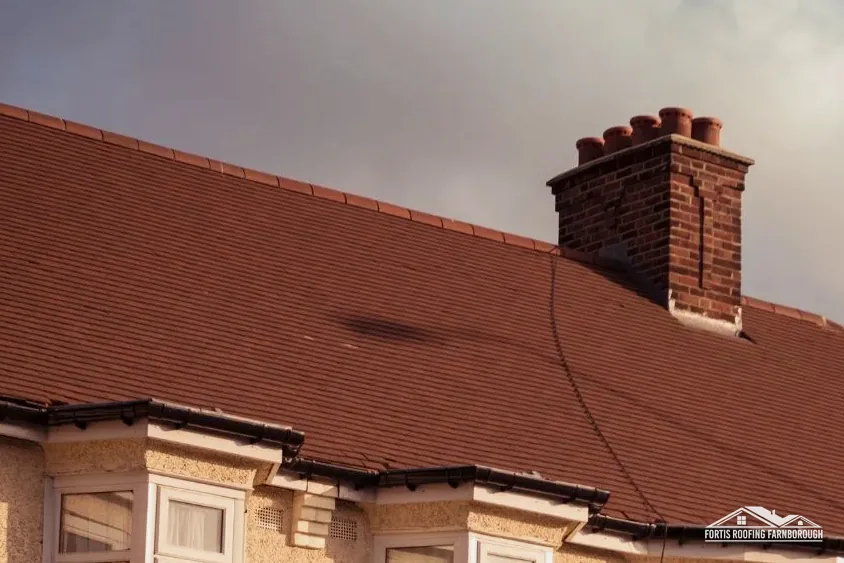
Hart's appraisal says the roofs in the conservation area are covered with clay tiles.
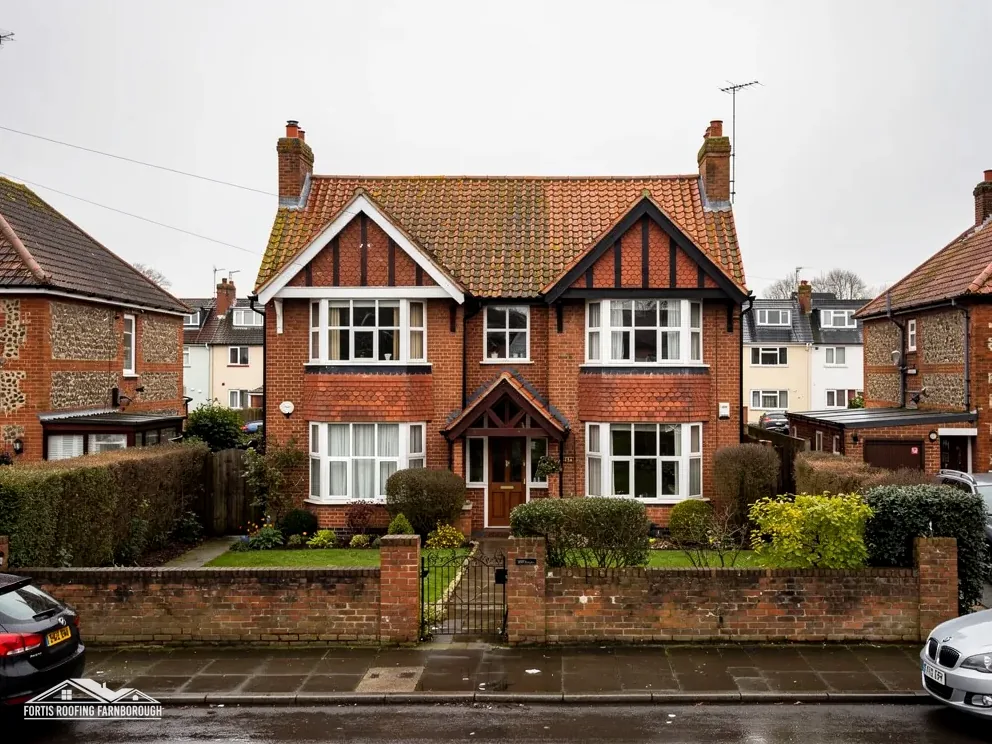
Brook Cottage, Brook House and Cedar Cottage are all listed Grade II, close to the village centre.
Map of Crookham Village with Church Crookham, Fleet, Elvetham Heath, Ewshot marked around it.
Map data © OpenStreetMap contributors. Loads only when you ask for it.
Crondall lies to the south, Church Crookham to the east, Fleet to the north-east, Ewshot to the south-east, and Elvetham Heath to the north.
About 6.9 road miles south-west of Farnborough · Hart District Council and Hampshire County Council.
Crookham Village, clay and canal
How the canal's brickworks and a 16th-to-20th-century village shaped Crookham Village, what Hart's two Article 4 directions reach, and how clay tiles are matched and licensed.

| No. | Chapter | The figure it turns on |
|---|---|---|
| 01 | Brickworks, brick-makers' cottages and housing from the 16th century | 12 listed buildings; housing 16th to 20th century |
| 02 | Two Article 4 directions that name frontage roof slopes | 1998 direction; canal sections also |
| 03 | Clay tile life, matching and the Hampshire scaffold | Clay tile 60-80 years; BRE minimum 60 |
Chapter 01 of 03
Crookham Village in four published points
Hart's appraisal of the Basingstoke Canal records several 19th-century brickworks near the canal, among them one at Zephon Common near Crookham Village, where a row of four brick-makers' cottages survives. Its appraisal of the Crookham Village conservation area counts 12 listed buildings and structures inside the area, says the housing dates from the 16th to the 20th centuries, and adds that its roofs are covered with clay tiles. The 2021 Census counted 4,044 residents in the civil parish, and 11 listed buildings stand within 500 m of the centre.
A canal, a brickworks and a village of 16th-century houses make a neat chain: clay dug locally, fired locally and laid locally. The appraisal does not say that any particular house carries tiles from those works, and we do not say so either. What it does say, for the conservation area, is that the roofs are clay-tiled, and that is a good reason to expect clay inside the area while still checking it, house by house, there and everywhere else.
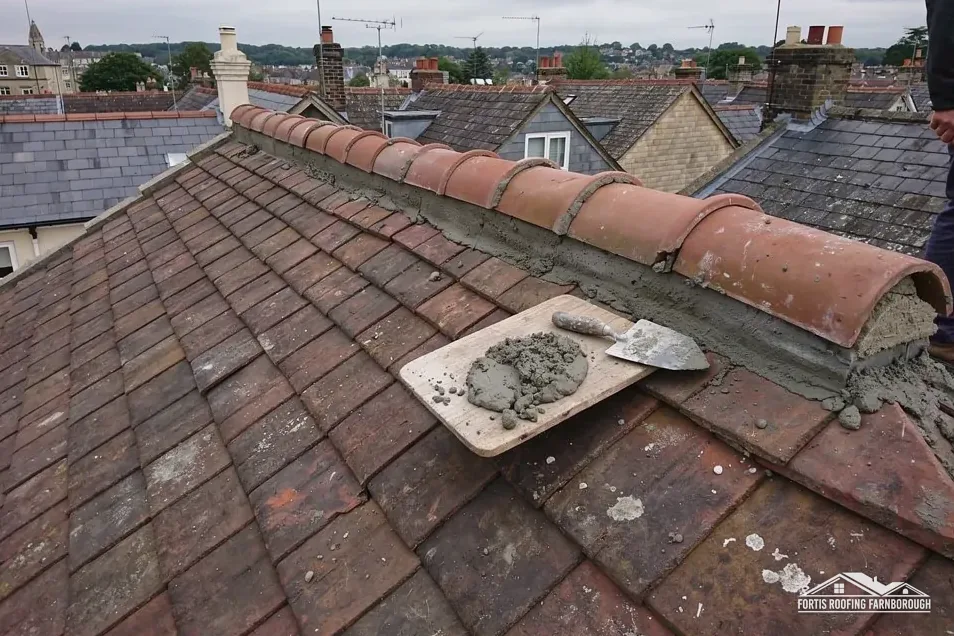
Clay tiles reward care. They are fired, so their colour and texture vary within a roof and between batches, and a replacement tile has to be chosen by eye against the weathered ones around it. We photograph the existing tiles, salvage every one that is still good, and hold candidate replacements up against the roof before anything is ordered. Old houses in the village may also carry hand-made tiles with a gentle camber, which are matched on the same principle.
The same survey covers the rest: junctions, chimneys, drainage and roof space. Our pitched roofing page lists the repairs clay-tiled roofs most often need, and our lead roofing and lead work page deals with the flashings and valleys that go with them. The quote is one written price, produced after the survey.

In a village with 12 listed buildings and structures inside its conservation area, listed status is common enough that every survey begins by asking the question. We check the National Heritage List before we climb, so that a listed roof is approached with the right care from the first minute, and so that nobody discovers a consent requirement halfway through a job.
Chapter 02 of 03
| Direction | Area | What it covers |
|---|---|---|
| Crookham Village Conservation Area Article 4 Direction (1998) | Crookham Village conservation area | Frontage alterations including a frontage roof slope; chimneys; porches; front gates, fences and walls; frontage painting |
| Basingstoke Canal Conservation Area Article 4 Direction | Broad Oak and Crookham Village sections of the canal area | The same frontage works, on unlisted dwellings |
| Hart's advice on repairs | Unlisted buildings in conservation areas | Matching work in the same detail and material needs no planning permission |
Hart's own list of Article 4 directions includes two that name Crookham Village. One is the Crookham Village Conservation Area direction of 1998. The other is the direction for the Broad Oak and Crookham Village sections of the Basingstoke Canal conservation area. Hart describes both as covering frontage alterations to unlisted dwellings, involving a frontage roof slope, together with front porches, front gates, fences and walls, painting of the frontage, and chimneys.
An Article 4 direction withdraws specified permitted development rights across a mapped area. Where one applies, altering a front slope or a chimney, which would elsewhere need no application, can need one here. The practical rule we follow is simple: a repair that keeps the existing tile, laid as before, is the easy case, and Hart's advice on repairs to unlisted buildings is that matching work in the same detail and material needs no planning permission. A different tile, a new roof window or an altered stack is a conversation for Hart's planning team, and we have it before we quote.
We work out which side of the line a job falls on before the price is fixed, not after. For each Crookham Village address, we check Hart's map for the conservation area and the canal sections, note whether the roof slope in question faces the road, and record the answer in the report. A back slope may be treated differently from a front slope, and we say which is which. A frontage roof slope means the slope that faces the street, and a corner house or a house on a bend can have two. We mark each slope on a sketch of the roof, with its aspect, so that the report shows exactly which parts the direction touches and which it does not, and the planning team can see the same thing.
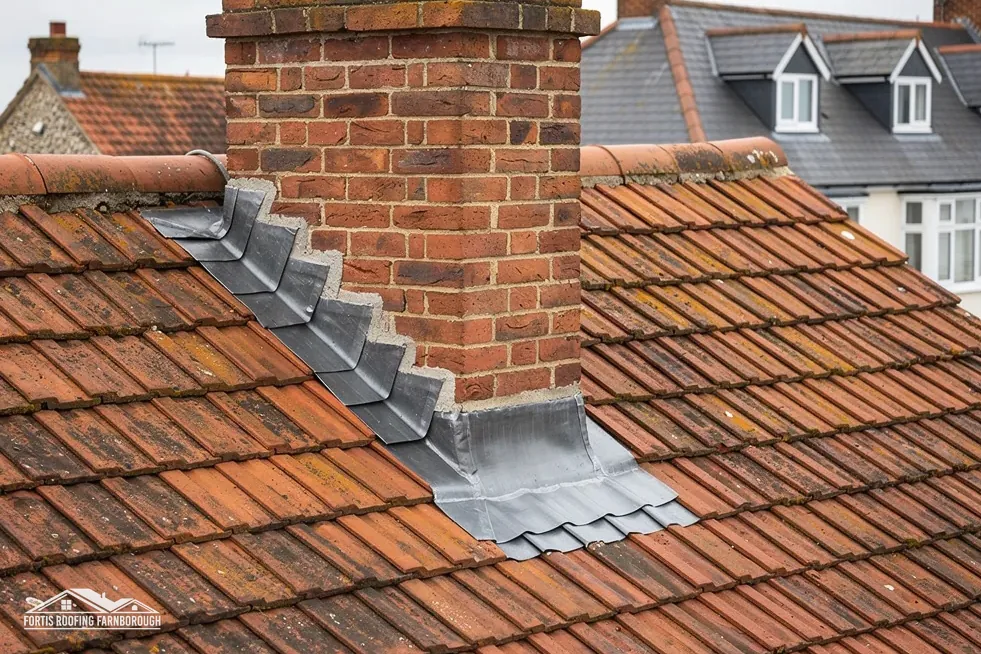
For the listed cottages, Brook Cottage, Brook House and Cedar Cottage, the route is listed building consent, which is separate from Article 4 and applies to work altering what makes a listed building special. Our chimney repairs page explains how stacks are mended, which matters because the direction names chimneys.
Usually, yes. We photograph the weathered tiles, salvage every good one, and hold candidate replacements up against the roof before ordering. A match is judged by eye in daylight, not from a catalogue, and the sample is shown on your own roof first. If the battens and fixings are sound, replacing failed tiles with matched ones is a repair, and we show you the evidence.
Hart's list includes the Broad Oak and Crookham Village sections of the Basingstoke Canal area, with the same frontage works as the village direction. Hart's map shows whether your address falls inside either, and we look it up before quoting for any change to a front slope or chimney, then record the answer.
Rushmoor supplies it through the Hart and Rushmoor Building Control Partnership, on 01252 398715; a private approver on the register is the alternative. A job within the Planning Portal's limits involves neither, and the survey measures where yours stands before any date is fixed, so you can plan around the answer.
Hampshire County Council never extends a licence, so an overrun means a fresh application and another 10 clear working days of notice. Extra 2-week periods cost £72 each when they are applied for at the outset, so a re-tile is licensed for its whole expected length at the outset, with spare days for weather and early warning if the forecast turns.
Get your free roof quote
Name your Crookham Village lane and the fault you can see. A visit is booked, then one written price arrives.
10-year workmanship guarantee, in writing.