The short answer
Leaks around a flat roof skylight usually start at the junction between the rooflight and the roof, not at the glass. The usual causes are a cracked or lifted membrane at the upstand, perished seals, ponding water that has nowhere to go, or a condensation problem that only looks like a leak. The repair depends on which one the survey finds.
Upstands and membranes
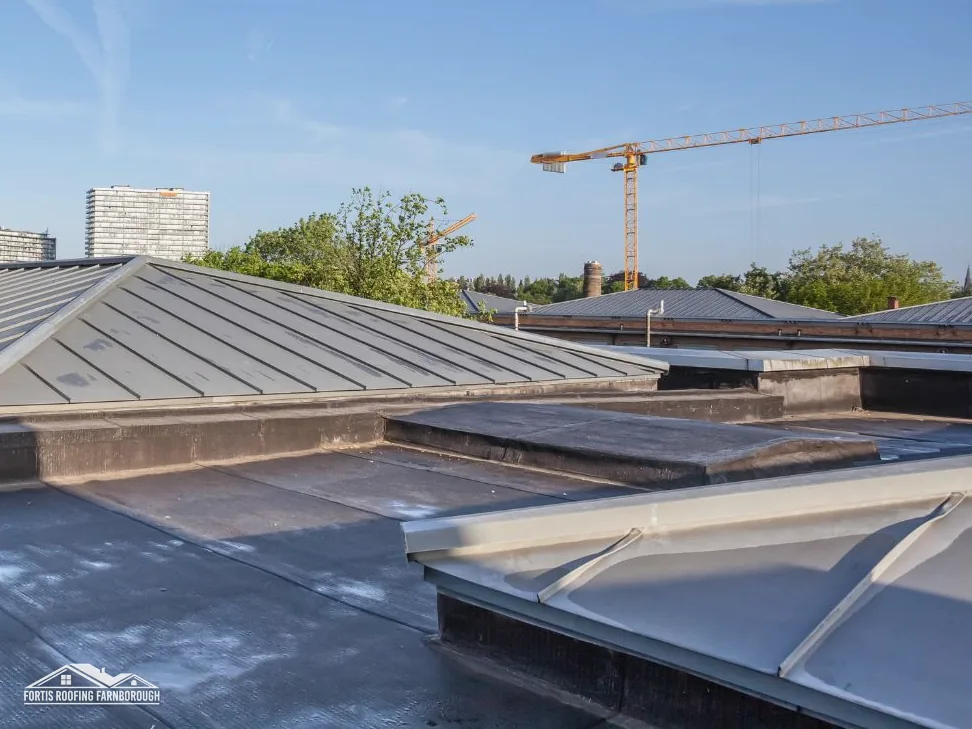
A flat rooflight sits on an upstand, a short raised kerb built around the opening so water cannot run in at the edge. The roof membrane, whether EPDM, GRP, felt or lead, is turned up the side of that kerb and sealed to it. That turn-up is the weakest point of the whole roof, and it is where most skylight leaks begin.
Membranes fail at the upstand in a few set ways. The material cracks or splits at the corner, where it is stretched in the cold. The bond lifts from the kerb as the adhesive ages. A felt turn-up dries out and opens at a lap. A GRP edge crazes and lets in water. A trim or cover flashing at the top of the upstand can come loose, which lets rain behind the membrane.
Height matters. An upstand that is too low lets standing water reach the edge of the frame. Approved Document L caps a site-built upstand at 0.35 W/(m²·K), so it carries insulation, and wet insulation stops working.
We trace the leak by looking at each edge in turn, photographing the membrane, and testing the suspect section with water from a hose before we decide what to do.
Seals, glazing and the unit itself
If the membrane and the upstand are sound, the next place to look is the rooflight. A dome or flat glass unit sits on a frame, and the joint between them is sealed. Over the years, a sealant joint hardens, shrinks and splits, and a rubber gasket flattens. Water then tracks along the joint and into the opening.
Polycarbonate domes crack and craze with age, and the fixings that hold them can loosen. Our answer on replacing a polycarbonate dome skylight covers that type. A failed double-glazed unit mists between its panes, which is not a leak, though it is often reported as one.
Condensation is the great imposter. Warm moist air from the room meets the cold glass or frame and runs down as droplets, which can look like rain. If the drips appear on cold, dry mornings, or only after showers and cooking, condensation is likelier than a leak. If they appear during or after rain, the roof is the suspect.
The guide to a leaking roof window covers the pitched case in the same way, and the two have causes in common.
Falls, ponding and the roof around it
A flat roof must drain. For flat roofs with flexible waterproofing up to 10 degrees, the current standard is BS 6229:2025, and its finished-fall floor is 1:80. IKO designs for 1:40, which leaves the finished fall comfortably above that. BS 6229:2018 was withdrawn in December 2025.
Where the fall is too small or has settled, water ponds, and a rooflight upstand can sit in a puddle. A skylight on a roof like that sees more water than it was designed for, and any weakness at its edge is tested all the time.
A rooflight can also act as a dam. If it sits across the line of fall, water banks up behind it. Moving the drainage or adding a small cricket, a raised area that sheds water around the obstruction, is the fix, and a roofer should look for it before a repair is chosen.
The membrane across the wider roof matters as well. If the roof is tired, patching the skylight edge only moves the leak elsewhere. The typical life of EPDM is 25-30 years per HomeBuilding and 30 to 50 years per Less, which makes the roof's age a fair question.
Repair or replace
A repair suits a local, identified fault: a lifted corner, a split seal, a loose trim. The work is to dry the area, cut back to sound material, bond a new patch or turn-up in a compatible product, and reseal the trim. That can be a sound fix on a roof that is otherwise healthy, though the repair can last no longer than the material it joins.
Replacement is the better choice when the unit is old, cracked or failed, when the upstand is too low or damaged, or when the membrane is worn out. Doing the rooflight with the roof covering saves paying for access twice. Part L counts a fresh waterproof layer on a flat roof as renovation, which reopens the insulation question, and a new rooflight is held to 2.2.
The cost of each route depends on the survey. We do not guess before we have traced the leak, because a guess that treats the glass when the fault is in the membrane wastes money and leaves the drip.
You see the photos and what the water test showed, and one written price follows. Our guide to flat roof rooflights covers the products, and roof windows and skylights the rest of the work.