A damp patch under a roof window sends many owners straight to a quote for a new window. Often the window itself is fine. The water is arriving at the frame from the flashing around it, or it is not rainwater at all but moisture from the room condensing on a cold surface. Replacing a sound window for either of those causes leaves the problem exactly where it was.
Three causes account for most leaking roof windows. A fault in the flashing, the metal and membrane that seal the window into the covering. Condensation, which forms when damp indoor air meets a cold surface. And a failed seal, either in the sash or in the glazed unit. Each leaves different clues, in different places, at different times.
This guide sets out how to tell the three apart, what you can check safely from inside the house, what a roofer checks from outside, how each fault is repaired, when replacement is the better choice and what to do before a repair can be arranged, for roof windows in Farnborough and nearby towns.
Three causes, three sets of clues
The place where water appears, and when, tells you a good deal. A few minutes of observation saves a lot of money.
Flashing faults
Water from a flashing fault arrives during or just after rain, and often in a pattern. It may stain the lining at the top corners or down the sides, drip onto the sill or run along the frame. It tends to be worse in wind-driven rain or when the rain is heavy and from a certain direction. It stops when the roof dries.
Condensation
Condensation appears on cold surfaces, usually the glass, the frame or the bottom of the lining, on cold mornings and in rooms with a lot of moisture. It does not need rain. It is worst in bathrooms, kitchens and bedrooms with the door shut, and it forms a film or beads of water that runs to the lowest point. It often clears as the day warms up.
Seal failure
A failed seal in the sash, where the opening part meets the frame, lets rain or draughts in at the edge of the glass. A failed seal in the glazed unit shows as misting or droplets between the panes that cannot be wiped away. The first is a leak, and the second is a failed unit.
Quick comparison
| Clue | Flashing | Condensation | Seal |
|---|---|---|---|
| When | In or after rain | Cold mornings, damp rooms | Rain or wind |
| Where | Corners, sides, top | Glass, frame, lining base | Edge of sash, or between panes |
| Dry spells | Stops | Continues | Misting stays |
Checks you can make from inside
You can learn a lot without going near the roof. Keep to the floor and a stable step, and do not lean out of an open window onto the slope.
Note when it happens
Write down the date, the weather and the time of day each time you see water. After a few events, a pattern appears. Water in heavy rain points to the flashing. Water on cold clear mornings points to condensation.
Look at the lining
Stains that run down from the top corners of the frame, bubbling paint or plaster, and damp at the sides are signs that water is reaching the lining from above. Dark mould along the bottom edge is more likely condensation. Dry the area and watch where the next water appears.
Look at the glass
Moisture on the room side of the glass, with beads that run down, is condensation. Moisture between the panes is a failed unit. Moisture on the outside is weather.
Check the sash seals
Close the window and look at the seals round the opening part. Gaps, cracks or sections pulled away from the frame can let rain in. A draught on your hand around the edge is a clue.
Check the loft side
If the window has a loft above or beside it, look at the insulation collar and the timber around the frame on a dry day, with a torch. Dark or damp timber, wet insulation and a damp smell tell you where water has been. Take care to stand only on the joists.
Check the room
Is the room very humid? A bathroom without an extractor, a bedroom with drying clothes or a kitchen with steam all raise the amount of moisture the window has to deal with.
Photographs of each stain, with the date, help a roofer and, if water has damaged something below, any insurer.
Flashing problems and how they are mended
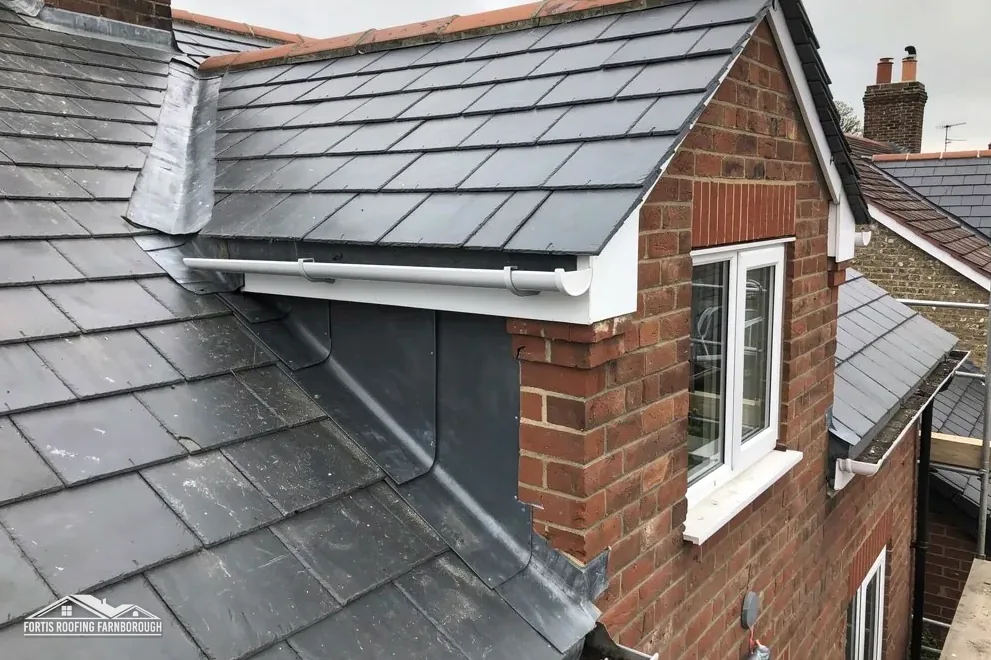
The flashing is the set of parts that seals the window into the covering. Our guide to roof window flashing kits explains what is in a kit. When it fails, it fails at the joins.
Common faults
- A kit that does not suit the covering, or was fitted from an older window.
- Overlaps made the wrong way round, so water runs under a piece.
- Sealant used where an overlap should be, which cracks with time.
- A head flashing set too shallow under the covering higher up.
- Slipped or cracked tiles beside the window, which let water behind the side flashings.
- Debris or moss lodged in the gutter above the window, forcing water sideways.
What a roofer checks
From outside, the roofer examines each flashing piece, the covering around it and the condition of the lining. They look at the top of the window, where water arrives most forcefully, and the corners, where the pieces meet.
The repair
If the flashing is sound but a tile has slipped or a gap has opened, a local fix may be enough. If the flashing is wrong, the covering is lifted, the flashing reset or the kit replaced, and the tiles relaid. Sealant used as a finish over a correct overlap is fine. Sealant used instead of an overlap is a short-term patch.
The window itself stays if its frame and glass are sound, and that is often the lower-cost route.
Condensation: a damp room, not a leaking roof
Condensation is the commonest false alarm. It looks like a leak, drips like a leak and stains like a leak, but its cause is humidity, not rain.
Why it forms
Warm, moist air from a kitchen, bathroom or sleeping room meets a cold surface, and the moisture drops out as water. A roof window is a cold surface by nature, since it is a thin pane exposed to the sky. A cold frame, or an edge with weak insulation, makes it worse.
What helps
- Extractor fans in bathrooms and kitchens, used during and after showers and cooking.
- Opening the window a little to let moist air out, or trickle ventilation.
- Keeping internal doors closed during steamy activity so that damp air does not drift to the loft.
- Avoiding drying washing in the room.
- A window with a lower U-value, which keeps the glass warmer. Our guide to roof window U-values and Part L explains the figures.
Roof space ventilation
Where the window sits in a roof, the loft's own ventilation matters as well. For a cold roof with an HR (non-breathable) underlay, Marley's BS 5250 guidance for that arrangement is an eaves opening of 25 mm for pitches of 15 degrees or less and 10 mm for steeper ones, and blocked eaves push damp air toward the cold parts of the roof.
When it is not just condensation
If the lining stains in a pattern that follows rain, or the timber around the frame is soft, the cause may be a leak that is being masked by condensation. A roofer can check both.
Seals, glass and the window itself
When the flashing is sound and the room is not damp, the window itself becomes the suspect.
Sash seals
The rubber or foam seals where the opening part meets the frame harden, shrink or tear with age and sun. A section that has pulled away leaves a gap. Seals can often be replaced without replacing the window, and the maker sells the correct parts for the series.
Sealed glazed unit
A modern roof window has a sealed double-glazed unit. If its edge seal fails, moisture enters the gap between the panes and shows as persistent misting that cannot be wiped away. The unit can sometimes be replaced alone, though on an older window the whole window is a better choice.
Frame and lining
A frame that has warped, a lining that has rotted or hardware that no longer closes the sash tightly can all let water or draughts in. Timber frames need paint or varnish to stay sound, and neglected ones can swell and rot at the corners.
Gutters and runoff above the window
A gutter that overflows above a roof window, or a valley that spills onto it, can drive water against the frame in volumes it was never designed for. Overflowing water can look like a leak in the window when the real fault is blocked drainage higher up the roof.
Wind-driven rain
Some windows leak only in a particular wind. That points to a gap in the seal or flashing on the exposed side. The leak may be small and slow, and is easy to miss until damp appears.
Age
An old window may be due for replacement even if no single fault is found. Our guide to replacing a Velux window explains the like-for-like route, which is the smaller job if the opening stays the same.
Repair or replace, and what to do meanwhile
The decision depends on the cause. A survey with photographs is the sensible first step.
Repair is sensible when
- The flashing is at fault and the window is sound.
- Only the seals need replacing.
- The cause is condensation, and the fix is ventilation.
- The window is fairly young and the frame is in good condition.
Replacement is sensible when
- The glazed unit has failed and the window is old.
- The frame is warped or rotten.
- The window does not meet current thermal standards and a replacement is wanted anyway.
- The roof is being re-covered, so the window and flashing can be done together.
Cost context
MyJobQuote's September 2026 guide shows a typical UK range of £1,100 for a mid-range Velux, with a straightforward swap around £100 lower. A flashing repair is the lower-cost route, which is why diagnosis comes first, and why a straightforward flashing fix is the cheaper outcome when it is the cause.
In the meantime
Put a bowl or towels under drips and move furniture. Take dated photographs of any damage. Tell your insurer if there is damage to the ceiling or contents, and keep receipts, though a gradual leak may fall under wear and tear. Do not try to reach the window from the roof, and do not seal it with mastic from a ladder.
Next step
Our roof windows and skylights service starts with a diagnosis, and a written price follows, with VAT stated.