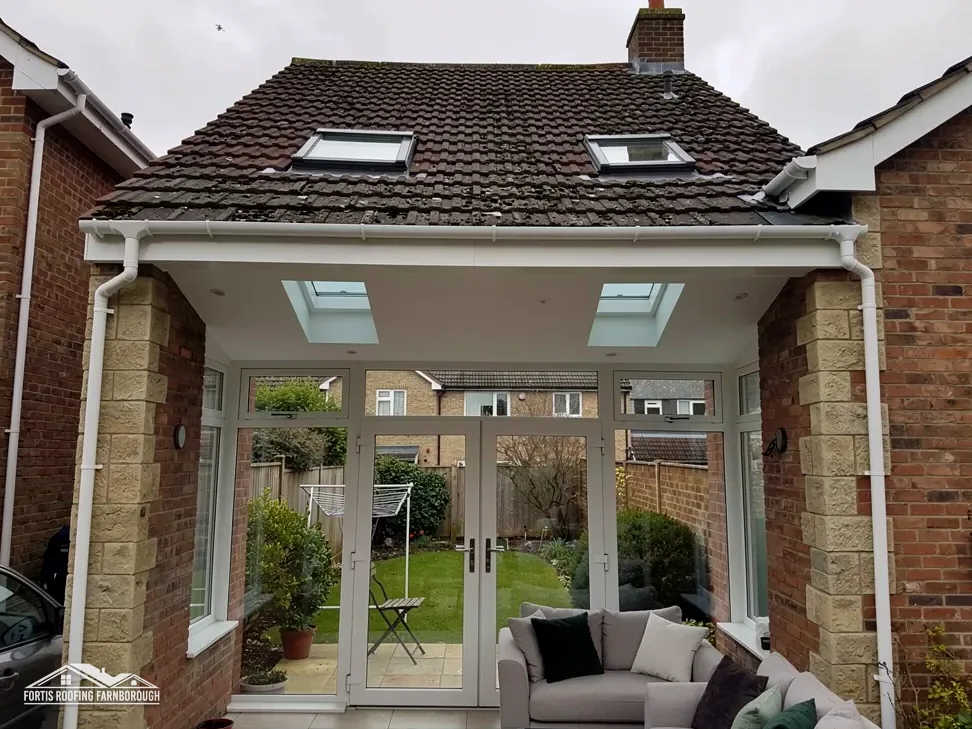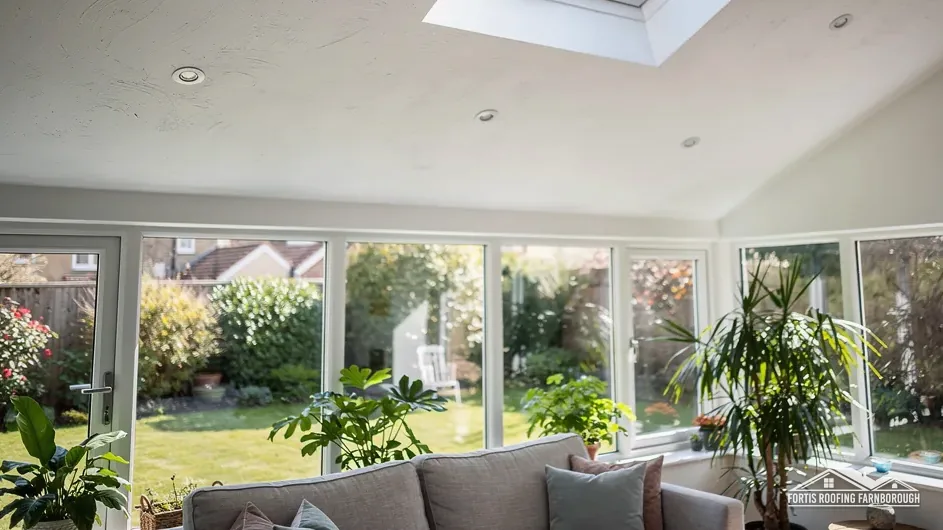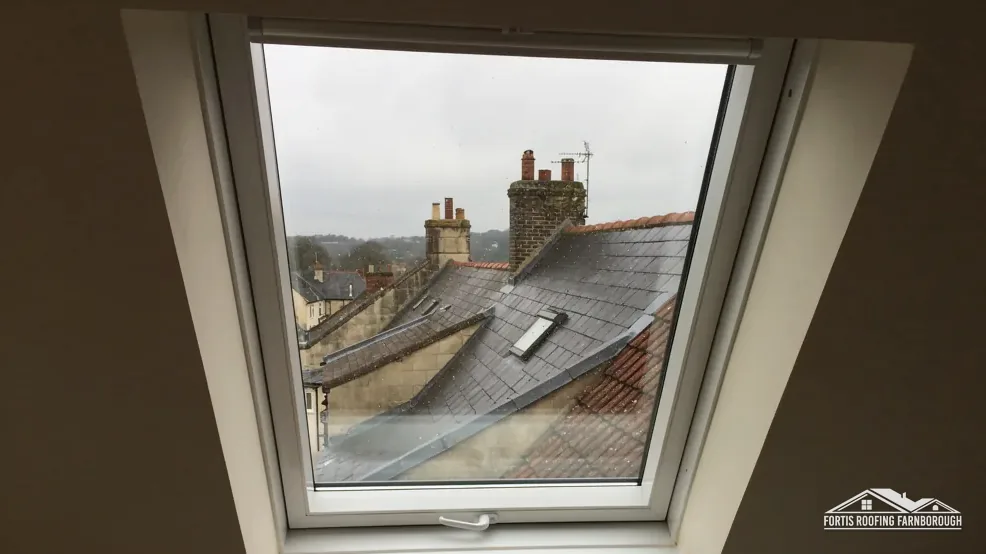
A roof window is glazing built into the sloping face of a pitched roof. The best-known brand in the UK is Velux, and its name is used for the whole category, though other makers supply them too. Most are opened by hand, with a bar at the top of the frame. An electric version is opened and closed by a motor, usually by a wall switch or a handheld remote, and some models have a sensor that shuts the window when rain starts.
The extras cost more than the manual version, and they bring electrical work. They are not right for every room. They can be a good choice for a window that is out of reach, over a stairwell, in a hard-to-reach loft or for someone who cannot easily stretch to a high bar.
This guide covers where an electric roof window helps, what the sensor does and does not do, whether you can fit one into an existing opening, how the thermal and planning rules apply, what national guides publish on cost, and what to ask before deciding, for homes in Farnborough and neighbouring areas.
What makes a roof window electric
The frame, glass and flashing of an electric roof window are much the same as a manual one. The difference is in the opening mechanism and the controls.
The motor
A small electric motor drives the sash open and closed. It may be powered from the mains or by a battery or solar charge, depending on the model. A mains version needs a cable run to the window, which is why electrical work is part of the job.
The controls
Control is usually by a wall-mounted switch or a handheld remote. Some systems link several windows or connect to a smart-home setup. The controls need a place to live and, in the case of a wall switch, a cable route that does not cut across finished walls.
Sensors
Some models include a rain sensor that closes the window when it detects water. It is a convenience for a window left open, and it does not replace judgement: it reacts to rain on the glass, not to a forecast, and it cannot close against an obstruction. A window left open in the dry can still have wind-blown rain reach the room before the sensor acts.
Manual override
A good system can be opened by hand if the power fails. Ask what happens in a power cut and whether the window can be closed manually, since a window stuck open during a storm is a problem.
Power cuts and fire safety
Ask the maker how the window behaves if the supply fails, and whether it can be closed or opened by hand. A window that has to work as an escape route has its own rules under Approved Document B, and a loft conversion needs that question settled early. Escape windows have set sizes, so raise the point early.
Same product, different mechanism
An electric roof window is the same weathertight window as a manual one in all other ways, and it sits in the same flashing kit. The flashing kit, which keeps the join to the covering watertight, is the same as for a manual window.
Where an electric window earns its keep
The question is whether the convenience is worth the cost for the room it is in. A few situations make it an easy yes.
Windows out of reach
A roof window set high on a steep slope, over a stairwell, above a landing or in a double-height space is hard to open by hand. A long pole is awkward, and standing on furniture is risky. A motor makes the window usable.
Ventilation in a busy room
In a kitchen, bathroom or bedroom, being able to open the window a little for air, and close it again from the bed or the doorway, is a daily help. The use is simple and regular.
Access needs
For someone with limited reach, strength or mobility, a remote or switch makes a window that would otherwise stay shut a working part of the house.
Several windows at once
A room with a row of roof windows, such as a loft conversion or a long landing, can be controlled together. That helps with summer ventilation, where opening all the windows lets warm air out.
Where it is less useful
A window within easy reach of the floor, in a room you rarely use, gains little from a motor. A manual window costs less, has nothing to fail and can be fitted in the same opening. Our guide to replacing a Velux window covers like-for-like swaps and new openings.
Think about who will use it and how often before choosing.
Retrofit or a new opening
Many owners ask whether they can swap a manual window for an electric one without a major job. Often they can, with a few checks.
Same opening
If the new window is the same size as the old and fits the existing opening, the work is a window and flashing replacement. The structure around the opening is already in place. What is new is the electrical supply or power source and the control.
Checks before you commit
- Whether the current frame is the same size and series as the replacement.
- Whether a cable can reach the window from the supply without a major chase.
- Whether the flashing kit suits your roof covering.
- Whether the room has a sensible place for a switch or whether a remote is better.
A new opening
Cutting a new opening in a roof is a bigger job. Rafters have to be cut and trimmed with a new header and trimmers to carry the load, the covering is opened and re-laid around the frame, and the opening is flashed. That is structural work, and it may need Building Regulations approval. A new opening in a roof slope is also a planning question in some cases.
Planning points
Class C permitted development takes in a house's roof alterations, and attaches a condition that any window in a side-facing roof slope is obscure-glazed. Flats have no permitted development rights, and listed buildings need consent as well. In a conservation area, check with your local planning authority.
Why survey first
The survey covers the roof structure, the covering and the route for the electrics, so the plan and the one written total reflect all of it.
Part L: the same U-value rules apply
An electric roof window is still a roof window, and Part L treats it as one. The motor makes no difference to the thermal requirement.
The figures
For new or replacement roof windows in an existing dwelling, Approved Document L (volume 1, 2021 edition with 2023 amendments) sets the target for a roof window as a U-value of 1.4 W/(m²·K), with Window Energy Rating Band B accepted as the alternative. Rooflights have a different figure, 2.2, and the two should not be confused. Under regulation 2(3) of the Building Regulations 2010, neither a roof window nor a rooflight is a thermal element, so the roof renovation rules sit apart from them.
Which edition applies
The 2021 edition took effect on 15 June 2022. A newer edition arrives on 24 March 2027 with renumbered tables, for work that is not higher-risk building work. Do not assume the later edition applies now.
Checking the product
The window's data sheet or label states its U-value or its energy rating. Ask for it and keep it with the paperwork. Our guide to roof window U-values and Part L sets the rules out in more detail.
Building control
Put the question to your building control body: in Farnborough that is the Hart and Rushmoor Building Control Partnership, on 01252 398715. Electrical work and structural alterations may also need attention.
Whichever route applies, a competent electrician should make the connection.
What roof windows cost, as published
Cost guides tend to price roof windows generally and not powered ones as a separate item, so the published figure below is for the window as a whole.
| Source | Job | Figure |
|---|---|---|
| MyJobQuote (Sep 2026) | Standard mid-range Velux window | £1,100 |
| MyJobQuote (Sep 2026) | Straightforward swap | around £100 less |
What the electric option adds
A motor, controls and the electrical work all add to the price of the window itself. The amount depends on the model, the supply route and the finish of any chasing and making good. It is a real addition to the bill, and the survey fixes how much for your window.
What moves the total
- The size and series of the window.
- Whether the opening is new or existing.
- The roof covering, which sets the flashing kit.
- The cable route and the cost of making good.
- Scaffold or access, and the internal finish.
One written total
You receive one price in writing after the survey, with VAT stated. If the job includes an electrician, the visit is arranged and the cost sits inside that total.
Long-term cost
Think about replacement parts and warranty terms for the motor and sensor. A manual window has fewer parts to fail, and a powered one can usually be operated by hand if needed. Ask what the maker's warranty covers.
Questions to ask before you buy
A short list of questions helps you compare electric windows with manual ones, and one supplier with another.
About the window
- What is the U-value or Window Energy Rating?
- Is it mains-powered or battery or solar, and what happens in a power cut?
- Is there a rain sensor, and how does it work?
- Can it be opened by hand, and how?
About the fitting
- Is the opening new or existing, and does the structure need altering?
- Which flashing kit goes with the roof covering?
- Where does the cable run, and how will the walls be made good?
- Does the job need Building Regulations or planning attention?
About leaks
Leaks around roof windows usually come from the flashing, not the window itself. Condensation and seals are other causes. Our guide to why a Velux window leaks sets out the usual diagnosis, which applies to powered windows as much as manual ones.
Fitting and finishing
The cable has to get from a supply to the window, and the route decides how much making good is needed inside. Behind plasterboard it can be simple. Through finished walls it can mean chasing and redecorating. We ask the electrician to look at the route at the survey, so the total reflects it.
Aftercare
Ask who maintains the motor and sensor, how a fault is reported and whether the window stays weathertight if the electrics fail.
Our view
If the window is hard to reach or the room needs frequent ventilation, electric is worth considering. If it is within reach, a manual window is simpler and cheaper. Our roof windows and skylights work starts with a survey of the roof and the room.