The short answer
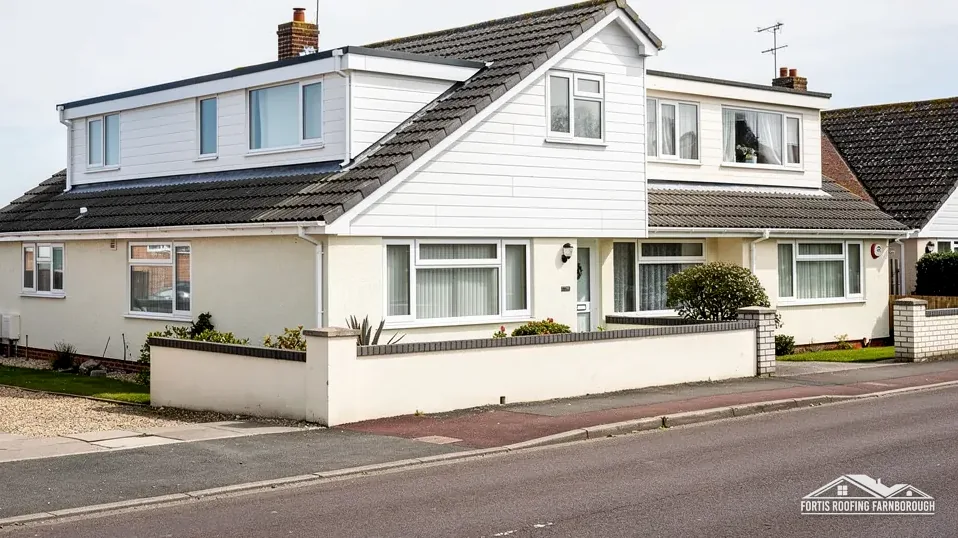
For a house, usually not. Planning law leaves out changes that leave the outside of a building looking the same, and Class C permitted development covers re-roofing a house even when the covering changes. Flats have no such rights. A listed house also needs listed building consent, and a local Article 4 direction can remove rights.
Two reasons a house re-roof is usually fine
There are two separate routes, and either may apply.
The first lies in what planning law counts as development. Under section 55 of the Town and Country Planning Act 1990, works that leave the external appearance of a building materially unchanged fall outside the definition. Swapping tiles for tiles that look the same is the plainest example, and no application arises.
The second is the General Permitted Development Order, which grants planning permission automatically for certain work. Class C of that order is the one for altering the roof of a house, and re-roofing is inside it. Putting a fresh covering on a house is therefore usually permitted development, even if the material looks different. The roof must not stand more than 0.15 metres proud of the original slope.
Class C has a condition for roof windows. Any window in a slope on a side elevation has to be obscure-glazed whatever its height. Separately, it may open only where its opening parts are more than 1.7 metres above the floor.
Notably, Class C does not exclude conservation areas or National Landscapes, so a house re-roof there is normally still permitted. The exception is a dormer, which our page on adding a dormer when re-roofing covers.
Flats, listed houses and religious buildings
Some buildings sit outside the simple picture.
A flat is the first. The permitted development rights above belong to a dwellinghouse, and the order's definition leaves out a block containing flats and a flat within one. Rushmoor's own guidance says the same for its area: flats need planning permission unless the job is a straight like-for-like swap that leaves the look unchanged.
A listed house is the second. The order contains no listed-building exclusion, so Class B and Class C still apply, yet works affecting the building's character also need listed building consent, under section 7 of the Planning (Listed Buildings and Conservation Areas) Act 1990. A roof is often a defining feature, so a change of material, pitch or detail can need consent. Our page on listed building roof replacement sets out the route.
Places of worship are the third. Church of England churches in use come under the faculty system. Farnborough's St Michael's Abbey is a Roman Catholic monastery, so its church uses that denomination's own process in place of council consent.
A scheduled monument needs its own scheduled monument consent.
If your building is any of these, ask before you order materials.
Where Article 4 changes the answer
An Article 4 direction is a local order that takes away chosen permitted development rights inside a set area. Where one reaches roofs, a job that normally needs nothing can need an application.
Published detail differs from council to council, and only some can be described. Rushmoor has two worth knowing: Cargate, in Aldershot, which reaches chimneys and flues, and Wellesley, which reaches antennas on a front slope. Hart made directions in 1998 for frontage roof slopes and chimneys within many of its conservation areas. Guildford's directions, where they apply, require permission to remove or alter a chimney. Basingstoke and Deane applies its directions in four town-centre areas, requiring planning permission for roof changes and expecting the original slate and clay roofs to stay as they are.
Everywhere else, the sensible step is to ask the council's planning team whether an Article 4 direction covers your address. Do not assume that the answer is no.
Planning is one regime, and Building Regulations are another. A re-roof that needs no planning permission can still need approval, for example if the new covering is 15 per cent or more heavier. Our page on heavier roof coverings explains that test.
Each of our area pages names the local planning authority.
What we check on your behalf
The first questions at the survey are about the building: is it a house or a flat, is it listed, and does it sit in a conservation area or other designated land? We then look at your council's published page and tell you what it says.
For an ordinary house, the answer is usually that Class C covers the job. We flag anything that moves it into Building Regulations territory, such as a much heavier covering.
For a flat, a listed property or an address under an Article 4 direction, we say plainly that an application or consent may be needed and who decides it. Making the application is for you or your designer, though we provide photographs and written descriptions of the roof to go with it.
Where a consent is needed, the quote treats it as its own step with a likely effect on the dates, and the work does not begin until the position is settled. Pricing is one written total.
The roof replacement hub explains the full sequence of a new roof. A short call to your planning team settles any doubt.