The short answer
It turns on the roof's dimensions and complexity, the covering, the weather and what the strip-out uncovers. The work follows a set order, from access to sign-off, and some steps cannot start until others finish. A scaffold licence adds waiting time before work begins if the scaffold sits on the road or pavement. A date is fixed only after the survey.
The usual sequence
A re-roof follows a logical order. Each stage relies on the one before it, so adding people does not hurry the whole.
- Survey and quote: the roof is measured and photographed, the covering and structure are examined and the price is agreed in writing.
- Booking and notice: materials are ordered, and any scaffold licence is applied for, with its waiting period.
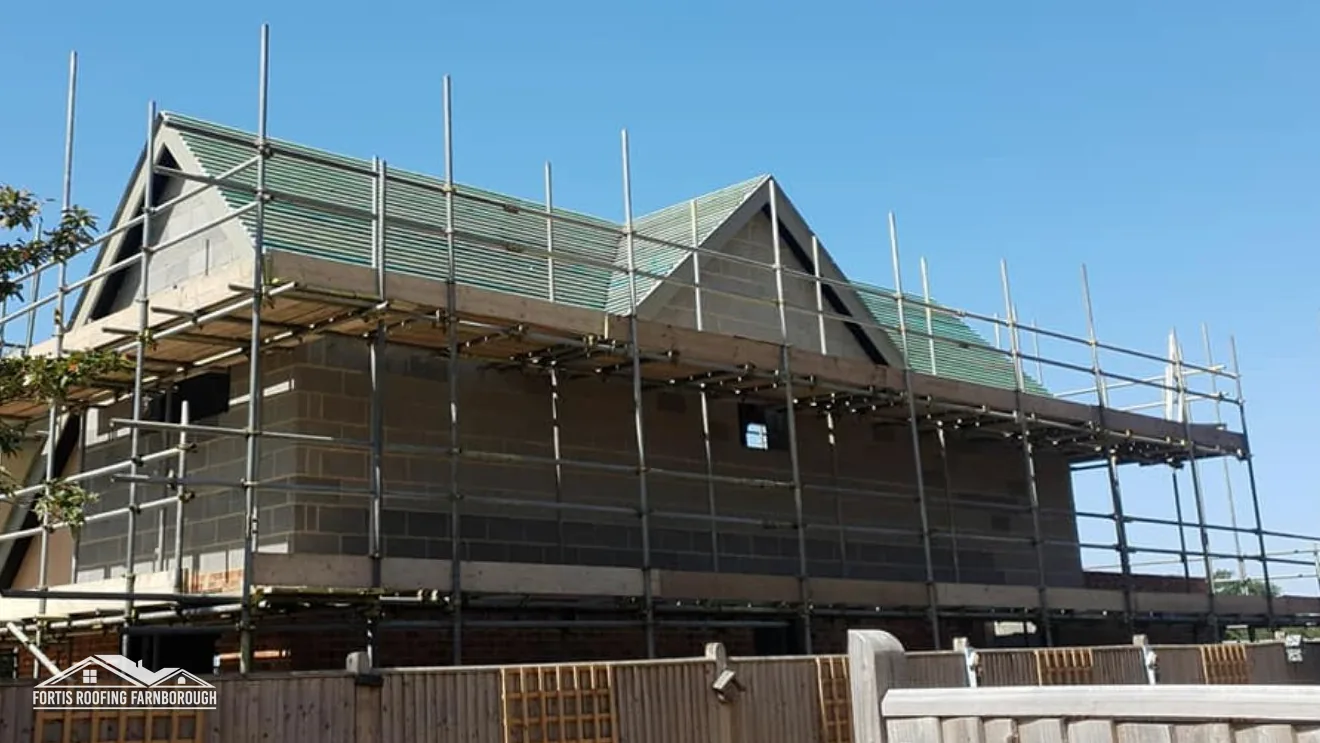
- Access: scaffold goes up, with edge protection and a safe way on and off.
- Strip-out: old tiles, battens and underlay come off, usually slope by slope, with the open area sheeted over each evening.
- Inspection of what is exposed: rafters, wall plates and ridge are checked for rot or damage.
- Repairs to timbers, if needed.
- New underlay, battens and covering, with flashings, ridge, hips and verges.
- Gutter work if included, clean-up, removal of waste and scaffold down.
- Final check and, where Building Regulations apply, sign-off by building control.
Several of these can overlap in practice, but the order of strip, check, repair and cover cannot be changed. The roof is opened in sections, so the house is exposed to the weather for as short a time as possible.
Our page on a new roof, step by step describes each stage in more detail.
What stretches it
Four things most often change the length of a re-roof.
The first is size and complexity. A large roof with several slopes, hips, valleys, dormers and chimneys takes longer than a plain gable of the same area, since each junction needs its own flashing and cutting.
The second is the covering. Slate and clay are laid piece by piece and take longer than large interlocking tiles. A reroof that includes new lead, new insulation or roof windows adds stages.
The third is the weather. Work stops in rain, high wind and frost, and a roof is never left exposed overnight. Met Office averages for South Farnborough (1991 to 2020) include about 118 wet days a year, so delays from weather are a normal part of the job, and an allowance is sensible.
The fourth is what stripping reveals. Rotten battens, decayed rafters, a failed wall plate or hidden damage can only be seen once the old covering is off, and repairs take time. Asbestos in soffits or sheeting, if found, changes the plan altogether. Our page on replacing roof timbers covers the timber side.
Access can add delay too, where a narrow site or neighbouring buildings slow the movement of materials.
Scaffold licences and notice periods
A scaffold that spans a pavement or carriageway needs the highway authority's licence, and authorities ask for notice before the start. The waiting time goes into the plan, and the highway side of the job cannot begin until the licence arrives.
Hampshire County Council, the highway authority for Rushmoor and Hart, wants ten full working days of notice before the planned start, and its scaffolding companies must apply on customers' behalf. Surrey County Council, until 31 March 2027, wants applications at least 10 working days ahead. Wokingham Borough Council also asks for at least 10 working days.
Where a council does not publish a notice period, ask the scaffolder who applies and how long the licence takes.
No licence is needed for scaffold standing entirely on private land, so a garden-only structure carries no such wait.
The licence period itself has a cost and a limit, and a long job may need the licence extended or renewed. Our page on scaffolding for a new roof covers that side.
Allow for this wait when you plan around a sale, a holiday or a family event.
What we can and cannot promise
We give a timetable after the survey, not before. By then we have measured the roof, identified the covering, looked at the structure and know whether a scaffold licence is needed.
The timetable is a plan with allowances, and weather and hidden damage can move it. We say what the likely stages are and what could change them, and we tell you early if something does.
The roof is left safe every evening. If rain is due, the open slope is covered, and you are told what each day involves, so there are no surprises on your side of the front door. Day-by-day updates are part of how the site is run, whatever the weather brings.
The single written total does not move because the weather does. If rotten timber is found, you see the photographs and agree the repair before it is done.
For the work itself, access and notice are the parts you can help with: tell us about narrow gates, parking and any dates that matter, and clear the loft and the area below the eaves in good time.
The roof replacement hub explains the full process.