The short answer
Verge tiles are the outer row on a gable end, and they loosen because the mortar that beds them cracks and shrinks while little else holds them. A loose one can drop without warning. The cure is to re-bed them with proper fixings, or to fit a dry verge system.
Why mortar verges fail
On a gable roof the tiles at the sloping end are laid slightly over the gable wall so that water drips clear of the brickwork. Along that edge, the tiles are often bedded in a ribbon of mortar, with the mortar also filling the gap between the tile ends and the wall. It is the only thing holding some of them.
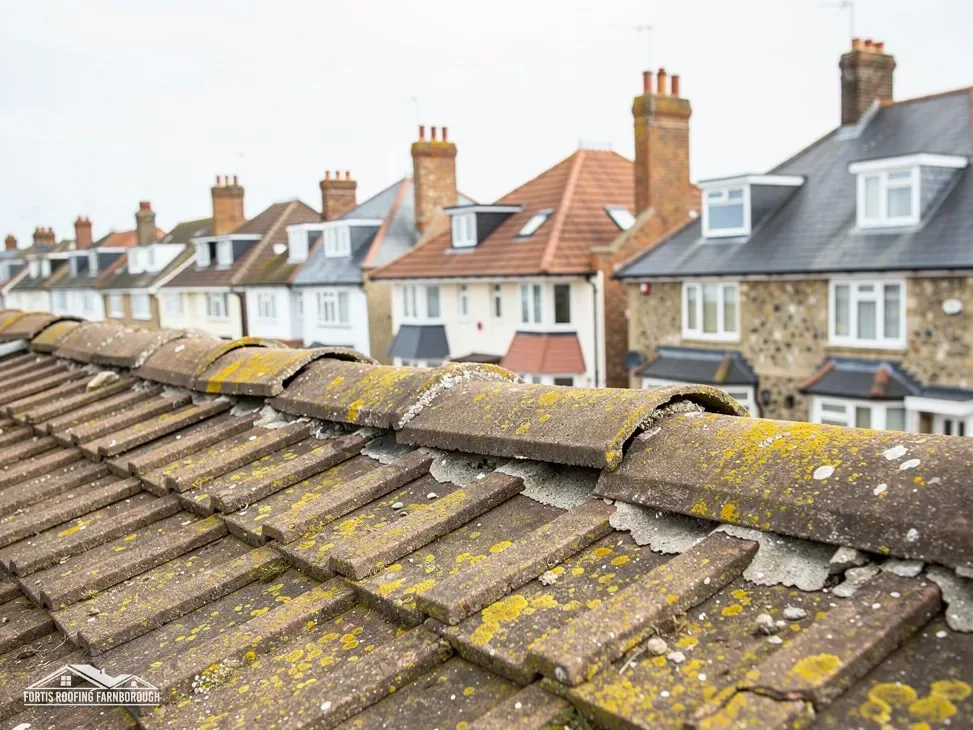
Mortar is rigid and tiles are not. Over the years the bedding dries out, shrinks, cracks and lets go, helped by frost and by the movement of a roof that heats and cools each day. Water gets into the cracks, freezes and pushes the pieces apart. Met Office averages for South Farnborough (1991 to 2020) include around 53 air-frost days, so the cycle repeats often.
The edge is also where air is forced up and over the roof, and a tile held only by a crumbling bed has little to resist that pull.
The signs are visible from the ground. Look for gaps along the mortar, tiles leaning out from the gable, crumbs of mortar on the ground below and daylight under a tile. Our page on hip versus gable roofs explains where the verge sits on the roof.
Mechanical fixing and what the standard says
Modern practice does not leave a verge tile to mortar alone. BS 5534, currently BS 5534:2014+A2:2018, is the slating and tiling standard that calls for mechanical fixing at roof edges. As Marley notes, working to it is not a legal duty, yet careful roofers follow it.
For verges, the traditional repair is to lift the loose tiles, clear the old bedding and re-lay them with fresh mortar plus a clip or a screw into the batten, so that each tile is held by metal as well as by the bed. Mortar is still allowed. It is simply not left to carry the load.
The test specification for dry-fixed verge, hip and ridge systems is BS 8612:2018. A system tested to it holds the edge tiles by mechanical means, with no mortar bed to fail.
Any repair has to look at the underlying structure too. A verge can loosen because the bargeboard, the rafter end or the wall plate beneath has moved or rotted. If the problem is below the tiles, the tiles will come loose again, however well they are re-bedded.
The timbers and the pointing against the wall get checked and recorded.
Dry verge as the lasting fix
A dry verge swaps the mortar for a purpose-made unit. A plastic or aluminium trim runs along the edge, clipped or screwed to the roof, with the end tiles fixed to it mechanically and a cap or end piece that covers the joint between tile and wall. Because there is no wet mortar, there is nothing to crack, and no cure time to wait for.
Where a verge has failed along most of its length, fitting a dry system is often the better value than re-bedding every tile, since the labour for either is similar and the dry system should not need doing again for the same reason. Our page on dry verge installation explains how the system goes on.
MyJobQuote (Oct 2026) says a dry verge system usually falls between £500 and £2,000. That is a typical UK range from a cost guide, not our price. Length, access and the condition of what lies beneath all move it.
It is not the answer on every roof. The system has to suit the tile and the pitch, and a gable edge that has rotted needs carpentry first. A mixed approach is possible: dry-fit where the edge is long and plain, re-bed where the run is short.
Mortar remains a valid choice where a conservation area makes the look the priority.
Why it is urgent, and what we do
A loose verge tile is not just a leak risk. It is a falling-object risk. Tiles at the edge of a gable are above paths, driveways and gardens, and one that comes away in a gust can hit someone or something. Keep clear of the area below, and photograph the verge from a safe spot if you can.
If a tile is already loose, we make the area safe first, by removing or securing the worst of it, then return to carry out the lasting repair. A temporary fix does not replace a proper one.
Storm damage is a common trigger. If your policy covers storms, the insurer should hear first, and photographs and receipts for any temporary work are worth keeping. The Financial Ombudsman Service looks to your policy's own storm definition, so read yours.
The survey covers the whole verge, the wall junction and the bargeboard, with photographs explained in plain words, and the repair we recommend fits what they show.
You receive one total in writing for it. Other edge and tile repairs are listed on the pitched roofing hub.