The short answer
Plain tiles are small, flat and laid in overlapping courses, so a roof holds hundreds of them. Interlocking tiles are larger and have side grooves that lock into their neighbours, so fewer cover the same area. The two have different minimum pitches: Marley's plain concrete tile needs 35 degrees, while its interlocking Edgemere needs 17.5. The right choice follows the roof and the look.
How each is laid
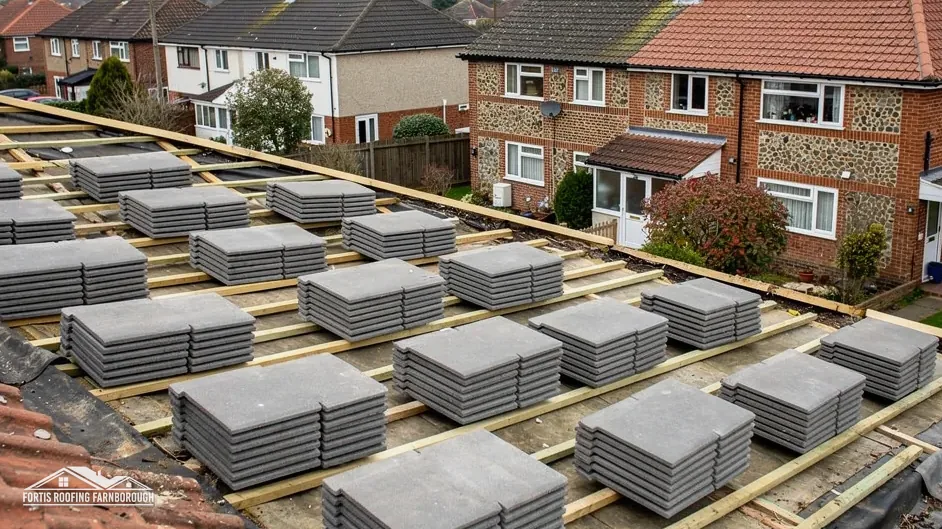
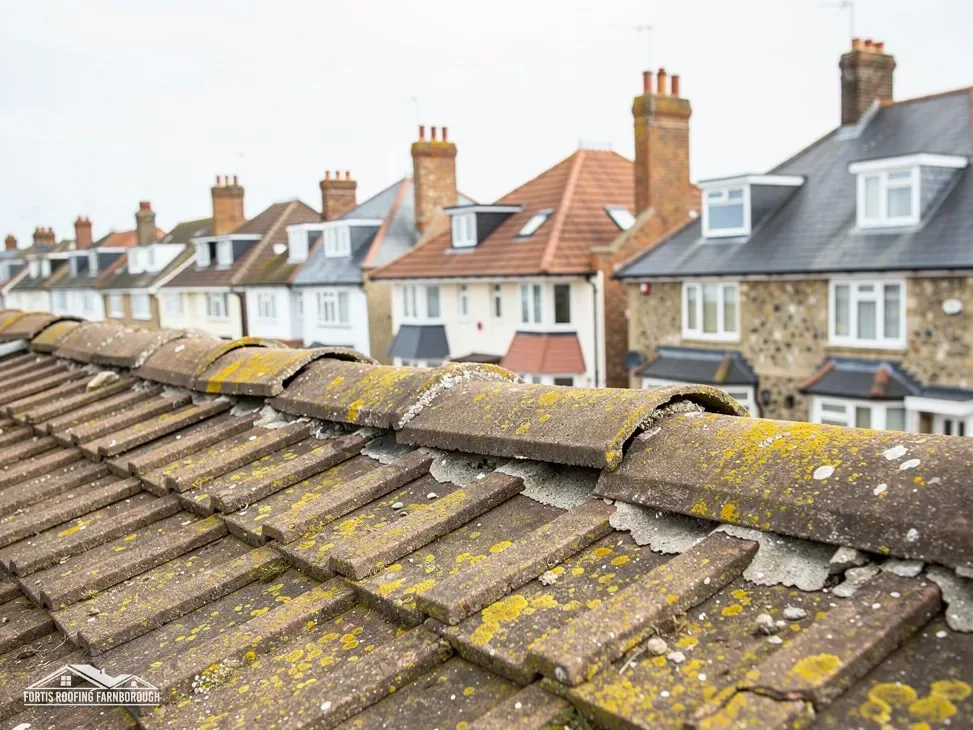
A plain tile is a small rectangle, usually slightly curved across its width. It is hung on timber battens by nibs at its top edge and held with nails, and each course overlaps the course below by more than half its length. Water has to pass over two or three thicknesses of tile before it could reach the underlay, so the roof sheds water through its many overlaps.
An interlocking tile is much larger and carries a rebate or groove along each side that locks into the tile next to it. The lock forms a barrier against water getting sideways, so the overlap at the head of the tile can be much smaller. A given area needs far fewer tiles, and the roof goes up faster.
Double Roman, Edgemere, Ludlow and Wessex are well-known interlocking profiles from Marley. The pantile, a wave-shaped clay tile, locks along its sides in a similar way.
Both families can be made in clay or concrete. A plain tile may be clay or concrete, and so may an interlocking one. So the question is less about material than about form: many small tiles overlapping, or fewer large ones locked side to side.
The shape also decides how the edges are finished. The hips and verges that finish the roof edge follow the same logic.
Minimum pitches
Pitch is the slope of the roof, measured in degrees, and each tile has a minimum below which water can be driven or creep under it. Marley's data lists the figures by product, and they differ widely.
- Plain concrete tile: 35 degrees.
- Edgemere: 17.5 degrees.
- Modern-Duo: 17.5 degrees for the smooth version.
- Double Roman: 22.5 degrees for the smooth version.
- Ludlow Plus: 22.5 degrees.
- Wessex: 15 degrees.
- Mendip: 15 degrees, smooth; the Mendip 12.5 reaches 12.5.
The pattern is clear: interlocking tiles generally allow lower slopes than a plain tile, because the lock and the deeper profile block water. A shallow roof over a porch or extension often points to an interlocking tile for that reason.
These are one maker's figures. Other makers publish their own, and the sheet for the specific product is the one to trust. Pitch must be measured on the roof, not guessed from the ground.
Our page on the minimum pitch for roof tiles sets out the clay figures too.
Weight and appearance
Appearance differs most. A roof of small plain tiles has a fine, textured look, with narrow courses and a surface that reads as many small units. It suits period houses, and it is common wherever the character of the area calls for it. An interlocking roof has larger, bolder lines, with the profile of each tile showing in shadow.
Weight depends on the product, and data sheets give the figure in kilograms per square metre. A roof that has been plain-tiled in clay is not the same weight as one re-covered in interlocking concrete, and a change of tile that raises the weight of the covering by 15 per cent or more brings in Building Regulations approval and a structural check.
Our page on changing to a different roof tile explains that test.
Lifespan is another published difference. HomeBuilding & Renovating (Sep 2025) lists clay at 60 to 80 years, plain concrete at 40 to 50, and Double Roman at 40 to 50. Marley puts concrete tiles at around 60 and says that is no assurance for any particular roof.
If your house is in a conservation area, or is listed, the look of the tile may be a consent matter. Your council can say whether an Article 4 direction applies.
What it means for repairs
Repairs depend on the form. A broken plain tile is lifted by raising its neighbours slightly and sliding it out, and a new one is nailed or clipped in. It is a small job, provided you can find a matching tile, which is the harder part on an old roof. Our page on how to match roof tiles for a repair explains.
An interlocking tile is held by its neighbours, so removing one means unlocking the tile above and beside it. It is quick once you know how, but a careless job can crack the next tile along. Large tiles also leave a visible gap if the replacement is a different profile.
Profiles are discontinued from time to time, and an interlocking tile that is no longer made is hard to match. A repair then may use a close profile from the same family or a reclaimed tile.
The survey identifies the tile, measures the pitch and photographs the damage. If a repair will serve, we quote for it. If the tile is obsolete and the slope is failing, re-covering the whole slope may be wiser.
The written price is a single total. The pitched roofing hub explains the rest of our work on tiled roofs near Farnborough and Fleet.