The short answer
Loose hip tiles are usually a failed mortar bed. A hip is the angled line running down an outward corner of the roof, capped by a row of tiles, and the mortar under those tiles cracks and crumbles with age. Repair means lifting them, clearing the old bedding and re-bedding them with mechanical fixings, or fitting a dry-fix hip system built to BS 8612.
What a hip is and why the tiles loosen
On a roof that slopes down on all sides, each outward corner carries a hip, a ridge-like line that runs from the summit to the eaves. Hip tiles, shaped to straddle the angle, sit in a row over the seam between the two slopes and keep the water out.
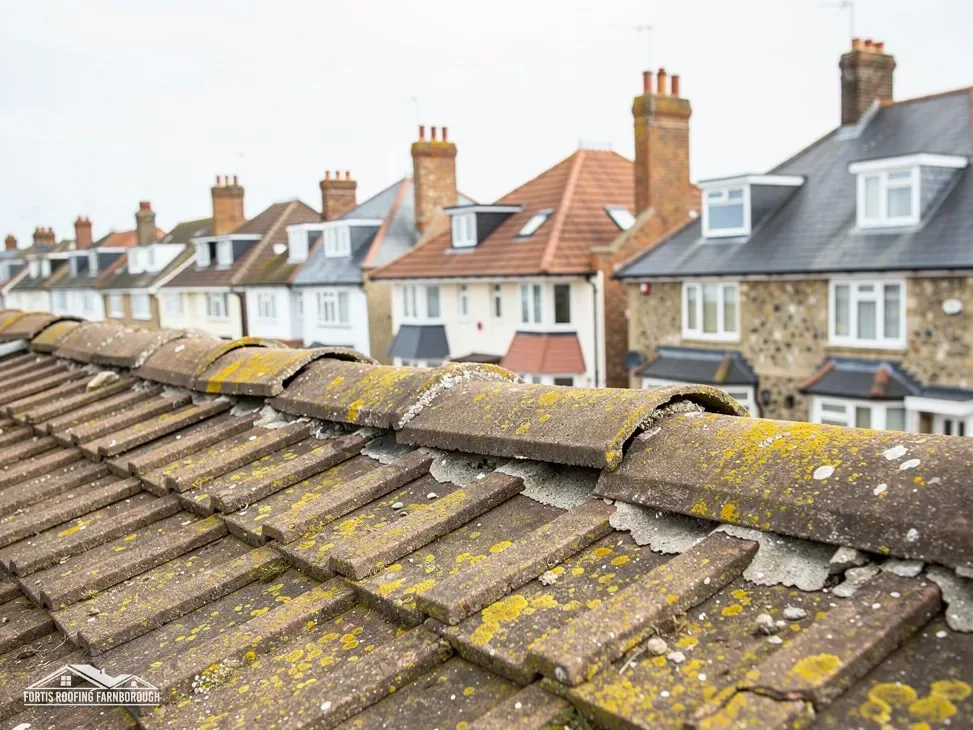
Traditionally those tiles are bedded in mortar. The mortar fills the gap beneath them, holds them in position and seals the joint. It is exposed to rain, frost and sun, and it shrinks, cracks and crumbles with age. Once it goes, the tiles lose their grip and begin to rock, slip or tilt.
The problem has a mechanical side as well. Hip tiles sit on a steep slope with gravity pulling them down, and at the bottom end a single tile called the hip starter or end tile carries part of the weight of the row. If its bedding fails, the whole run can creep.
Marley's reading of the 2014 revision of BS 5534 is that the old assumption, a mortar bed doing all the holding, no longer stands for hips and ridges. That is why present-day practice adds metal fixings to the mortar or does without the mortar.
Re-bedding with fixings
The traditional repair keeps the mortar but strengthens it. The loose hip tiles are lifted off, starting from the top, and the old bedding is chipped away until a sound base remains. The tiles are then re-laid on fresh mortar, and each one is also held by a mechanical fixing, such as a stainless steel screw, a nail or a clip, as BS 5534 recommends.
The code of practice is BS 5534, currently BS 5534:2014+A2:2018. It is not the law, as Marley points out, but it is the standard careful roofers work to.
Mortar is not banned. It is not relied on alone. The result is a hip that has two lines of defence, the bed and the fixing, and it should hold even if the mortar eventually weathers.
The bottom tile is dealt with first, since it carries part of the load of the row above it. If the end tile is loose, nothing above it is secure, so it is fixed firmly before the rest are re-laid. Our page on hip versus gable roofs covers the shape of the roof and why hips have more to maintain.
Dry-fix hip systems
A dry-fix system dispenses with the wet mortar. Hip tiles are held by a mechanical frame or clips fixed to the roof, with a trim or filler along the joint to keep out wind and weather. Nothing in it can crack as mortar does, and fitting does not wait on anything setting.
BS 8612:2018 is the test standard for dry-fixed systems at the verge, hip and ridge of tiled and slated roofs. If you choose one, ask which system it is and whether it has been tested to that standard.
Dry-fix is not automatically better. It suits tiles in good order and the pitch matches the system's data sheet, and it is a poor choice if the tiles are brittle or the hip line is irregular. Each maker's system works with certain tile families.
On a mortar-bedded hip that has failed in places, a mixed repair is also possible: re-bed sound lengths with fixings and use dry-fix parts where the old bedding is beyond saving. Our page on dry ridge versus mortar weighs the two approaches, and its points apply to hips as well.
We look at the tiles, the pitch and the access before suggesting either.
Costs and what we do
Cost guides cover ridge work more often than hip work, but the ranges give an idea. Which? (Nov 2025) quotes £80 to £300 for a new ridge tile, excluding VAT. MyJobQuote (Oct 2026) says ridge tile replacement falls between £225 and £550. Both are typical UK ranges, and a long hip with poor access costs more than a short one with a ladder at the eaves. Our page on ridge tile repair cost goes through the figures.
First we photograph the hips from a ladder or with a camera, check how many tiles are loose and whether the mortar has failed along the whole run or in one place. You see what we found.
A short stretch of failed bedding can be repaired. A hip that has loosened over its whole length is better re-laid or fitted with a dry system, and we tell you which, with the reasons.
If a tile is about to fall, we make the area safe first. You receive a single written total, and the waste goes with us. The pitched roofing hub covers the other repairs we handle across Farnborough, Aldershot and Fleet.