The short answer
A lead valley is a channel of lead sheet laid in the angle where two roof slopes meet, with the tiles or slates lapped over its edges. A dry valley is a ready-made trough, often plastic, fixed in the same angle without mortar or lead. Royston lists Codes 4 to 8 for pitched valley gutters. Lead is the hand-made option, and a dry valley is the factory-made alternative.
Lead in the valley angle
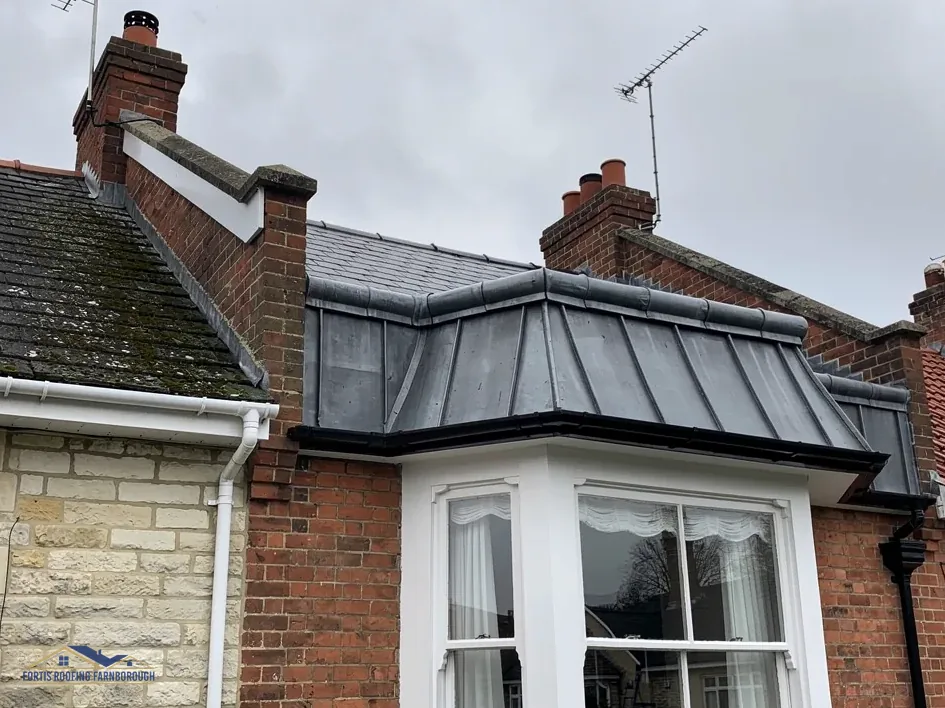
In the angle between two sloping roofs a valley gutter takes the water from both. A lead valley is formed from sheet laid on boards in that angle, running downhill from the ridge to the eaves, each length overlapping the one below. Tiles or slates on either side are trimmed along the valley and lapped over the lead's edges, so a narrow channel of metal shows between them.
Royston Lead's cast-lead brochure lists pitched valley gutters as use C, against Codes 4, 5, 6, 7 and 8. That is a wide choice, and the roofer picks by length and by the area of roof draining into it. A long valley receiving two large slopes carries a lot of water and suits a heavier code than a short one.
The lead goes down in lengths with overlaps, not one long sheet, and clips hold its edges so the metal can slide as it warms and cools. That freedom to move is how it avoids splitting.
The result is a valley that can be reshaped, patched and repaired, and it suits most pitched coverings. Our page on how thick roofing lead is lists the codes in full.
How a dry valley works
A dry valley is a factory-made system. Instead of lead laid by hand, a preformed trough runs down the angle, usually in plastic, with a raised edge on each side. The tiles are trimmed to meet its edges and sit on it, with no mortar bedding along the line.
"Dry" means no wet mortar, the same idea as dry-fix ridge and verge systems. Mortar can crack and drop out, and a dry system takes that weak point away from the valley edge. Elsewhere on the roof mortar is not banned, though Marley points out that mortar strength alone is no longer counted on for the hip and ridge course.
A dry valley is not automatically the better product. BS 8612, the test specification for dry-fix systems, names verge, hip and ridge, and valley troughs sit outside that list. Check the manufacturer's data sheet for the pitch range and the tiles a system is approved for, since an unsuitable match is the usual cause of trouble.
A dry valley is a reasonable answer where a plain valley needs new work. It has a more uniform look than hand-dressed lead, where each fold is made on site.
Which suits your roof
Neither is right everywhere. Some points help to decide.
- Lead suits roofs where the valley has a complicated line, such as a valley that meets a dormer or changes angle, because sheet can be shaped on site.
- A dry valley suits a plain, regular valley between two similar slopes, where a standard trough fits the angle.
- An older roof, especially a listed or conservation-area home, may call for lead to match what was there.
- Where a valley has to be replaced as part of a re-roof, the existing lead may be reused or renewed, as covered in our page on whether leadwork is part of a re-roof.
The roofer's survey sorts out the choice. We look at the valley's length and angle, the coverings on either side, what the valley is built on and whether its boards are sound.
If the covering is a type that a dry valley maker does not approve, lead is the safer option. If the roof is plain and regular, a dry valley may do the job well, and the survey will show which of the two you have.
Cost and what we recommend
MyJobQuote (Sept 2026) gives around £540 for replacing a whole roof valley. It is a published national figure, not our price, and it moves with the material, the length and the access. Our blog post on replacing a lead valley goes through what moves the price.
Scaffold is a common reason a valley costs more than expected, because working at the roof edge needs safe access. Check whether any quote includes the scaffold and VAT, and whether new boards are covered should the old ones prove rotten, since rot can show once the old lead is lifted and it changes the work.
First comes the survey, with photographs of the valley, its boards and the lead or trough already there, plus a measure of its length. If the existing lead is sound and only a joint has failed, a repair costs less than starting again, and you hear that first.
You get one written total price covering the work we recommend. We work across Farnborough, Fleet and Camberley, and the lead roofing hub lists the rest of our leadwork details.