The short answer
Published figures differ. HomeBuilding gives EPDM a typical life of 25-30 years, while Less gives 30 to 50 years. The two numbers are typical ranges rather than promises, since the real life depends on installation quality, drainage, exposure and care. Laid as a single sheet over a flat roof, the rubber has few joins to fail.
What the two sources say
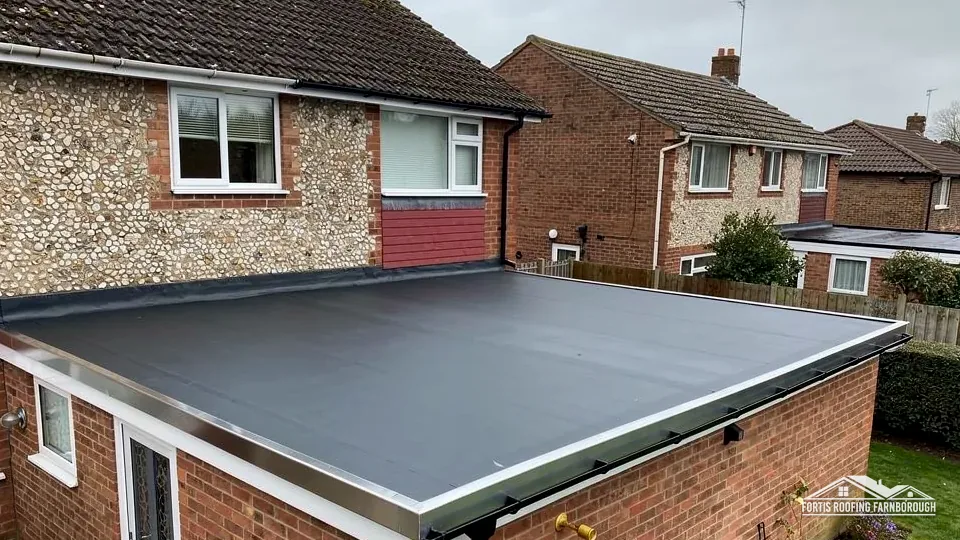
The name EPDM abbreviates ethylene propylene diene monomer; the material is a synthetic rubber supplied in broad sheets and bonded to the deck. It is used on garages, extensions, dormer roofs and larger flat roofs, and it has a reputation for toughness.
HomeBuilding & Renovating, in its supply-only table updated on 30 September 2025, gives EPDM a typical life of 25-30 years. Less, in its flat roof cost guide updated on 27 October 2026, gives 30 to 50 years. The two ranges meet only at 30 years, so the sources disagree, and both figures are given here by name.
The fair reading is that EPDM often lasts a long time, and that the range is wide. Neither source is a guarantee, and a warranty on a product or an installation is a different thing from a lifespan.
To put the figures against other coverings in the same sources, HomeBuilding gives felt 10-15 years, GRP 25-30 years and lead 60-100 years, while Less gives felt 10 to 20 years and GRP 25 to 40 years. EPDM sits at the upper end for a non-metal single-layer covering.
Treat the lower figure as a planning minimum and the higher as a good outcome. A roof that reaches 30 years has done what both sources expect.
Why the figures differ
Lifespan guides are not measurements of identical roofs. They draw on different sources, different assumptions and different definitions of failure. One may count the point at which a membrane first needs significant repair, another the point at which it is replaced.
Quality of work has a large effect. Rubber sheeting relies on the deck below it, the adhesive, the seams, the details at upstands and outlets, and the care taken at corners. A roof laid on a damp or uneven deck, or with poorly sealed edges, may fail early whatever the material.
Environment matters. Exposure to sun, ponding water, foot traffic, falling debris and neighbouring trees all age a membrane. A roof that drains well and stays clean does better than one that holds water.
Maintenance counts. Clearing outlets, checking seams and flashings, and fixing small damage promptly extend life. A roof that is never looked at tends to fail at an edge or penetration that a quick repair would have saved.
The thickness and grade of the membrane also vary between products, and a thicker sheet from a reputable manufacturer generally costs more and lasts longer.
Getting the most from an EPDM roof
Good drainage comes first. A roof designed for a 1:40 fall and finished to at least 1:80 under BS 6229:2025 should shed water without ponding. Standing water is not always a fault with EPDM, but long-term ponds near seams and edges raise the risk.
Inspect the roof twice a year and after storms. Look at the seams, the edges where the membrane turns up a wall, the outlets and any penetrations such as pipes and rooflights. A lifted edge or a split at a corner is a small repair when found early.
Keep it clean. Remove leaves, silt and moss from the surface and the outlets by hand, and avoid sharp tools that could cut the membrane. Walking should be limited to what the roof is designed for, with walkway pads where access is needed. Our page on walking on a flat roof covers this.
Costs give context. MyJobQuote lists EPDM at around £60 per square metre and an average rubber roof at around £1,050 (MyJobQuote, Oct 2026), both typical UK figures. Access, size and deck repairs push the price up, and our quote follows the survey as one written total.
A well-built, well-maintained EPDM roof gives long service for its cost.
Repair or replace an ageing EPDM roof
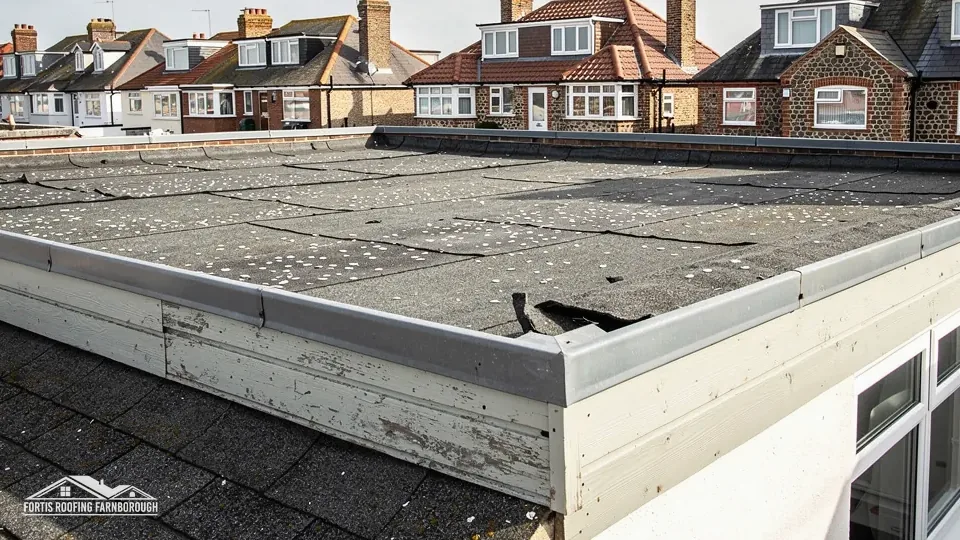
Years alone do not settle it. An EPDM roof at 25 years can still be sound, and one at 12 can be failing if the installation was poor. The evidence in the membrane and the seams is what counts.
Small splits, lifted seams, damaged upstands and failed sealant around a penetration can usually be repaired locally, and EPDM repair kits and patches are made for the purpose. If the membrane is sound elsewhere, a repair is the better buy.
Replacement becomes the right answer when the membrane is hardened, cracked or crazed across large areas, when seams are failing widely, when the deck is wet or rotten, or when repairs are recurring in different places. At that point patching chases the problem around the roof.
On the survey we inspect the whole membrane, photograph defects, test seams and check the deck and falls where we can. The findings come in plain words, along with the route we recommend. Our page on whether a flat roof can be patch repaired sets out the signs that a patch will not last.
The flat roofing hub covers all the coverings we work with.