The short answer
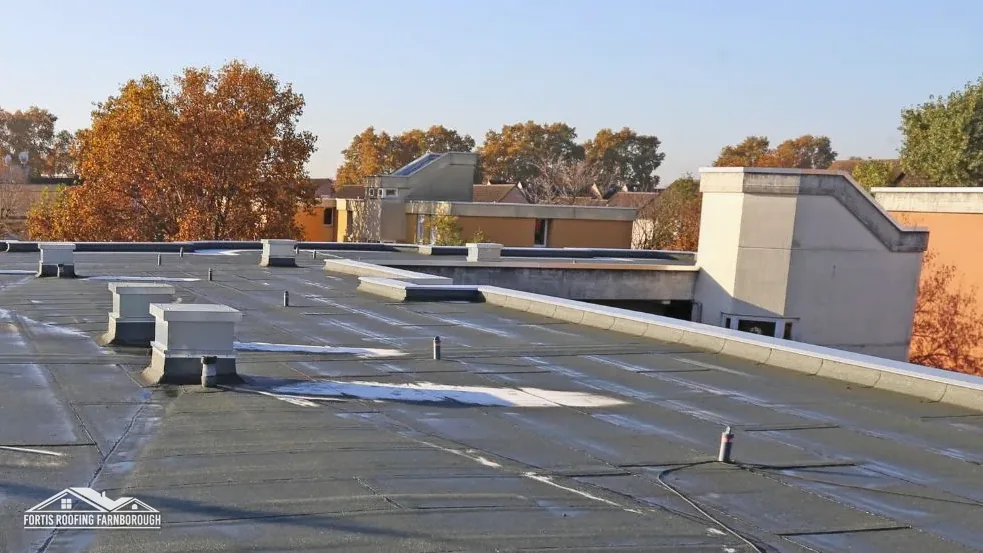
PVC and TPO are both single-ply roofing membranes: flexible sheets, welded at the seams with hot air, laid over insulation on a flat or shallow roof. PVC is polyvinyl chloride, and TPO is thermoplastic polyolefin, a different plastic. In general terms they install and repair in similar ways. Both need good falls, and the choice turns on the detail, the substrate and the system maker.
What the two membranes are
A single-ply membrane is a factory-made sheet of waterproof plastic, usually 1 to 2 millimetres thick, that forms the whole waterproof layer of a roof in one thickness. It is the opposite of built-up felt, where several layers are bonded on site. Rolls are unrolled over the insulation, fixed or bonded, and joined at the edges to make a continuous surface.
PVC is polyvinyl chloride, a plastic that has been used in roofing for decades. It is formulated with plasticisers to keep it flexible, and sheets often carry a reinforcing layer of polyester or glass fibre. TPO is thermoplastic polyolefin, a newer family of polymers that is also flexible and heat-weldable, and which does not rely on the same plasticisers.
Both are thermoplastics. That means they soften when heated, and two sheets can be fused together with hot air to form a joint that is, in effect, a single piece of plastic. This is the feature that sets them apart from adhesive-jointed systems and from rubber membranes such as EPDM, which are glued or taped at the seams.
Our guide to single-ply roofing explains the family of systems in more detail.
How they compare in general terms
The differences between PVC and TPO are narrower than the sales material suggests, and they vary between manufacturers. Anyone who offers a simple ranking should be asked for the data sheet behind it.
Installation is similar. Both are laid over insulation on a deck, mechanically fixed, adhered or ballasted according to the system, and welded at laps. Both need preparation of the substrate and care at upstands, corners and penetrations, where special pieces are welded in place.
Properties differ in detail. Manufacturers describe their products as flexible, resistant to UV light and able to be coloured, with reflective white or light grey finishes common on commercial roofs. Fire performance, chemical resistance and behaviour in contact with other materials, such as bitumen, are set out in each maker's literature, and compatibility with the substrate matters. PVC can react with bitumen-based surfaces and may need a separating layer, a point to check on a re-roof over old felt.
Lifespan claims vary between makers, so ask for the manufacturer's data on the exact product, and remember that a stated life is a typical range, not a promise.
The system maker's warranty and its own installer scheme are separate from the plastic itself, and they deserve a question of their own.
Drainage and the British Standard
Whichever membrane is chosen, the roof still has to drain. A single-ply sheet is waterproof, but it does not cure ponding, and standing water puts strain on seams and details.
BS 6229:2025 is the current code for flexible membranes on a continuous deck, up to a 10 degree pitch, and it covers membranes of this type. Its minimum finished fall is 1:80 across the main roof and internal gutters. The older 2018 edition is withdrawn.
Manufacturers advise designing for a steeper 1:40, such as the IKO guidance, because construction tolerances and deflection of the deck erode the fall. A roof designed at 1:40 is still draining when it ends up shallower.
Drainage detail matters. Outlets must be large enough and at the low points, with sump or leaf guard arrangements. Tapered insulation can create falls in a roof that was laid flat, and it is common in refurbishment.
BS 6229 deals with membranes and not with lead, which follows a different standard.
When the survey looks at a roof for a new single-ply covering, falls and outlets are checked before the membrane is chosen. A good membrane on a poorly drained roof gives poor results.
Repairs, seams and choosing
Repair is one of the strengths of welded membranes. A puncture or a split can be patched by cleaning the area, cutting a piece of matching membrane and welding it over the damage with hot air. A properly welded patch becomes part of the sheet.
Repairs depend on the membrane being clean and compatible. An old, weathered sheet may need cleaning with the manufacturer's cleaner before it will weld, and a different brand or type of membrane will not necessarily bond. That is why repairs are best carried out by someone who knows the system, and who has the right material.
Seams and details are where roofs leak. Ask how laps are tested, how upstands and penetrations are formed and whether the manufacturer inspects the work.
When choosing, weigh the building, the substrate, the access, the maintenance plan and the maker's terms. A good installation of either membrane is worth more than the choice between them. Our answer on how long a commercial roof lasts sets out published lifespans for other systems.
The survey comes first, with photographs of the roof and the options explained, and a single written price follows for the system chosen. More commercial work is on the commercial roofing hub.