The short answer
A roofer's day rate depends on the crew, the skill needed, the access and what is included, and there is no single rate that applies across the trade. For that reason a roof job is normally priced as a whole, as a single written total once the roof has been surveyed. That total is what you compare, alongside the ranges published in national cost guides.
Why a day rate does not tell you much
People ask for a day rate because it feels like a fixed unit, the way an hourly rate does for a plumber. On a roof it hides more than it reveals.
A day means different things in different firms. One roofer working alone with a ladder covers a small amount of roof. A crew of three with a scaffold and a skip covers far more between morning and evening. A figure for one person says nothing about how many people turn up, how long they stay or how much gets done.
The figure also leaves out the main unknowns. How many days will your job take? Is scaffolding needed? Are materials supplied by the roofer, and are they extra? Does the rate include waste removal and VAT? A low daily figure that runs to ten days can cost more than a higher one that finishes in four.
For that reason, a day rate is a poor basis for comparing roofers. It is a way of describing how a firm charges, not what your roof will cost. A written quote for the whole job, from a roofer who has seen the roof, is the figure that matters.
What sets the cost of labour
Several things push the labour side of a roof price up or down, and none of them is visible in a single daily figure.
The first is the skill the job calls for. Replacing a few concrete tiles is quick work. Dressing lead around a chimney, laying natural slate to a pattern or welding a flat roof membrane is slower and needs more experience, and the time shows in the price.
The second is access. A single-storey extension roof can be worked from a ladder. A three-storey house, a roof behind a conservatory or one over a narrow path may need scaffolding or a tower, and setting it up and taking it down is time before any roofing starts.
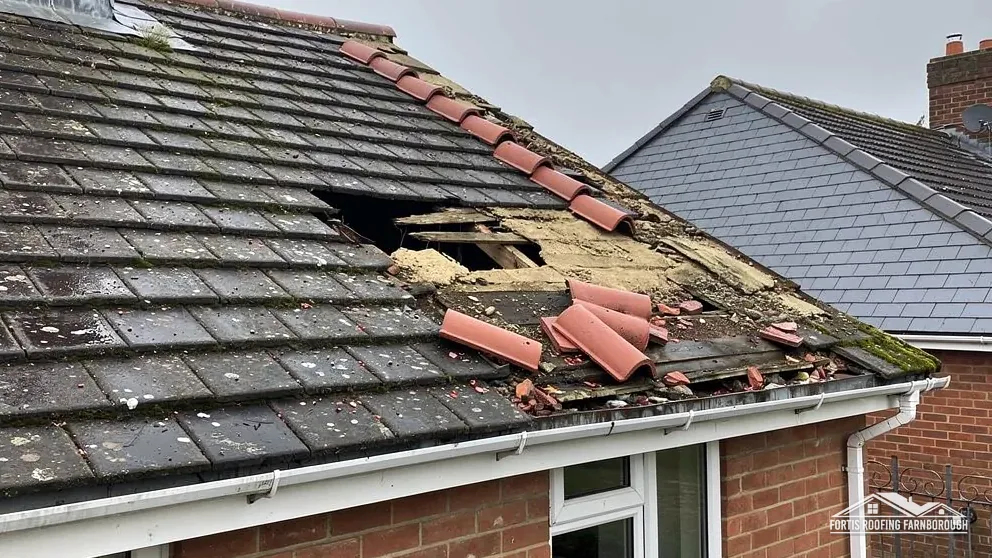
The third is the condition of what is underneath. Rotten battens, damaged rafters and torn underlay add work that only come to light when the covering is lifted or the loft is inspected.
The fourth is how complicated the roof is. Hips, valleys, dormers and chimneys all slow a crew down. A simple two-slope roof goes faster than one of equal area with a dozen junctions.
The survey is where these are measured, so the price follows from what the roof needs.
Why a roof job is priced as a whole
A roofer who has surveyed the roof can work out the time, the materials and the access, then state one total for the job. That total is useful to you in a way a day rate is not, because it covers the outcome. You know what you are paying for the finished work, and the risk of the job running long sits with the roofer, not you.
It also makes comparison fair. When three firms quote for the same described work, each gives one total, and you can set them side by side. Our answer on how many roofing quotes to get explains what to check in each, including whether VAT and scaffolding are covered.
Day-work pricing has a place, mostly for small jobs where the scope cannot be known in advance, such as hunting for a leak. Even then, a good roofer agrees a cap or a review point before the meter runs on.
We price each job as a whole after a survey, with the photos and measurements to back it, so there is nothing to translate from a daily rate into a final bill. The written quote is the figure that binds, and the photographs from the survey are what back it up.
Where to find real price ranges
National cost guides publish typical figures for named jobs, and they are a better frame than a day rate. Which? (Nov 2025) gives £75 to £400 for fixing one to six broken tiles and £80 to £300 for a new ridge tile, both ex VAT. MyJobQuote's 2026 figure for an average roof repair is around £650. Both come from national guides and are not our prices.
Our page on how much roof work should cost goes through more of them, with the sources and dates, and our costs page collects the ranges in one place.
If a roofer does quote by the day, ask these questions before agreeing:
- how many people will be on site, and for how many days?
- are materials, scaffolding, waste removal and VAT in the figure?
- what happens if the work takes longer than planned?
- will everything be confirmed in writing before work starts?
A firm that answers these clearly is worth considering. One that avoids them is telling you something. You can see everything we offer from the homepage.