Malthouse Farm's granary
The Granary at Malthouse Farm is listed Grade II, entry 1240226, with Malthouse Cottage listed beside it.
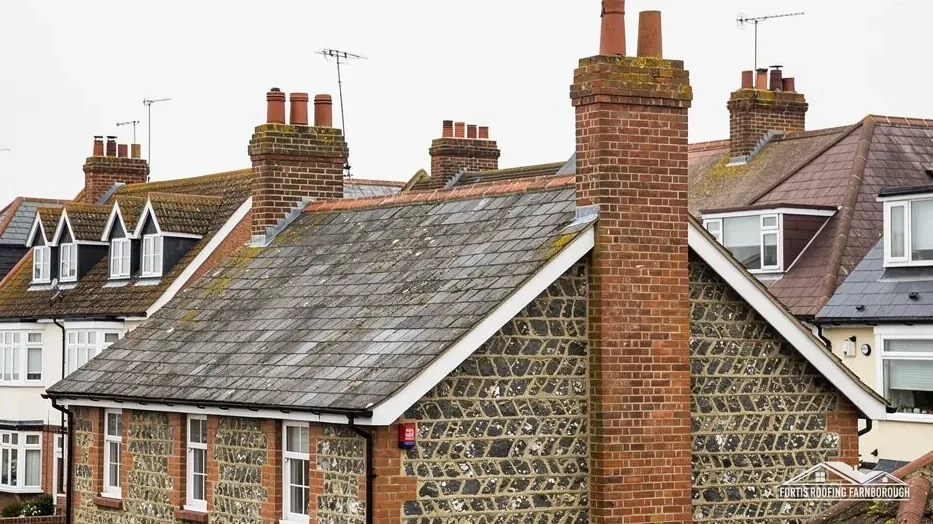
Roofs on Hambledon's old farm buildings and cottages in the Surrey Hills
Hambledon is a small Surrey Hills parish where an 1824 church roof was part tile, part stone slate. We survey old farm and cottage roofs with bats and nests in mind.
The Granary at Malthouse Farm is listed Grade II, entry 1240226, with Malthouse Cottage listed beside it.

In 1824 the old church was described as covered partly with tiles, and partly with stone slates.
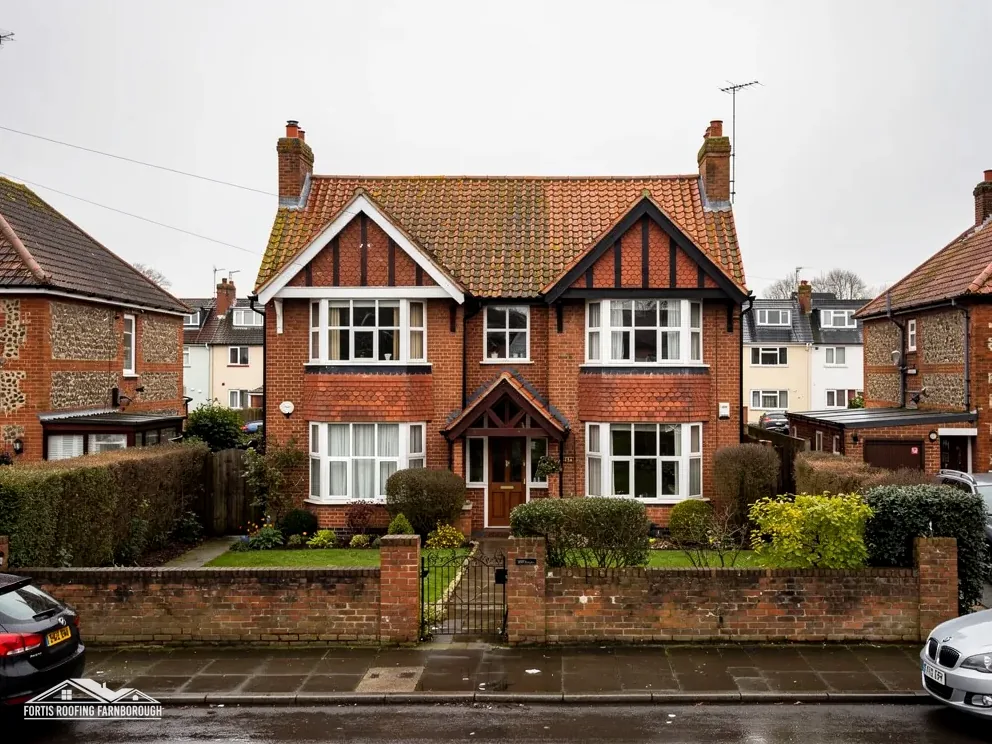
The county history says brick-making is carried on in the clay soil of the south of the parish.
Map of Hambledon with Witley, Chiddingfold, Milford, Dunsfold marked around it.
Map data © OpenStreetMap contributors. Loads only when you ask for it.
Witley and Milford sit to the north-west, Chiddingfold lies south, Dunsfold south-east, and about four miles off is Godalming, the nearest town.
About 19 road miles south-east of Farnborough · Waverley Borough Council and Surrey County Council.
Hambledon, barns and wildlife
A parish of 770 people in the Surrey Hills National Landscape, what the 1824 church description says about tile and stone slate, and the law on bats and nesting birds when an old roof is repaired.

| No. | Chapter | The figure it turns on |
|---|---|---|
| 01 | A parish of 770 inside the Surrey Hills | Village centre inside the National Landscape |
| 02 | Tile, stone slate and clay country | 1824: tiles and stone slates |
| 03 | Barns, bats and nesting birds | Bats protected, roof repair named |
Chapter 01 of 03
Hambledon: people, land and designation
Hambledon is a small Surrey village, and the national layer puts the village inside the Surrey Hills National Landscape, once called an Area of Outstanding Natural Beauty, with about 79 per cent of a 1.5 km box drawn round it inside the boundary. The planning data service also shows the Hambledon A and B conservation areas within about 0.75 km of the centre. For a roof, that means two designations lie over much of the same ground, and either can change what planning allows for a roof alteration, compared with an undesignated street. Nobody wants to find that out after the scaffold is up, which is why we ask first.
The practical consequence is narrow but important. Putting back the same covering is a repair. A new dormer, or any alteration that reshapes the roof, is a planning question here, so we ask Waverley's planning team before pricing it. The planning permission guide explains the rules, and at survey we tell you whether yours is a repair or an alteration, with the council's answer attached where one was needed.
Waverley decides planning questions here and runs its own building control team, while Surrey County Council looks after the highway. From 1 April 2027 West Surrey Council replaces both, and until then everything we describe is current practice.
Waverley gives no share for re-roofing, so we use the Planning Portal's national test: building control rarely needs an application where the work stays under 25 per cent of the building envelope and under 50 per cent of the roof. A re-slate of a whole roof sits outside both limits.
Village lanes in the Surrey Hills are often narrow, and scaffold on the highway would need a licence from Surrey County Council. If a lane cannot take scaffold, a tower, a cherry picker or work from the garden may do the job, and the survey settles which. That decision is made before the price is set, because the way we reach the roof shapes the whole job. The one written price that follows names the access we have planned, so there is no surprise on the first morning.
Because a lane may serve several houses, we also tell neighbours what to expect when a delivery is due. A short note through the door, with a contact number, avoids most of the friction that a blocked lane can cause.
Deliveries are timed for the lane, skips are placed where they will not block a neighbour, and the site is left tidy each day.
Chapter 02 of 03
| Subject | Record |
|---|---|
| The parish | 2,721 acres, about 4 miles from Godalming |
| The ground | Green Sand in the north; thickly wooded clay in the south, chiefly oak |
| Brick-making | Carried on in the clay soil |
| The old church, 1824 | Covered partly with tiles, and partly with stone slates |
| St Peter's church | Almost entirely rebuilt in 1846 |
| Residents today | 770, ONS Census 2021, Hambledon parish |
The county history describes Hambledon as a small parish of 2,721 acres, about four miles from Godalming, with its northern part on the Green Sand. The clay in the south is very thickly wooded, chiefly with oak, and brick-making is carried on in the clay soil. In 1824 the old church was described as covered partly with tiles, and partly with stone slates, and St Peter's church was almost entirely rebuilt in 1846.
It is a short account, but it points to a real mixture. Clay, brick and oak are all local, and an old building could carry clay tile, stone slate or both. Our survey establishes each roof on its merits. A roof that was part tile and part stone slate in 1824 may have been re-covered entirely since, so the history is a guide to local materials, not a description of any house today.
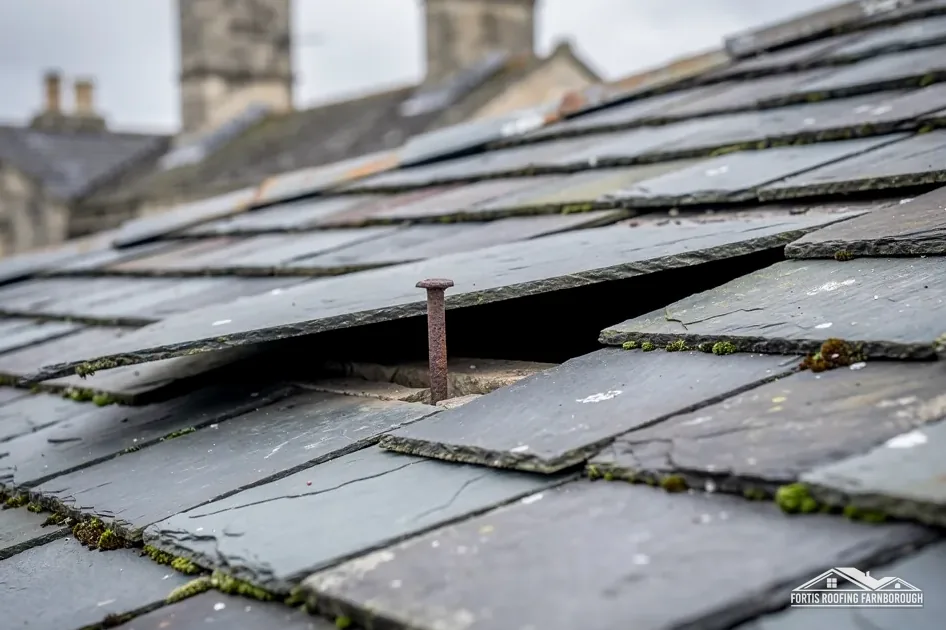
A roof that mixes materials is repaired in two ways at once. Tiles are lifted and re-hung or replaced like for like. Stone slates are heavier, thicker and uneven, and they need sound battens and strong fixings. If the roof frame has been weakened by damp, the covering cannot be repaired in isolation.
On a survey we look from the roof space as well as from outside. Daylight through a covering, wet or blackened timbers, and droppings or staining on the underside tell their own story. We photograph each, note where the ridge bedding has failed and mark the slopes that could be repaired.
When a mixed roof needs new tiles, matching matters. Handmade clay tiles vary, and a new machine-made one beside an old one shows. Sound tiles lifted from a hidden slope can sometimes go back on the visible one, which keeps the look and saves buying new. Our pitched roofing page explains how repairs are matched, and the slate roofing page covers natural slate.

Brick-built chimney stacks on old cottages are part of the same survey. Their flashings and flaunching, the mortar cap that holds the pots, are among the first details to fail, and we photograph each from the roof, not from the ground. Stacks on old cottages can lean slightly or crack along old joints, and a photograph from above shows the cracks that a view from the lane misses.
Chapter 03 of 03
Hambledon's listings and the wildlife law that touches old roofs
Chart Cottage, the Granary at Malthouse Farm and Malthouse Cottage are each listed Grade II, and eight listed buildings stand within about 500 metres of the centre. Old barns, granaries and cottages in a village like this are also the kind of buildings that bats and nesting birds use, so wildlife law is part of a roof survey here.
The law gives bats and their roosts full protection, and GOV.UK includes re-roofing and roof repairs in its list of activities likely to affect them. Two provisions are worth knowing. Section 9(4) of the Wildlife and Countryside Act 1981 catches anyone who, intentionally or recklessly, disturbs a bat inside a structure it shelters in, or blocks its way in. Regulation 43 of the Habitats Regulations 2017 covers deliberate disturbance and also harm to a roost or breeding site, and the damage offence requires no proof of intent.
Under section 1 of the 1981 Act it is an offence to harm or remove a nest, whether in use or still being built, when a person does so intentionally. GOV.UK states that a licence cannot be had for the purposes of development or construction, so a nest in use is a reason to wait.
In practice the rule is simple. If a survey finds droppings, staining, a nest or a bat in a roof space, we stop that part of the job and tell you. The next step is advice from an ecologist or the statutory nature body, not a decision by a roofer, and nothing that could be a roost or an active nest is removed, sealed or covered in the meantime.
Planning around the evidence is better than discovering it halfway through. If bats use a gap at the ridge, a new ridge detail may have to keep that gap, and a barn conversion may need roosting provision built in. We note such features and the photographs go in your file. Old farm buildings and granaries are exactly where this matters. It also protects you, because a roof job that ignores a roost can be stopped, and a stopped job costs far more than a plan made first.
Possibly, but not by guesswork. GOV.UK names roof repair among the work that may affect bats, and the law protects their roosts. If we find signs at survey we stop work on that part and tell you, so that you can take specialist advice before anything is lifted, covered or sealed over.
The layer we use places the village centre inside it, with about 79 per cent of the surrounding 1.5 km box, and the Hambledon A and B conservation areas, which Waverley lists as designated in 1974, lie within about 0.75 km of the centre. For a like-for-like repair that changes little. For a new dormer or a different covering, we ask Waverley's planning team before pricing, and pass you their reply.
Not necessarily. Each slope is judged by its own condition, so one that has failed can be re-covered while a sound one is left alone. We photograph both from outside and from the roof space, and the written price then covers only the work the evidence supports, nothing more.
We never knowingly disturb an active nest. The 1981 Act treats intentional damage to a wild bird's nest in use or being built as an offence. If a survey finds one we tell you, and work on that part is rescheduled once the birds have finished with it.
Get your free roof quote
Give us your Hambledon address and a note of the problem; a surveyor will visit, check the roof space and photograph it.
10-year workmanship guarantee, in writing.