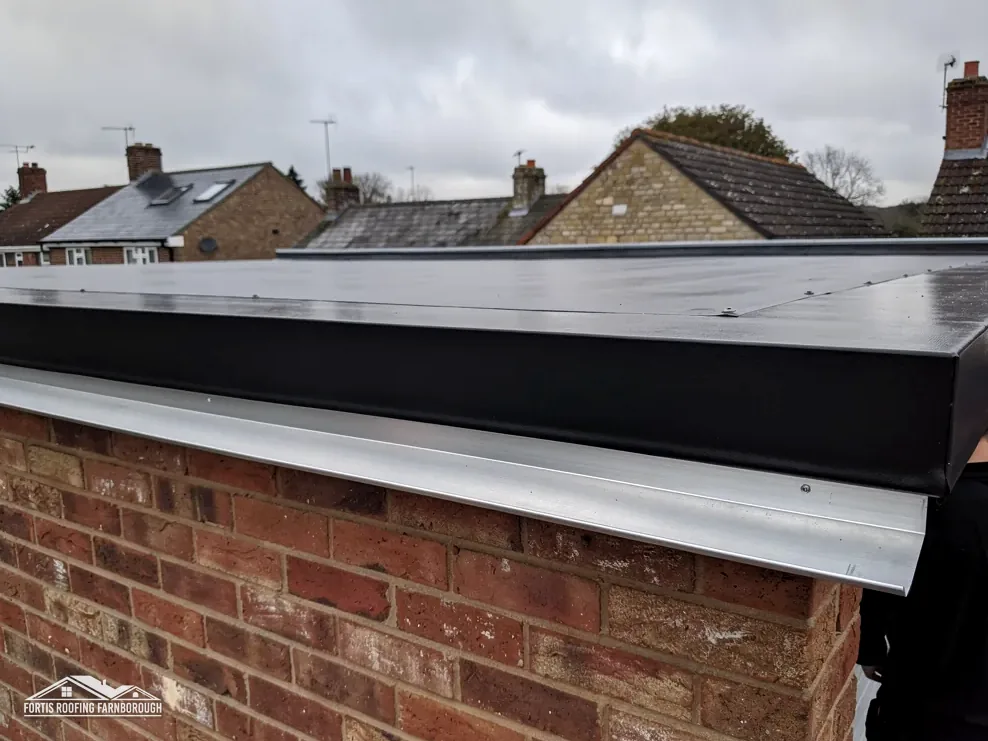
A concrete gutter is a channel cast in concrete, usually at the eaves, where the roof meets the wall. Unlike a plastic or metal gutter that hangs on brackets, it is built into the structure, so it cannot simply be unscrewed and replaced. Its surface wears, its joints open, and its outlets can silt up and fail, and when any of that happens, water gets into the roof edge, the wall below and the ceilings behind.
That is why the question about a concrete gutter is bigger than the gutter alone. A small crack may be sealed and left. A badly cracked or spalling channel may be lined with a waterproof layer. A gutter that has failed completely, or is part of a failing edge, may have to be cut out and replaced. Each route has its own cost, disturbance and life, and a survey decides which one fits.
This guide covers how concrete gutters fail, the damp risks that follow, the three repair routes, a published cost figure for replacement, the falls and outlets that must work afterwards and the asbestos check on older rainwater goods. It is general advice, and each gutter needs to be seen.
Why concrete gutters crack and leak
Concrete is strong in compression but weak in tension, and a gutter holding water, freezing and thawing, takes a hard life. Most failures start small and spread.
Cracking and spalling
Hairline cracks form from movement, shrinkage and frost. Water enters, reaches the steel reinforcing bars inside the concrete and rusts them. Rust expands, pushes the concrete away from the bar and breaks off pieces. That flaking is called spalling, and it leaves the reinforcement exposed and the gutter thinner.
Joints and outlets
Concrete gutters are cast or laid in lengths, and the joints between them were sealed with a compound that ages and splits. The outlets, where water leaves for the downpipe, can be blocked by silt, moss and leaves, or can have loosened where the pipe meets the concrete. A blocked outlet makes the gutter overflow over its back edge into the roof or wall.
Standing water and moss
If the fall is poor, water sits in the channel after rain. Standing water speeds up wear, grows moss and algae and increases the chance of freezing damage. Our guide to how much fall a gutter should have sets out the fall for any gutter, and the same logic applies here.
Age and movement
Every building moves a little over time. Settlement or movement in the wall or roof can open cracks that were sound once. If a crack keeps returning, the cause is movement, not just the surface.
Our survey looks down into the channel, photographs the cracks and the outlets, and checks the wall beneath for stains.
The damp risks behind a failing gutter
A leaking concrete gutter rarely shows its worst damage at the gutter. The water goes where gravity and the structure take it, and the consequences appear elsewhere.
The wall below
Water running over the back or front edge, or out of a cracked joint, runs down the wall. The brickwork stays wet, which can bring green algae, salt staining and eventually damp inside. A damp patch on an internal wall under the eaves is often traced back to a gutter above. Our answer on a damp wall from a leaking gutter explains the signs.
The roof edge
Where the gutter meets the roof, water that overflows can get under the lowest tiles, and soak the underlay, the battens and the rafter ends. Rot there is hard to see from the ground, and it can spread along the eaves.
Ceilings and the loft
If the water gets through the wall or the roof edge, it can stain ceilings and walls inside, often a long way from the gutter. A tracing of the path, as in a roof leak survey, shows where it came from.
Frost
Freezing water expands, so a wet gutter with a crack can be broken open by frost. A small crack in autumn can be a large one by spring.
Why speed matters
Because damage spreads, a gutter that is leaking needs a decision soon, not a long wait. A short-term seal may hold a season, but the underlying cause, whether movement, outlet or fall, needs addressing. If damp is already inside, keep dated photographs, and let your insurer know first where a claim is possible.
Three routes: patch, line or replace
There are three ways to deal with a failing concrete gutter, and they suit different conditions. The survey photographs show which fits.
Patch and seal
For hairline cracks and open joints in an otherwise sound channel, the surface can be cleaned, cracks opened and filled with a repair mortar or flexible sealant, and the channel recoated. It is the lowest-disruption option and suits an early-stage fault. It does not cure movement, so cracks may return.
Line the gutter
A lining is a waterproof layer applied inside the channel. Options include a liquid-applied membrane, GRP, felt or a single-ply sheet, bonded to prepared concrete and turned up the sides and into the outlet. It makes the gutter watertight again without removing it, and suits a channel that is sound enough to carry the lining but whose surface or joints have failed. The detail at the outlets and the back upstand decides whether it lasts.
Replace the gutter
Where the concrete is badly cracked, spalled with exposed rusting bar, or no longer holds its shape, replacement is sounder. The failed section is cut out, and a new gutter in a different material is fixed to the roof edge, often a lined timber, metal or purpose-made unit. It is the most disruptive option and may need scaffold and work at the roof edge.
Choosing between them
If most of the channel is sound, lining is sensible. If the structure is failing, patching or lining only hides it. The quote that follows the survey names the route the evidence supports.
Cost: the published figure and what moves it
MyJobQuote gives an average of £2,400 for concrete gutter replacement. That page is older than most of the others, dated January 2026, so read it as a guide to scale and not a current price, and bear in mind that gutter lengths differ widely. It is a typical UK figure from a national guide, not a Fortis Roofing Farnborough price.
| Source | Typical figure | Page date |
|---|---|---|
| MyJobQuote | Average £2,400 | January 2026 |
What moves a concrete gutter price
- Length: the run of gutter to be dealt with, and how many outlets.
- Route: patching costs less than lining, and lining less than replacement.
- Access: work at the eaves of a two-storey house usually needs scaffold, and a Highways Act 1980 section 169 licence applies if it goes over a road or pavement, which adds notice time.
- Condition: exposed rusting reinforcement, rotten rafter ends or a damaged wall edge add repair work.
- Finish: the lining or replacement material, and whether the fascia and soffit are renewed at the same time.
Comparing
The published gutter figures for plastic systems, such as MyJobQuote's £1,000 to £1,600 for replacing guttering (Oct 2026), are for a different job and cannot be set beside a concrete figure. Our guide on gutter repair cost covers those. Citizens Advice recommends collecting three written quotes, and when you hold them, check each names the route, the length and the access arrangement. One total price, in writing, is what to look for.
Falls, outlets and the standard
Whichever route is chosen, the gutter has to drain. A repaired channel that holds water is only half repaired, and ponding speeds up the next failure.
The fall
Brett Martin advises a fall of 1 mm for every 600 mm of gutter. That figure is for a rainwater system in general, and a concrete gutter should be checked for a fall towards its outlet. A lining can correct a poor fall slightly, with a screed or build-up, but only within limits. A new gutter can be set to the right fall from the start.
Outlets and downpipes
The outlet is where failures concentrate, because debris collects there. At a lining or replacement, the outlet is rebuilt and the downpipe connection renewed. We look at whether the outlet is large enough to clear heavy rain, and at whether the downpipe is clear.
The British Standard
BS EN 12056-3:2000, on roof drainage layout and calculation, is listed as current by the British Standards Institution. It deals with how rainwater drainage is designed. Whether it applies to an existing concrete gutter, and how, is a point for the designer or building control, and we would raise it on a larger or more complex roof.
Overflow routes
If an outlet blocks, where does the water go? A gutter that overflows over the front is better than one that spills into the roof. The survey notes the overflow path, and any change to it is a design decision.
After the work
Test the gutter with a hose before the work is signed off, and look for standing water some time after the test, because a slow-draining channel only shows itself later. Clear it once or twice a year thereafter, especially after autumn leaf-fall. See our gutters, soffits and fascias page for the work we cover.
Check what the gutter is made of before work
Not every old rainwater channel that looks like concrete is concrete. Older buildings used asbestos cement for roof sheeting and for rainwater goods, and the material cannot be identified by eye.
What the HSE says
The Health and Safety Executive classes work with asbestos cement products, such as roof sheeting and rainwater goods, as non-licensed, provided the material is carefully handled and removed without breaking it up. That includes weathered asbestos cement that is not otherwise substantially damaged. Work that will crush or break the material up moves into the notifiable non-licensed category. For buildings put up or refurbished before 2000, the HSE's advice is to assume asbestos is there until proven otherwise.
What that means for a gutter job
Before any cutting, grinding or demolition of an old gutter, we consider whether it could be asbestos cement. If there is doubt, a sample is tested before the work. Cutting a concrete gutter produces dust, and dust from asbestos cement is a hazard. Waste from asbestos cement is wrapped twice, labelled, and moved on a consignment note, never thrown into an open skip.
A survey costs little against the risk
MyJobQuote gives an average of around £325 for an asbestos survey (Sep 2026). Where a gutter is plainly cast concrete, with visible aggregate and reinforcing, the risk is low, but where it is a thin, smooth, grey channel, testing is sensible.
Other checks
We also look at the soffit and fascia, since asbestos insulating board has been found in external soffits, and at the roof covering above.