The short answer
Sometimes. A new covering can be laid over an old one if the old roof is dry, flat enough, well bonded and free of damp, because it saves stripping and disposal. Over a wet or blistered roof it traps moisture and fails early. An overlay is also a new layer in a thermal element, so Part L still applies, and falls and weight need checking.
When an overlay works
An overlay means fitting a new waterproof covering directly over the existing one instead of stripping to the deck. The attractions are plain: less labour, no heavy waste to carry away, less time with the building open and a lower cost. For the right roof those are real savings.
The right roof is dry through and through, with a deck that is sound, flat and firmly fixed. The old covering must be well bonded, with no large blisters, no soft or wet spots and no widespread cracking. Seams, edges and upstands should be in decent order, since the new layer will copy any bumps, ridges and defects beneath it.
The old roof also has to be a suitable base for the new material. Some single-ply membranes and adhesives do not suit bitumen felt and need a separating layer, and torch-on over certain surfaces is not allowed. The new product's data sheet states what it can be laid over, and a roofer follows it.
A moisture test helps. A roofer can use a moisture meter or take small core samples to look for trapped damp, because what you cannot see from the surface is what causes problems later.
If the old layer is felt and has plenty of life left in it, an overlay can give a fresh waterproof skin and extend the roof's life at modest cost.
When it traps moisture and fails
The danger is damp sealed in. If the existing roof is wet, whether from an old leak, condensation or a damp deck, a new membrane laid over it locks the water in. The moisture cannot escape upward, and heat makes it expand and lift the new covering into blisters. Insulation soaked in the build-up stays soaked.
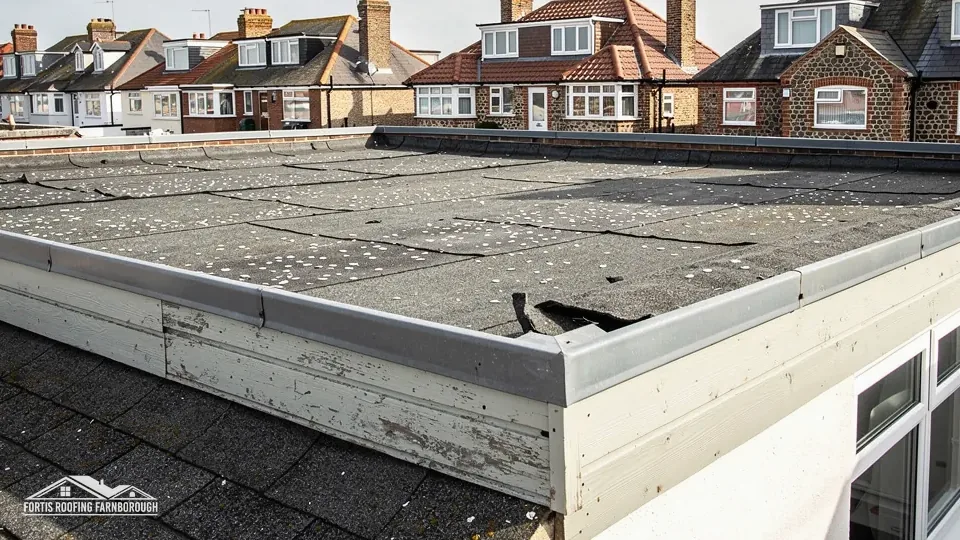
Warning signs on the old roof include blisters, spongy areas underfoot, stained ceilings below, a musty smell in the void and previous patch repairs that never quite worked. Any of these makes an overlay a poor bet.
Overlaying also hides the deck. You cannot see rot, damaged boards or failed insulation under two layers, and a problem you cannot see is one you cannot fix. When the roof is finally stripped, there may be a heavier, wetter and more costly mess.
Multiple layers add weight. A flat roof deck and its supports were designed for a covering of a certain weight. A second layer, or a third, adds load, and a significant increase can bring a structural issue. Weight needs a check too, since a significant rise in loading, over 15 per cent in Approved Document A, can need structural attention.
Finally, an overlay does nothing for falls. If the old roof ponds, the new one will too, a problem our page on why water ponds on a flat roof explains.
Part L and falls still apply
Putting a new layer over an old one is not a way round the Building Regulations. Under regulation 2(3) of the 2010 Regulations, a new layer in a roof is renovation, so Approved Document L bites on an overlay as much as on a strip-and-replace.
Under Table 4.3 of the 2021 edition, a roof worse than 0.35 W/(m²·K) is improved to 0.16 where that is feasible, with the paragraph 4.13 fallback for cases that are impractical or that would not repay the cost within 15 years. AD L 2026 applies from 24 March 2027. Insulation can sometimes be added in the overlay build-up, as boards laid over the old covering and under the new one.
That raises the roof height, and the knock-on effects at edges, thresholds and upstands have to be dealt with. Our page on insulating a flat roof when replacing it sets out the numbers.
Falls can be corrected too. BS 6229:2025 keeps a minimum finished fall of 1:80 for flexible-membrane roofs, with design at 1:40, and tapered boards laid in the overlay build-up can create it.
Check with your building control body before you commit. Whether an overlay is accepted for your roof depends on its condition, the build-up and the result.
How we decide on your roof
We survey the roof before recommending either route. That means looking at the surface and seams, pressing for soft spots, checking the falls, looking at the ceiling and void below for damp and, where it matters, testing for moisture in the build-up.
If the old roof is dry, flat and well bonded, an overlay is offered with the right system for the surface and the insulation and fall improvements that Part L and drainage may require. If it is not, we explain why stripping is the better buy, and show you the evidence in photographs.
Some roofs fall between the two. A roof with one wet patch might be cut back locally, dried and overlaid elsewhere. We say what the options are and what each means for the finish and the life of the roof.
Lifespans give context. HomeBuilding gives felt 10-15 years and Less 10 to 20 years, so adding a new layer to a felt roof that is already old buys less than laying a fresh covering on a prepared deck.
The price is one total in writing. The flat roofing hub covers coverings and repairs, and how long it takes to replace a flat roof sets out the programme.