The short answer
Look at the shape, the edges and the colour. Slate is thin, flat and split-edged, clay tiles have a warm, slightly uneven finish and often a gentle curve, concrete tiles are uniform and heavy with a moulded interlocking profile, and fibre cement is thin, flat and very regular. Knowing which you have matters because repair methods, minimum pitch and weight limits differ.
Slate and fibre cement: the flat ones
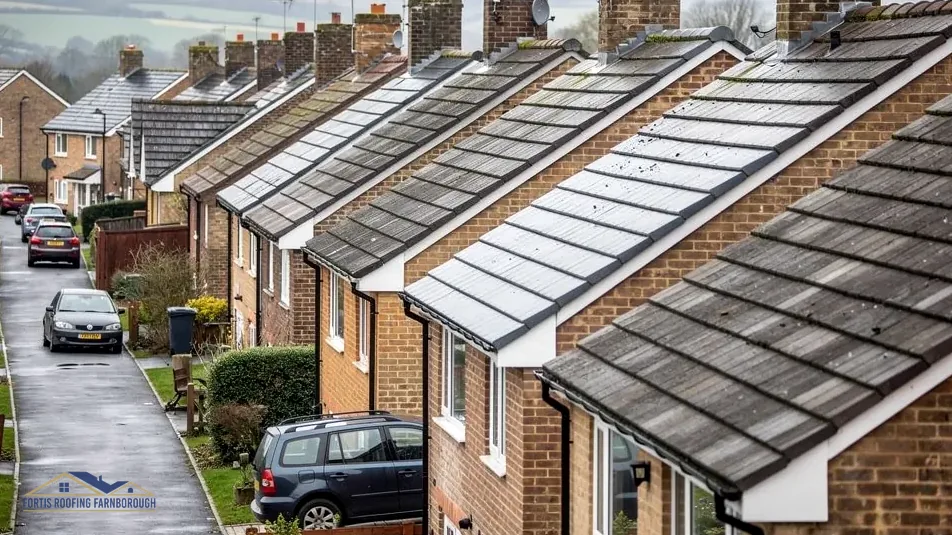
Both of these lie flat on the roof in overlapping courses, so they are easy to confuse from the ground. Natural slate is a split stone. Its edges are slightly irregular, its surface has a faint texture and its thickness varies a little from slate to slate. The colour runs through grey, blue-grey, green or purple-black, and wet slate darkens.
Fibre cement slates imitate the look. They are very regular: every slate has the same thickness, the same sharp edge and the same uniform colour. On an older roof they may carry streaks of moss or a chalky bloom.
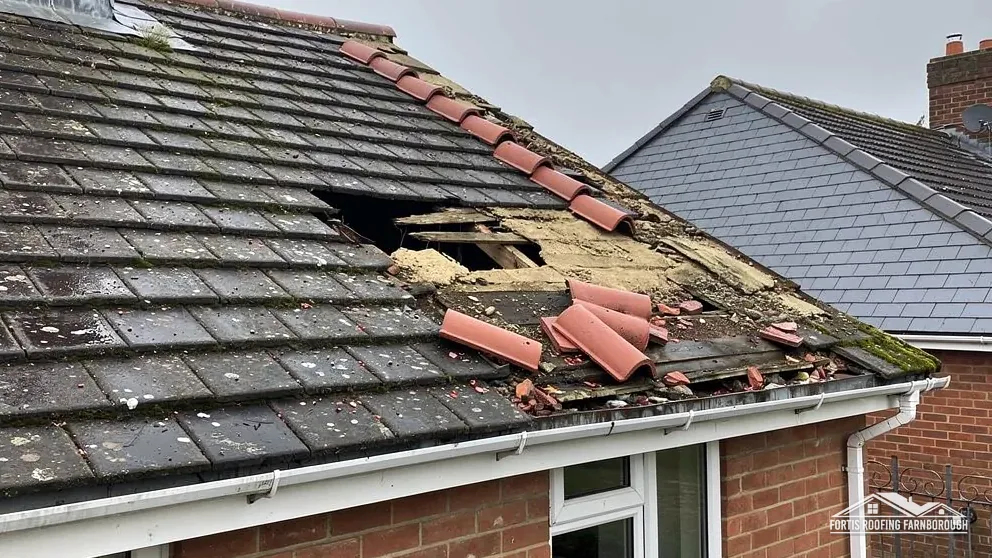
If a slate has slipped and you can see its broken edge close up, a split stone shows layers, while fibre cement looks like a dense, fibrous board. Do not break or drill any sheet you suspect is old fibre cement. Older fibre cement products can contain asbestos, and a roofer should identify the material before cutting it.
The difference counts for money and life. HomeBuilding (Sep 2025) gives Welsh slate as "100+ years" and Spanish natural slate as "75-100 years", while fibre cement tiles are put at "30-40 years".
Clay and concrete tiles
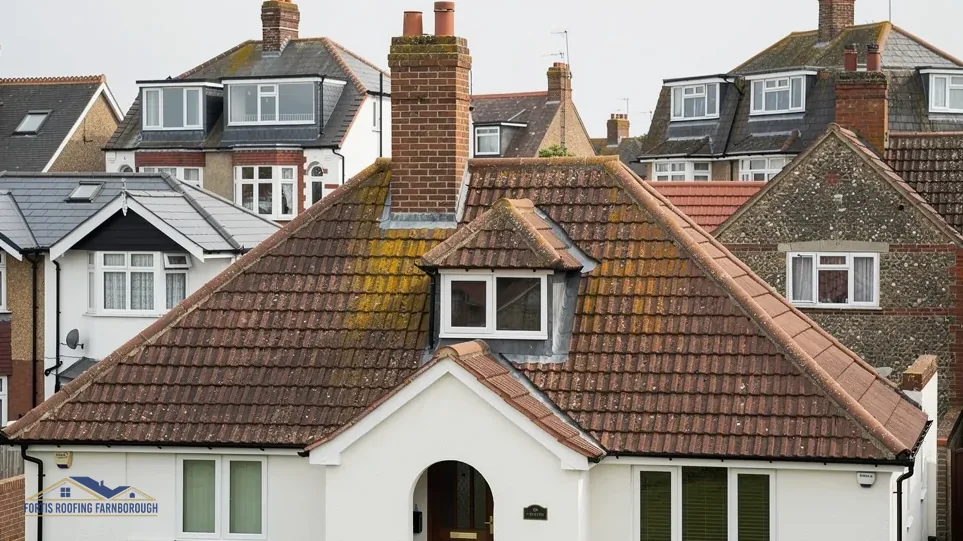
Tiles are thicker than slates and shaped, so you can often see their profile from the pavement. Clay tiles are fired from clay, and the finish shows it. Colours range through reds, oranges and browns with variation from tile to tile, edges are a little uneven and many are given a slight curve. A plain tile is small and flat, and a pantile has a wave in section.
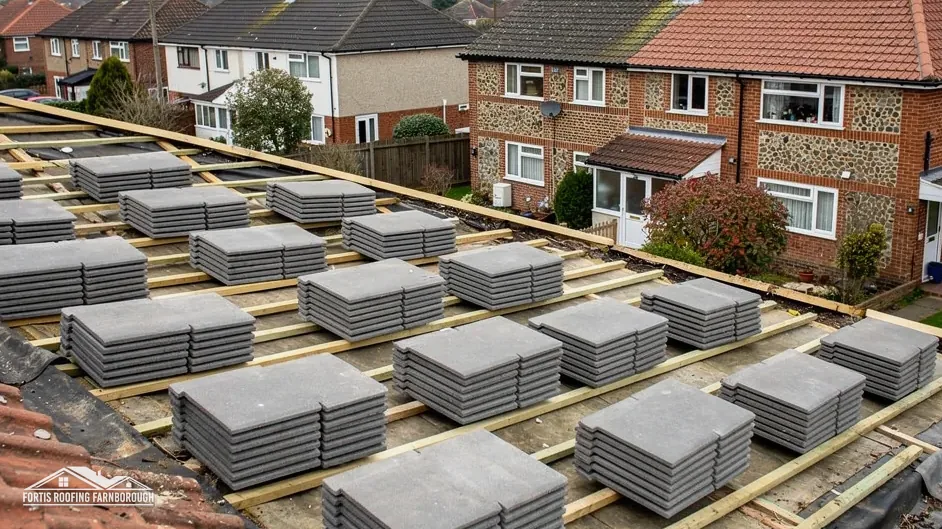
Concrete tiles are moulded. Look for a uniform colour from tile to tile, crisp edges and a deeper profile with interlocking side joints. A Double Roman, a wide tile with two broad ridges and a flat or rolled section, is one example. Concrete fades with weather, and the coating wears to a duller, rougher look.
Weight is a clue as well. If you have a spare tile in the loft or garage, concrete is noticeably heavier in the hand than clay of a similar size.
Published lifespans differ again. HomeBuilding gives clay at "60-80 years" and plain concrete or Double Roman at "40-50 years", while Marley puts roof tiles at around 60 years and applies the BRE 60-year minimum to clay only. Our page on how long a roof lasts sets the ranges side by side.
Why the covering changes the job
Three practical things follow from the identification.
The first is pitch. Each covering has a minimum slope below which it should not be laid. For natural slate, Cupa says BS 5534 indicates a 20 degree minimum, and rules hooks out on any slope under 25 degrees. Marley's product data lists minimums for its concrete and clay tiles, from 12.5 degrees for one Mendip tile to 40 degrees for its Canterbury clay, so the exact tile matters.
The second is weight. Building Regulations approval applies when a new covering is 15 per cent or more heavier, and the Planning Portal advises a structural check. Swapping a light slate for a heavy concrete tile is the usual cause.
The third is the repair method. A single slate is held with a tingle or a hook, a plain tile with nibs and clips, an interlocking tile with a different cut. A roofer who knows the covering picks the right fix and the right match.
Nothing here says what any particular street or town has on its roofs, because that has to be checked house by house.
How to confirm, and what to do next
Start with photographs. Stand where you can see the whole slope in good light, then zoom in on a few tiles and on the edge of the roof where the covering ends. If the loft is safe to enter, add a view of the covering's underside and the battens, the timber strips that carry it.
Check the paperwork, if you have any, because documents often record what was laid. A homebuyer's report, an old quote or a building control completion certificate may name the covering.
Then ask. A roofer's survey identifies the covering as a matter of course, along with its approximate age and condition, and a good one tells you why they believe it is what they say. If anything about the material is unclear, particularly sheeting that might be old fibre cement, the roofer should identify it before any work starts.
Once you know what you have, the next questions are about age and condition, and our answer on how often a roof should be inspected helps you decide when to look. For the services behind this answer, start from the homepage.