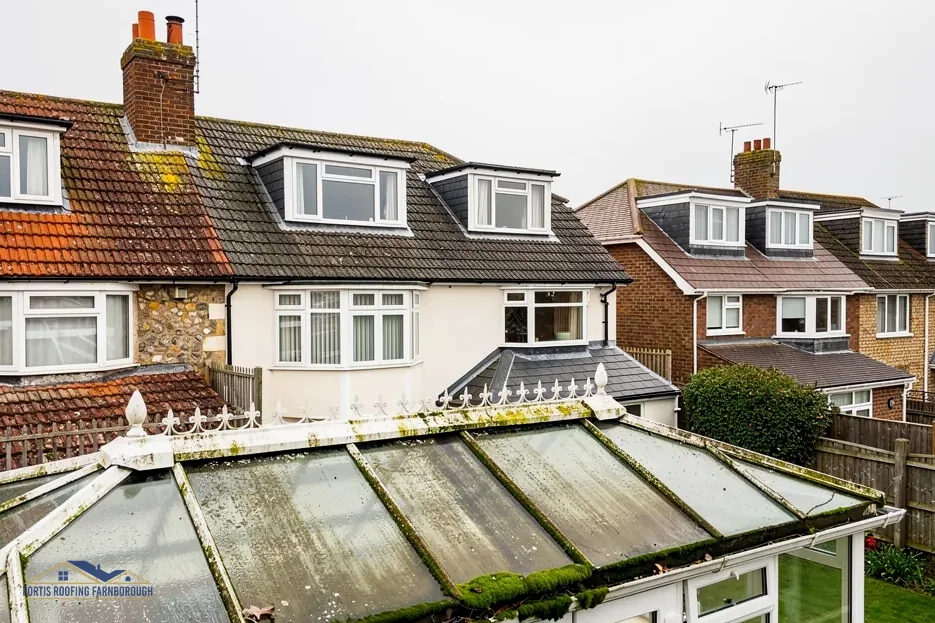
A conservatory roof does a hard job. It is glazed or lightly built, it sits against a house wall, and it takes the weather from above with little to shelter it. That is why owners ask how long one will last, and why the answer has two layers: the published figure for the covering, and the condition of everything around it.
For polycarbonate, the lightweight twin-wall sheet found on many older conservatories, two sources give a figure. HomeBuilding & Renovating says polycarbonate roofs have a typical lifespan of 10 years, and The Eco Experts puts it at about 10 to 15 years. Those are ranges from guides, not promises, and the two do not quite agree, which is why we give both.
For glass and for solid roofs, the picture is different. They are heavier, they depend on the frame and the build-up under them, and the lifespan of the whole roof is shaped by detailing rather than by one material figure. This post explains what to look at on each, what a replacement involves and what the rules say, so that the choice of repair or renewal rests on facts.
What matters is your own roof, and a survey is how that is judged.
What the published figures give
Two published guides give a lifespan for the most common conservatory roof covering, polycarbonate, and they differ slightly. That difference is itself useful, because it shows that nobody can name an exact age at which a roof must be replaced.
The polycarbonate range
HomeBuilding & Renovating's guide to conservatory roof replacement costs says polycarbonate roofs have a typical lifespan of 10 years. The Eco Experts, writing about conservatory roof materials, says about 10 to 15 years. Taken together, the range is 10 to 15 years, with the lower figure being the more cautious one. Neither is a promise. A roof in a sheltered position, well maintained, may outlast the range; a roof with failed seals or a poor frame may not reach it.
Typical costs, for context
The same guides give replacement costs. MyJobQuote gives conservatory roof replacement as between £3,200 and £6,000 (updated 20 October 2026), and The Eco Experts as between £2,300 and £6,000 (updated April 2024). These are typical UK ranges, and the price for your conservatory comes after a survey.
Why a range, not a date
A lifespan is an average over many roofs with different frames, orientations, workmanship and care. It is useful for planning, not for diagnosis. The better question is what condition your roof is in, and whether the problems are in the sheets or elsewhere. A repair to a seal or a flashing can extend the life of the whole roof, and that is often a better buy than replacing a roof whose frame is sound. Keep a note of what has been repaired and when, so that the next survey starts from a record.
What ages polycarbonate roofs
A polycarbonate roof is a set of sheets held in aluminium or uPVC bars, with seals and a ridge, and a flashing or cap where the roof meets the house. Each part ages in its own way, and a failure in any one of them can send water into the room.
The sheets
Over the years the sheets are exposed to sun, rain and temperature swings. Look for cracks, discolouration, algae in the cells and any sheet that has shifted or lifted. A sheet that has come away from its bar can let water past the seal.
The bars and seals
The glazing bars hold the sheets, and the seals and caps close the joints. Seals can harden and shrink, and caps can work loose. A leak at a bar is often a seal problem that a repair can cure, without a new roof.
Where roof meets wall
At the wall junction, a flashing or a sealed joint is what keeps water out. If the flashing is lead, MyJobQuote puts lead flashing at over 80 years, as a lower bound, so the lead may outlive the roof. If a different material or a sealant has been used, it may not. Our guide to conservatory roof flashing covers this junction.
Condensation inside
Water on the inside of the sheets is condensation, not a leak, and is usually about ventilation and temperature. It is worth separating the two before you decide anything, because a roof can look wet inside and still be watertight, and the cure for condensation is different from the cure for a leak. Check the weather on the day: condensation shows on cold mornings, leaks show after rain.
When we survey, we check each part, from the sheet to the cap, and photograph the problem areas.
Glass and solid roofs are different builds
Glass and solid conservatory roofs are not simply a longer-lasting version of polycarbonate. They are different constructions, with their own details, weights and ways of failing.
Glass roofs
A glass roof uses sealed glazed units held in bars. Its life depends on the bars, the seals and the units themselves, and on the frame that carries them. The weight is greater than polycarbonate, so the frame has to be up to it. If the frame is sound, replacing units or seals can be a repair; if the frame has corroded or moved, that changes the picture.
Solid roofs
A solid roof, whether tiled or a panel system, is built up in layers: structure, insulation, a waterproof covering and a finish below. They are heavier again, and the build-up has to deal with insulation and moisture. A lightweight tiled roof is one route, and the guide to conservatory roof options sets the choices side by side.
No single lifespan
For glass and solid roofs the age of the roof is a poor guide on its own. A survey of your own roof tells you more than a figure would. It looks at the frame, the build-up, the seals and the junctions, and it says what remains in good order, which sets the choice of repair against renewal on firm ground and gives you a list you can price against.
Weight matters on an old frame
An existing conservatory frame was built for a particular roof. Fitting a heavier roof onto it needs a check that the frame and base can carry it, and that the fixings at the house wall are sound.
What the rules say about a replacement roof
Replacing a conservatory roof is not only a joinery job. On the Planning Portal's reading, a replacement roof is judged under Building Regulations on structural safety, energy efficiency and ventilation.
Structure
The roof has to be supported adequately by the frame and walls. A heavier roof, such as a solid or tiled one, changes the loads, which is why the structure gets checked at the planning stage. Where a new covering changes the weight carried, the Planning Portal advises taking structural advice before the work starts.
Insulation and ventilation
Energy efficiency and ventilation are part of the requirement too. A solid roof brings insulation and moisture questions that a polycarbonate roof does not, and ventilation is part of managing them. The detail depends on the design, and your building control body will state what it wants submitted.
Who to ask
In Farnborough and across Hart, building control is the Hart and Rushmoor Building Control Partnership. A registered building control approver is the private alternative. Ask which route applies before work begins.
Planning is a separate question
Building Regulations and planning permission are different regimes, and one does not stand in for the other. If your home is listed or in a conservation area, check the planning position with your council before any change to the roof. Our guide to conservatory roof planning permission covers it.
File the approval and any completion certificate with the deeds and guarantees for the house, since they are worth having at a sale.
When a conservatory roof is nearing its end
Few conservatory roofs fail all at once. They give signs, and recognising them early saves money and damp.
Signs worth acting on
- Drips or stains around the bars, or damp patches on the house wall at the junction.
- Sheets that are cracked, clouded or visibly lifted.
- Seals that have shrunk, split or fallen out.
- Caps and trims that are loose or missing.
- Sagging bars, or movement when the roof is touched.
- Growth of algae or moss in places that stay wet.
- The room feeling much hotter or colder than it used to.
Repair or replace
If the frame is sound, a repair is often the better buy: reseating a sheet, renewing seals, resealing the junction. If the frame has moved or corroded, the sheets are failing across the roof, or the room has become unusable for most of the year, replacement is worth pricing. A survey will say which applies.
Ask what the repair will achieve
A repair should have a clear aim: stop this leak, restore this seal. Ask how long the repair is expected to hold and what you will do if the problem returns. A good answer references the evidence in the photographs.
Look at it before winter
A conservatory roof that leaks in October will not improve in January. A look in early autumn, with the gutters and the junction checked, is a sensible habit. Clear leaves from the valleys and outlets, wipe down the sheets and look at every seal from inside the room as well as outside.
Getting a conservatory roof surveyed
A survey of a conservatory roof is smaller than a house roof survey, but the same principles apply: look at every part, record what you find, and explain it.
What we look at
We inspect the sheets or glazing from outside and inside, the bars, seals and caps, the ridge and eaves, the junction with the house wall, the gutters and the frame. We photograph each problem and measure what is needed, so that the findings can be checked by you or by anyone else you ask.
What you receive
The findings come with a recommendation, whether a repair, renewal of part of the roof or a complete new one, and the reasoning behind it. Where a repair is enough, you hear that. A new roof enters the picture only when the photographs support it, and the price is a single total, written down.
Questions to ask any firm
- Is the frame sound, and what evidence shows it?
- What is the weight of the new roof, and can the frame carry it?
- Does the work need building control, and who arranges it?
- How is the roof sealed where it joins the house?
Our conservatory roofs page explains how we approach these jobs. Costs for a typical replacement come from the published ranges above, and your own price follows the survey.