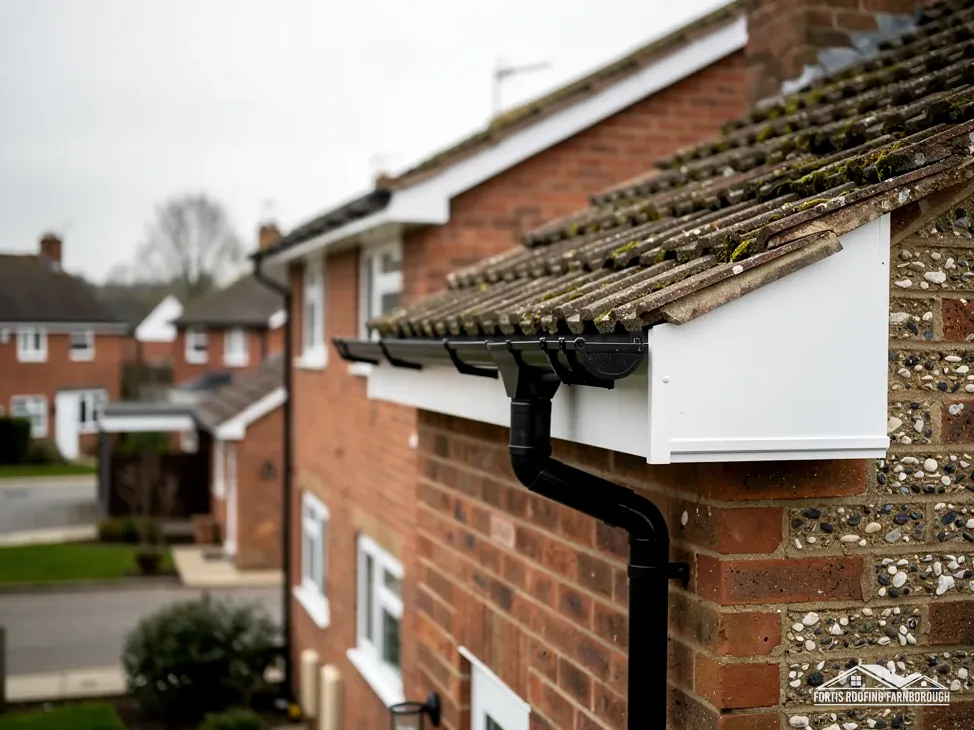
The soffit is the board you see when you look up at the eaves, running from the wall out to the fascia, which is the front board that holds the gutter. On an older house they are the part of the roofline most likely to prompt a call to a builder: a flaking surface, a stain, a gap that lets in birds. They are also one of the places where asbestos insulating board, AIB for short, can be found.
That is the reason this post exists. Nothing here says that any house in Farnborough has asbestos in its soffits, and many may not. What it says is that the age of a house decides whether the question must be asked, that nobody can answer it by eye, and that the first step is identification, not replacement. HSE is the source throughout.
Farnborough's housing was laid out in layers, and Rushmoor's own overview dates them: Cove's developments to the 1950s and 1960s, Southwood's to the 1980s, among others. We use those dates as a guide to which houses fall inside the "before 2000" rule of thumb and never as a statement about a particular building. The sections below cover what AIB is, how to find out, what the work involves and which questions to put to a contractor. For our approach to roofline work in general, see the gutters, soffits and fascias page.
What asbestos insulating board is, and why soffits
Asbestos insulating board is a flat panel made of asbestos fibres in a binder, which was used in buildings for fire protection, insulation and lining. It is a different product from asbestos cement, the corrugated sheeting seen on some roofs, and the rules treat them differently.
Where it can turn up
HSE lists external soffits among the places AIB is found. It can also appear in ceiling tiles, partitions and around heating appliances inside, but the soffit is the part a roofer or builder meets first, because it sits right where gutter and fascia work happens.
Why it is hard to spot
In HSE's words it is hard to tell AIB items apart from lookalikes that contain no asbestos. A soffit that looks like any other painted board may be one or the other. Age, thickness, appearance and the way the board is fixed are clues, not proof.
Why it matters
Asbestos becomes a hazard when its fibres are released into the air, which happens when the material is drilled, sawn, sanded, broken or heavily disturbed. An undamaged, sealed board is a different case from one being cut or smashed. That distinction runs through all the HSE guidance, and it is why the answer to many questions is "leave it alone until it has been checked".
None of this calls for alarm. It calls for a short pause before any work starts on the soffits of an older house, and the pause is cheap compared with the alternatives. A homeowner who finds out afterwards that boards were cut without precautions has a much harder problem than one who waited a week for a test result.
The date that matters, and Farnborough's housing eras
HSE gives a plain rule of thumb: for a house put up or refurbished before 2000, presume asbestos is present. The presumption stands until a survey or test shows otherwise.
What the rule means in practice
It means the question has to be asked for any house older than that, and that the answer is a record, not a guess. It does not mean every older house contains asbestos. It means nobody should work on the soffits of one as though it did not, until they know.
The council's dating of the town
Rushmoor's overview records the following. The 1860s saw North Camp and South Farnborough set out. Suburban commuter housing followed in the early twentieth century. New housing developments came at Cove in the 1950s and 1960s, and at Southwood in the 1980s. All of those periods fall before the year 2000, so all of those houses sit inside the rule of thumb, whatever their age within it.
What the dates do not show
The dates do not show that a house in Cove or Southwood has asbestos soffits. A house may have been re-roofed, re-boarded or refurbished since it was built, and the soffits may be an entirely different material. A refurbishment before 2000 would still count under the rule, while one afterwards may have replaced the boards.
The point is simply that these are the streets where the question should be asked, and the age of the house is the first fact to establish.
Finding out what your soffits are
The only reliable answer comes from identification, and that means a proper check, not a look from the pavement.
Step one: do not disturb it
That means no drilling, scraping, sanding or cutting of a soffit you have doubts about, and that includes screwing a new bracket or a cable clip into it. Do not pressure-wash it. If a board is already cracked or broken, keep people and pets away from the area below it, and do not sweep the debris.
Step two: gather the facts
- The year the house was built, and any refurbishment since.
- Whether the soffits have ever been replaced, and when.
- Any survey paperwork from a purchase or an earlier job.
Step three: have the material identified
A sample analysed by a laboratory is the usual way to be certain, and an asbestos survey can do it as part of a wider check. MyJobQuote's figure for an asbestos survey is around £325 (updated 9 September 2026), a national typical figure rather than a price of ours.
Step four: record the result
Keep the result with your house papers. Any contractor who works on the roofline afterwards should be given it, and so should a later buyer. A result that says no asbestos was found is as useful as one that says it was, because it lets the next job start without a pause.
Our survey of a roofline records the condition of the gutters, fascias and soffits with photographs, and notes where a material needs testing before anyone works on it.
What the rules say about doing the work
If the soffits are found to be asbestos insulating board, the way the work is classed under HSE's guidance depends on its scale and duration.
Short-duration work on board
HSE treats short-duration removal of asbestos insulating board as part of a refurbishment project as notifiable non-licensed work. That means it must be notified to the enforcing authority and the right precautions taken, but the contractor does not need a licence for it.
Work that is not short
If the risk assessment shows the work on AIB will not be of short duration, it is licensable work. Licensable work has to be carried out by a contractor that holds the relevant licence, so ask to see the evidence.
Records
For notifiable non-licensed work, a register of the work, sometimes called health records, must be kept for 40 years, which is a long time to keep a file and a reason to choose a contractor who intends to be around.
Waste
Under HSE's guidance asbestos waste is wrapped twice and labelled. It moves on a consignment note, with an upper-tier registered carrier, and the household exemption stops short of it, so an ordinary skip is the wrong place.
Asbestos cement is different
Board and cement are different products. Lifting asbestos cement with care sits in the non-licensed category, and the two sets of rules differ, which is why identifying the material first matters.
Questions to put to any contractor
If you are asking someone to work on the soffits, fascias or gutters of a house that dates from before 2000, put these questions before you agree a price.
Before the work
- Have the soffits been identified, and where is the result?
- If not, who will arrange identification and when?
- Which category does the work fall into under the HSE rules, and why?
- Does the work need notifying, and who will do it?
If asbestos is confirmed
- Who will do the removal, and what evidence is there that they can lawfully do it?
- How will the work be set up, and how will the area be kept clear?
- Where will the waste go, and will you see the consignment note?
- What will replace the boards, and what does the written price include?
Be cautious of
A contractor who says the board is "safe to cut" without testing, who offers to remove it quickly for cash or who plans to put it in an ordinary skip. A contractor who is confident in the work will answer these questions plainly.
Our approach
We survey the roofline, record what we see in photographs and measurements, and say where testing is needed before work starts. One written price follows. Our guide to soffit ventilation covers the roof-space side of replacing boards.
Replacing soffits, fascias and gutters sensibly
Once the material is known, the job is an ordinary one: new soffits, fascias and gutters fitted to the roof edge. A few points help it go well.
Plan the sequence
If asbestos is found, the removal comes first and the replacement second, and each step has its own timing, so a single day for the whole job is unrealistic. Do not fit new gutters over old boards on the assumption that they will not be disturbed, because fixings go through the board.
Access
Eaves work needs a safe platform. If scaffold will occupy the pavement or road, the highway authority's licence must be in place first, and its timing belongs in the programme. Our post on whether you need scaffolding to replace guttering covers the options.
Ventilation
Soffits often carry ventilation for the roof space, and replacements should keep it, because a roof that cannot breathe collects moisture in the loft and shortens the life of the timbers. Our guide to fascia capping versus replacement explains how capping affects the boards beneath, which matters if the boards below may contain asbestos.
Neighbours and records
Tell neighbours if work will create dust or noise, and keep the paperwork: the identification result, the written price and the waste records. Ask the contractor to confirm in writing what the boards turned out to be and what was carried out, so that the house has a clear history for the next owner, whoever that is.
If you are planning roofline work on an older house, arrange a survey first, and the written price will follow.