Old cottages and farm buildings
In 1911 the county history described a hamlet of old cottages and farm buildings, with many new houses beside them.
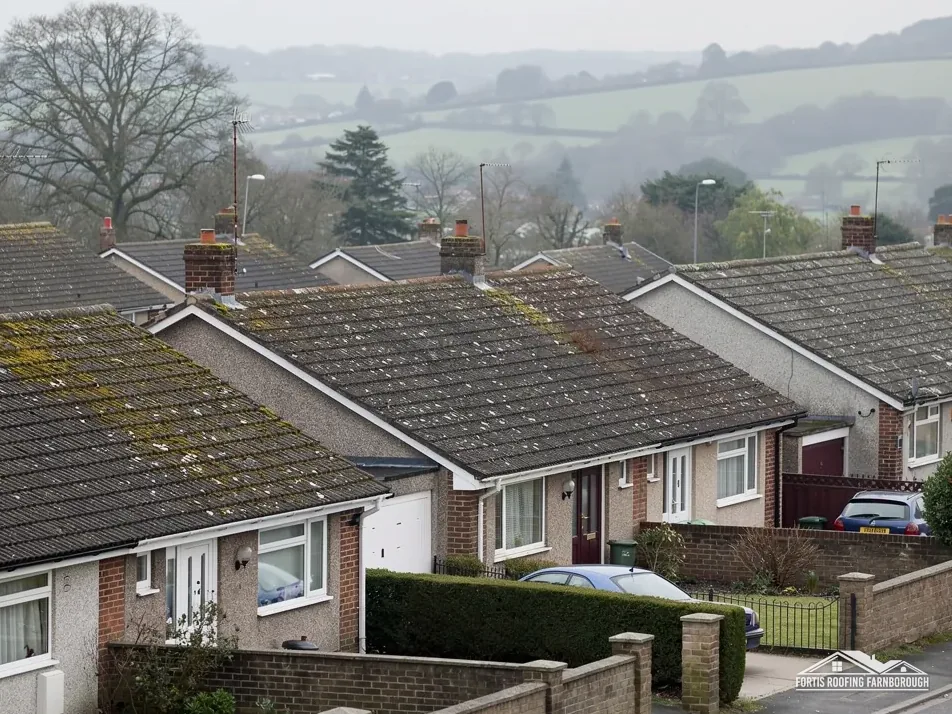
Roofs on The Street, from old cottages to barn conversions
Shackleford is a small village in the greensand hills, inside the Surrey Hills National Landscape. We survey old cottages and barn conversions with equal care.
In 1911 the county history described a hamlet of old cottages and farm buildings, with many new houses beside them.

Guildford's profile says The Street mixes classic country housing with newer barn-conversion-type development.
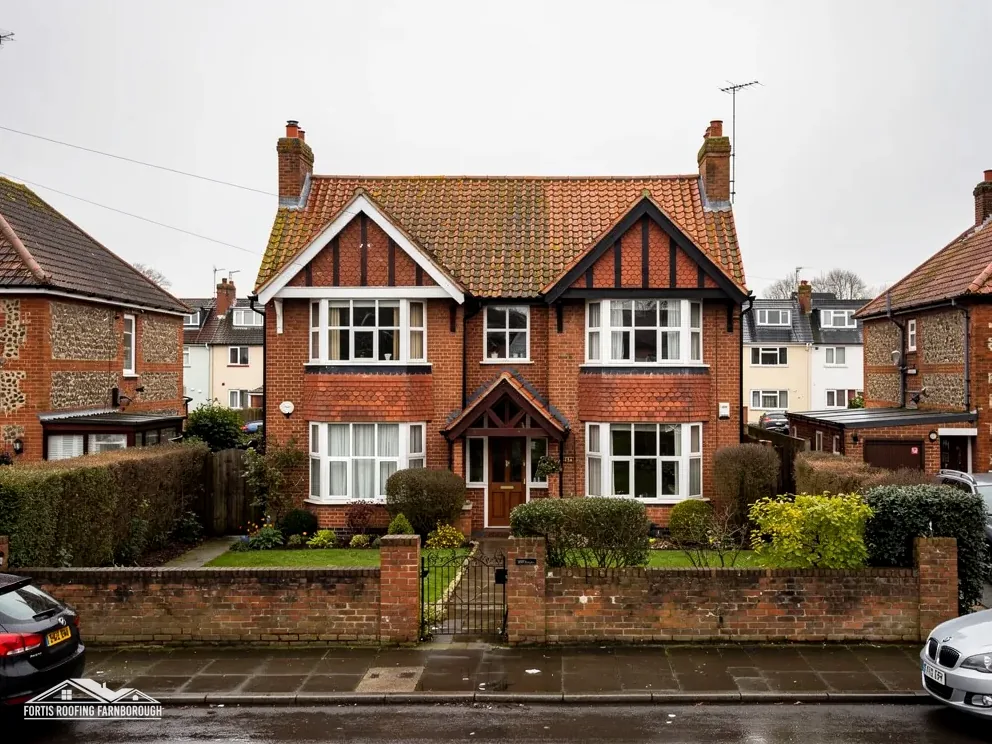
Aldro School and a Cross Farm barn each hold a Grade II listing, which puts their roofs under consent rules.
Map of Shackleford with Puttenham, Compton, Milford, Elstead marked around it.
Map data © OpenStreetMap contributors. Loads only when you ask for it.
Shackleford lies in the greensand hills beneath the Hog's Back, close to the A3, and Farnborough is 12.9 road miles from it, to the north-west.
About 12.9 road miles south-east of Farnborough · Guildford Borough Council and Surrey County Council.
Shackleford, within the Landscape
How the Surrey Hills designation, Guildford's planners and Surrey's scaffold licence fit together for a Shackleford roof, and what the hamlet's recorded past says about the buildings you might own.

| No. | Chapter | The figure it turns on |
|---|---|---|
| 01 | A village inside the Surrey Hills Landscape | 100% inside the Surrey Hills National Landscape |
| 02 | A hamlet, an almshouse founder and The Street | Wyatt's almshouses, early 1600s |
| 03 | Aldro School, Cross Farm and the conservation area | Three Grade II listings within 500 m |
Chapter 01 of 03
Shackleford at a glance, in published figures
Shackleford is covered completely by the Surrey Hills National Landscape, formerly an AONB, on the planning data's area test around its centre. That matters more than any other single fact about a roof here. Land of this designation is treated as protected in planning law, and some permitted development rights are withdrawn on it. A plan to change how a roof looks belongs with Guildford Borough Council before a roofer is asked for any price. Swapping like for like is a separate thing: that is upkeep, and upkeep fills most of a village roof's calendar.
Guildford handles planning for Shackleford and operates its own building control team. The highways stay with Surrey County Council through to the end of March 2027, and after that West Surrey Council inherits both roles. The parish counts 707 usual residents, and the village is 12.9 road miles from the A325 in Farnborough, the point from which we reckon every distance.
On re-roofing, Guildford sets no local percentage, so the Planning Portal guide governs. Where a job leaves most of the building envelope and over half of the roof untouched, below the Planning Portal's 25 and 50 per cent limits, no application is called for. A heavier covering is judged on another scale, with a rise of 15 per cent or more in weight bringing approval and a structural check. We measure the slopes and identify the covering before telling you which side of those lines your job lies on.
Surrey's licence runs for 28 days at £208, and a renewal is charged at the same rate, so a job that slips into a second month pays a second fee. The council asks for 10 working days of notice. Nothing on its page tells you who sends the form in; raise it with the scaffolder at booking. Where the poles stand entirely on land you own, the licence plays no part, and some Shackleford plots may have the room for it.
Weather can halt a job part-way, so the scaffold plan carries some slack and you are told the likely number of days before work begins. A longer hire costs more, and it is better to know that at the start than at the end.
Chapter 02 of 03
| Source | What it records |
|---|---|
| County history, 1911 | A hamlet of some old cottages and farm buildings, with many new houses |
| County history, 1911 | Hall Place, house of Richard Wyatt, founder of the red-brick Mead Row almshouses |
| County history, 1911 | Hall Place offices became an inn, later a modern mansion |
| Guildford profile, 2013 | Built along The Street, classic country housing and newer barn-conversion-type development |
The 1911 county history describes Shackleford as a hamlet of some old cottages and farm buildings and many new houses, a mix that has stayed in place for over a century. It names Hall Place as the house of Richard Wyatt, who founded the red-brick Mead Row almshouses near Farncombe early in the 17th century. The offices of Hall Place later became an inn, which was in turn turned into a modern mansion.
Farm buildings in the record are a reminder that the village was once working land. Outbuildings, stables and cart sheds survive as garages and studios in many places, and their roofs are often forgotten until the ceiling inside gives way. We include them in the survey when you ask.
Guildford's settlement profile calls Shackleford a village built along The Street, mixing classic country housing with newer barn-conversion-type development. For a roofer, those two descriptions point to two different kinds of survey. A classic country house has a roof with history in it: patches, extensions, a ridge that has been rebedded more than once. A barn conversion has large, simple slopes, often with roof windows or rooflights set into them, and its problems tend to sit at the openings.
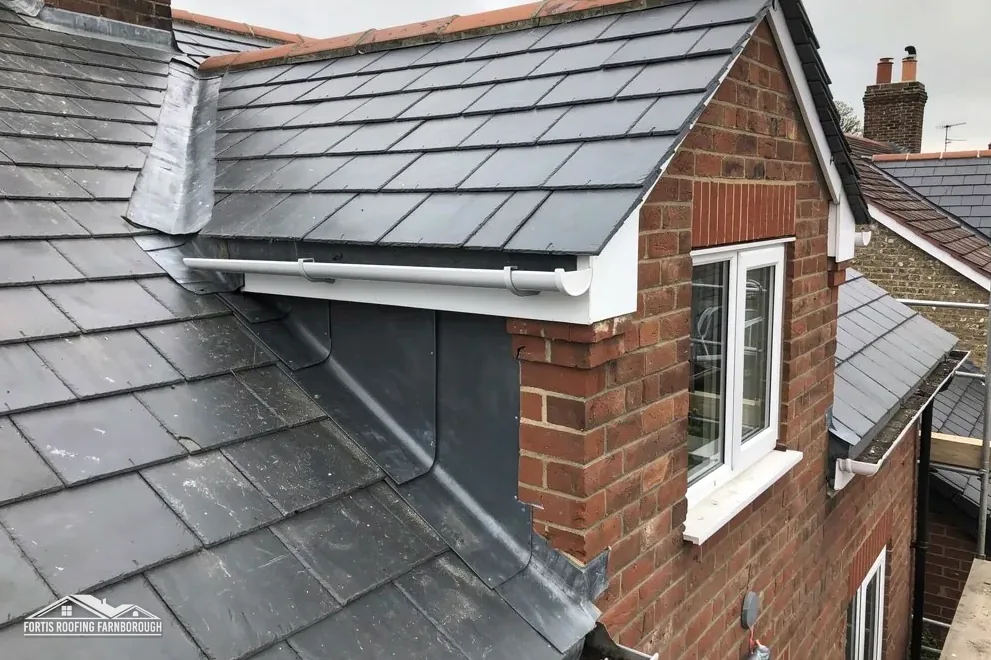
On a converted barn, the roof windows get our first look. The flashing kit around each one, the seal at the head and the condition of the roof's covering around the frame are the points that fail. Our roof windows and skylights page describes how a window is repaired or replaced.
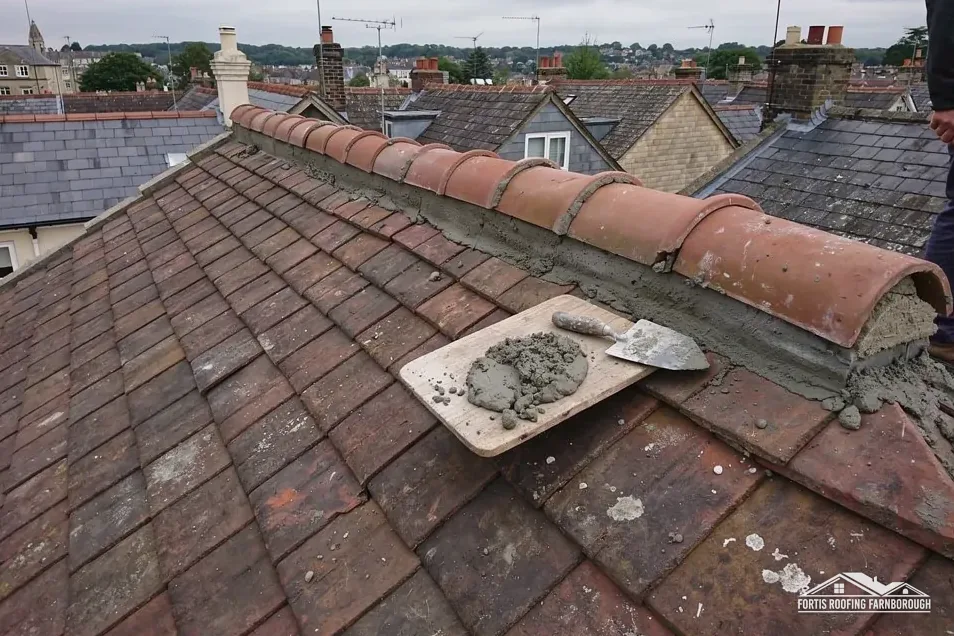
The classic country houses ask for patience. We lift tiles where we need to, we check battens and the felt or underlay beneath, and we record each junction. Where an extension joins the old building, we examine the abutment, which is the likeliest place for water to find a path.
Two dates in the record
Both kinds of house share a weak point at the eaves. Long gutters on country houses drain big roofs, so a sag or a blocked outlet will soak the fascia and the wall behind. Running water through the gutters, where it is safe, shows which joint drips, and the photographs record it.
Neither type tells us what is on your roof, so we do not guess. In the survey report each slope's covering is named after a close look, and the one written price is built on that.
Chapter 03 of 03
Shackleford's heritage record in four figures
Shackleford has a conservation area of its own, lying within about 0.75 km of the village centre. The national list shows 18 listed buildings within 500 m of that centre, among them Aldro School, a barn at Cross Farm and a house called Cobblers, each listed Grade II. Aldro School was first listed in May 1985. With that many listings in a small place, it is likely that a roof you are asked to look at, or one beside it, has a protected neighbour.
Listed building consent from Guildford Borough Council is what stands between a listed roof and any alteration that would touch its character. Permitted development rights survive listing, yet consent is required alongside them, so the opening move is a photographic record of the roof with a plain account of the intended work. We prepare that as part of the survey if the house is listed.
Under Guildford's approach, an Article 4 direction can reach a chimney, so that taking one down or reshaping it requires the council's say-so. The council's online map shows each address's position. We look before we visit, so we can tell you at once whether chimney work is an ordinary repair or a question for the planners.

On the Environment Agency's Flood Map for Planning, some of the land within about 250 m of the village centre falls in Flood Zone 3. The map speaks of land and not of individual houses, yet it is a fair prompt to keep roof water draining away from the walls. Gutters, hoppers, downpipes and the gullies they discharge to are on our survey list. What we can reach is cleared, and what we cannot reach is photographed from a distance.
If a repair would be seen from the road, we also note the colour and texture of the existing tile, as the council's officers are more comfortable when they can see what is there. We give you a short written note to pass on, with the photographs, whenever you ask for one.
An unlisted house outside the conservation area is easier, although the National Landscape still colours any change of look. A well-matched repair keeps a village street looking as it should and avoids a conversation with the council altogether. For tiled slopes, ridges and valleys, our pitched roofing page has the detail.
Often it is, because the flashing kit at the sides and head of each window is where water can get in, or the seal has aged. The flashing, the seal and the covering round the frame are checked and photographed, and you hear whether a repair will hold or the window should be replaced.
A different covering changes how the roof looks, and designated land has fewer permitted development rights, so put it to Guildford's planning team before committing. A re-roof that copies what is there is another matter. We record your existing tile, colour and ridge, which gives the council the evidence it needs to answer promptly.
One Surrey County Council licence covers 28 days at £208, and a renewal costs the same, so a longer job pays again. The council asks for 10 working days of notice, and its page is silent about who files the form, so raise it with the scaffolder. Poles on your own land fall outside the licence.
Not directly. The consent rules apply to the listed building itself, not to its neighbours. Your unlisted house still sits inside the National Landscape and perhaps the conservation area, so any change of look is worth putting to Guildford. A repair that follows the roof as it stands sidesteps most of those questions.
Get your free roof quote
Give your Shackleford address plus a line on what looks wrong, and the survey gets booked.
10-year workmanship guarantee, in writing.