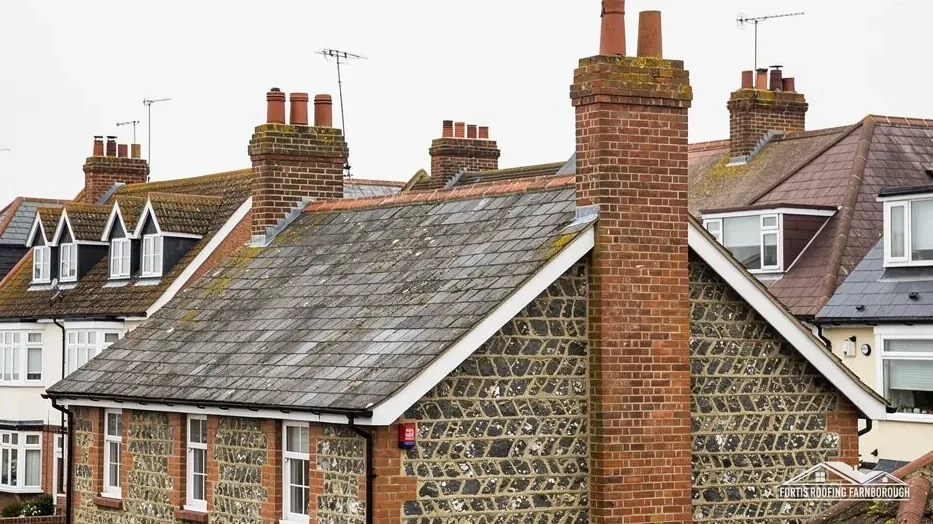
Victorian and Edwardian villas
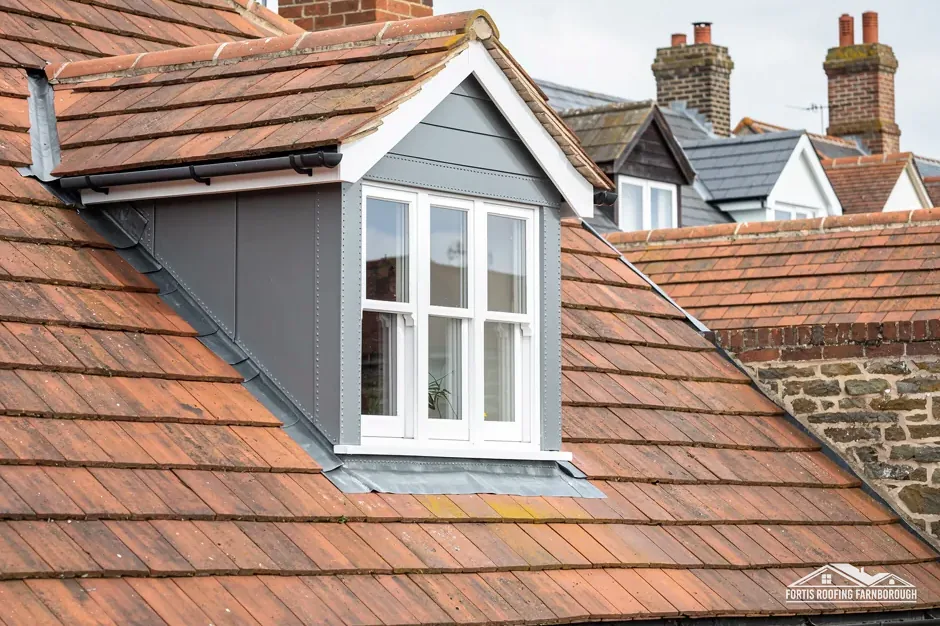
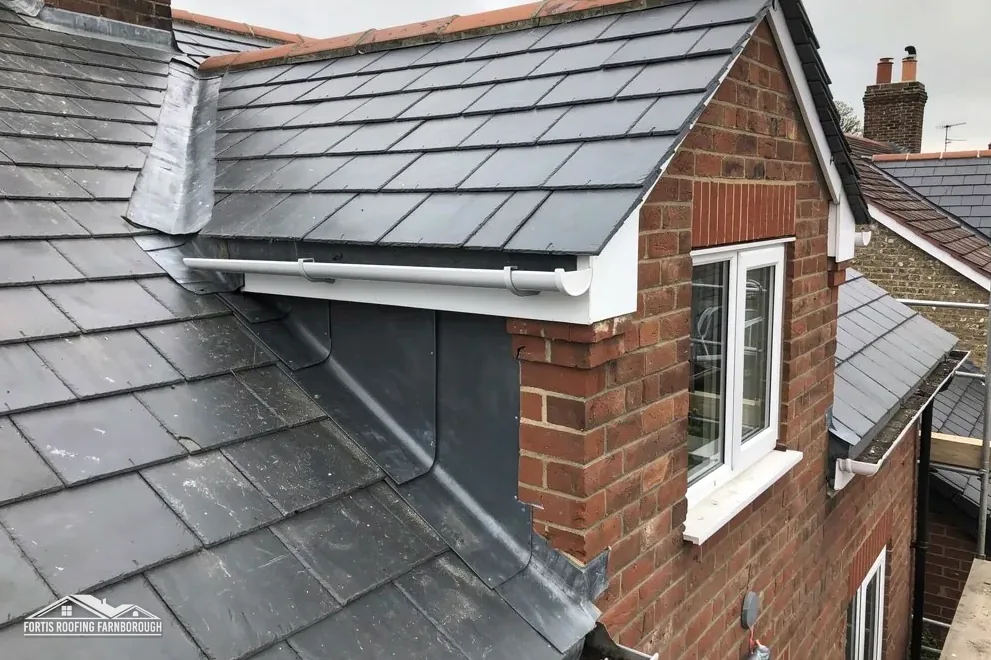
The Village Design Statement describes red brick with grey slate roofs for the centre's villas of 1890 to 1915.

Roofs in a village that grew from eight dwellings to estates
Lightwater is a village in Windlesham parish beside the M3, with heathland and a country park to the west. Each roof is measured, photographed and given one price.
The Village Design Statement describes red brick with grey slate roofs for the centre's villas of 1890 to 1915.
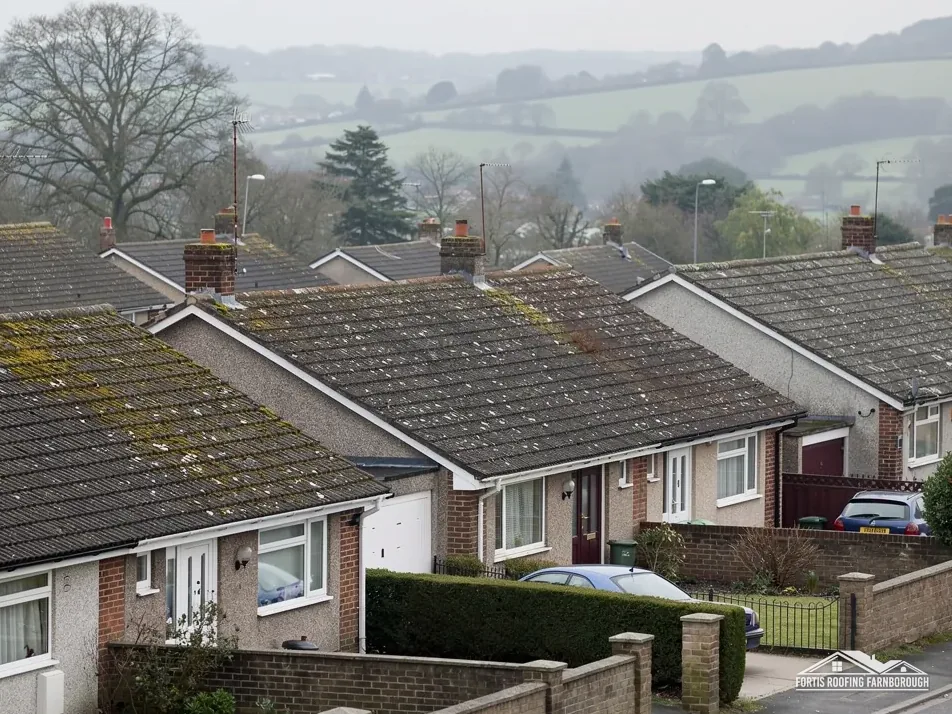
Rectory Farm and Herons Court date from the 1970s, and The Moorlands and Briars from the 1980s.
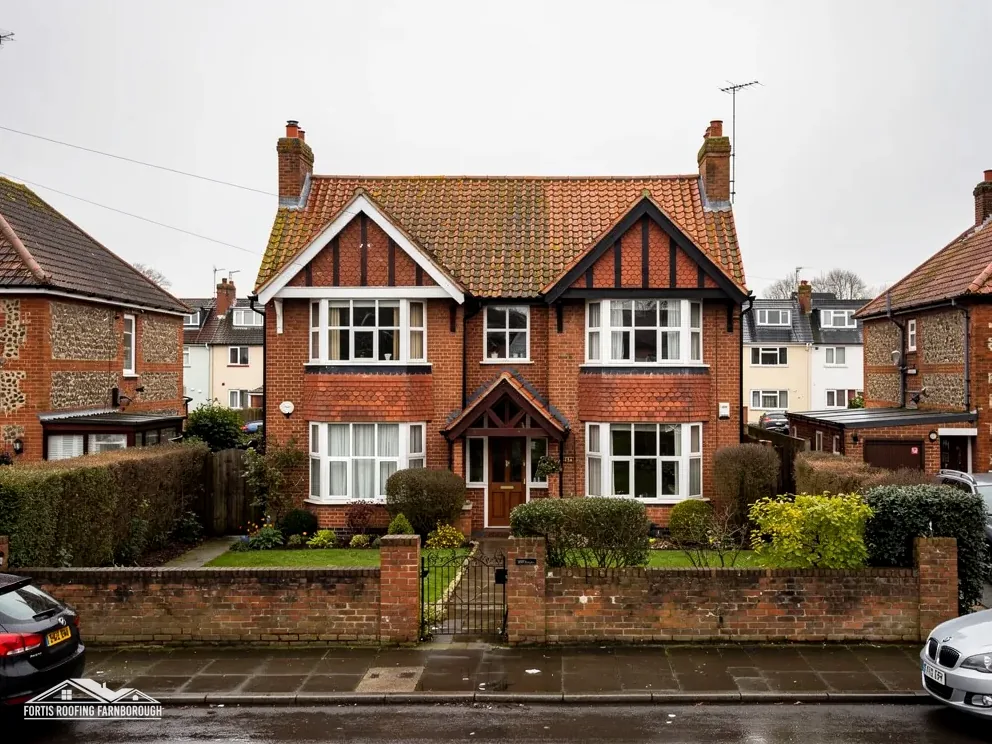
The barn at Rectory Farm House and Lee Lane Farmhouse are both listed Grade II.
Map of Lightwater with Bagshot, Windlesham, West End, Surrey Heath, Heatherside marked around it.
Map data © OpenStreetMap contributors. Loads only when you ask for it.
Windlesham lies north-east, Bagshot north-west, West End south-east, Heatherside south-west, Chobham further east, and Knaphill south-east beyond West End.
About 7.2 road miles north-east of Farnborough · Surrey Heath Borough Council and Surrey County Council.
Lightwater, villas and estates
How a heath hamlet grew from eight dwellings to a village of estates, what the Village Design Statement says about slate and tile, and which barn, farmhouse and conservation areas bear on a roof here. Sources are named.

| No. | Chapter | The figure it turns on |
|---|---|---|
| 01 | From eight dwellings in 1813 to 1980s estates | Eight dwellings 1813; doubled by 1935 |
| 02 | Grey slate villas and the tiled estates beside them | Villas 1890-1915 slate; newer houses tiled |
| 03 | Rectory Farm barn, five conservation areas and scaffold | Barn Grade II; five areas within 2.5 km |
Chapter 01 of 03
Lightwater's growth in published dates and figures
The 1813 Windlesham enclosure map shows only 8 dwellings in what is now Lightwater. Building picked up from about 1893-94, and by 1935 the village had more than doubled. Estates followed from the 1960s to the mid-1980s: Rectory Farm and Herons Court in the early to mid 1970s, and The Moorlands and Briars in the 1980s. The 2021 Census counted 6,536 residents in the built-up area, which lies 7.2 road miles north-east of Farnborough, a distance taken from the A325.
That history makes three layers. A thin scatter of older buildings predates 1890, a Victorian and Edwardian core was built between 1893 and 1915, and post-war estates followed from the 1960s, with infill continuing since. Each layer has its own age and so its own weak points, and a survey finds which apply to your roof.
On roofs from the early layers, the weak points are old fixings, worn flashings and valleys that have been patched more than once. On estate roofs they are ridge and verge fixings, tired felt and gutters never replaced. The Village Design Statement records infill from the mid 1980s onwards as well, so roofs here range from recent to well over a century old, and each deserves a proper inspection before it is written off or trusted.
We begin each Lightwater job at the ridge and work down. Measurements come first, then hand tests of fixings, close photographs of every junction, a look from the loft with a torch, and a trace of the water to the drain. All of it lands in a report arranged slope by slope. A repair that is enough is the quote we give, and the usual repairs are listed on our pitched roofing page.

An age band is only a guide, and it should be treated with suspicion. A villa built in 1900 can have been re-covered in the 1980s, and an estate house of 1975 can still wear its first tiles. So the report names the age band as a hint and the photographs as the proof, and where the two disagree, the photographs win. That is the rule on every Lightwater job, old villa or new estate, and it keeps the advice grounded in what we saw, with photographs to prove each point.
Chapter 02 of 03
| Phase | What the statement describes | What we check |
|---|---|---|
| Villas of 1890-1915 in the centre | Red brick with grey slate roofs | Slipped slates, nails and valleys |
| More modern houses | Tiled roofs | Ridge and verge fixings, tile condition |
| Rectory Farm, Herons Court | Built in the early to mid 1970s | Felt, fixings and gutters |
| The Moorlands, Briars | Built in the 1980s | Fixings, flashings and gutters |

The Village Design Statement describes the centre's Victorian and Edwardian villas of 1890 to 1915 as red brick with grey slate roofs, and says more modern houses have tiled roofs. That is the council's account of the village's building phases, offered as background and never as a rule for any single house. A villa may have been re-covered in tile, and a modern house may have a slate porch, so the statement guides our questions and never our answers.
A grey slate roof from around 1900 is more than a century old, and its covering has probably been repaired, perhaps partly replaced, since. Natural slate can last a very long time. HomeBuilding gives Welsh slate as 100+ years and Spanish natural slate as 75-100 years, though those figures describe new material in typical conditions and promise nothing about your roof. What fails first is usually the nail: when it rusts, slates slip. A run of slipped slates is mended by re-fixing and replacing, and the rest is checked. Our gutters, soffits and fascias page covers the drainage that goes with such roofs.
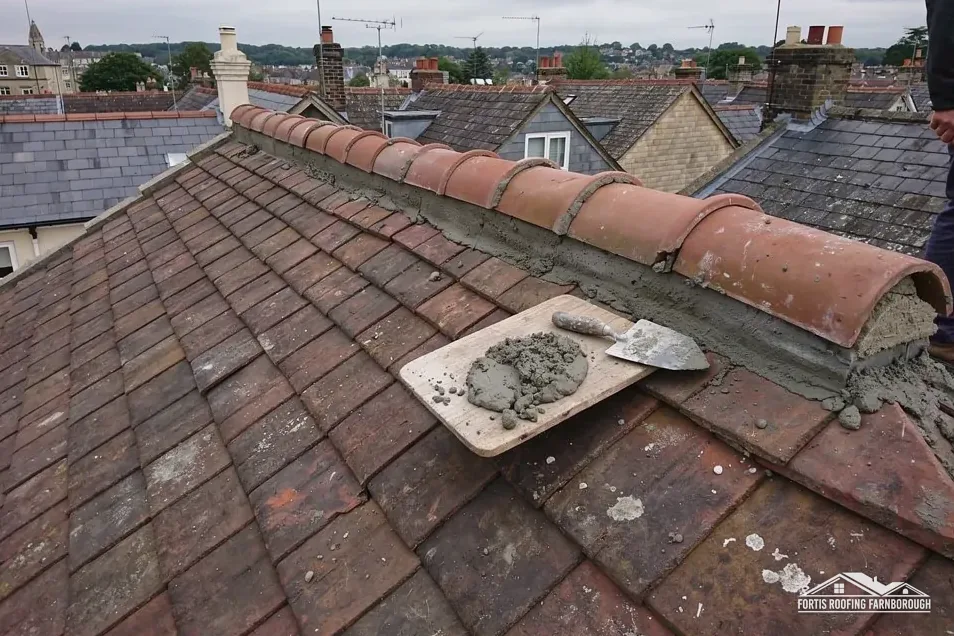
The estates are a different job. A tiled roof from the 1970s or 1980s is now roughly forty to fifty years old. HomeBuilding gives plain concrete tile as 40-50 years, while Marley expects its tiles to last around 60, so the sources differ and we show both. Neither is a promise. The deciding evidence sits on the roof: cracked or slipped tiles, loose ridge pieces, torn felt and failed flashings.
Where an estate house has had its loft converted, roof windows may have been added, and each opening depends on a flashing and a seal that can fail. Our roof windows and skylights page explains how they are repaired and re-flashed.
Moss and lichen settle on slate and tile alike, especially on the shadier slope. The makers of tiles and slates warn that jet-washing can damage a covering and shorten its life, so we recommend gentle removal, and the survey records where growth is heavy enough to block a gutter or lift an edge, so that you can decide whether cleaning is worth doing now or can wait until other work is under way.
Chapter 03 of 03
Numbers behind a Lightwater roof job
The barn near Rectory Farm House and Lee Lane Farmhouse both carry Grade II listings, as does Lightwater War Memorial, and 5 listed buildings stand within 900 m of the centre. Anyone altering the character of either farm building must obtain listed building consent first, whereas an unlisted house nearby sits outside the listings, and the National Heritage List shows which case yours is. The national dataset names five conservation areas within about 2.5 km: Bagshot Church Road, Bagshot Park, Bagshot Village, and Church Road and Updown Hill in Windlesham. None reached the 1.5 km box drawn around Lightwater's place point.
Building control in Lightwater is the business of SHBCC, the consultancy that serves Surrey Heath, and homeowners may alternatively hire a private approver from the register. A few refixed tiles involve neither. Limits from the Planning Portal: 25 per cent of the building envelope and 50 per cent of the roof, with approval also required once a new covering is 15 per cent or more heavier, after a structural check.
Surrey County Council issues the scaffold licence for road or pavement: £208 buys a 28-day period, and the council asks for 10 working days of notice. The page gives no applicant for the licence, which we settle with the scaffolder ahead of sending you the dates. A scaffold kept inside your own plot needs no licence. From 1 April 2027 West Surrey Council succeeds both the borough and the county, and a job spanning that day is traced to its new holder first.
Lightwater lies beside the M3, with heathland and a country park to the west, so trees and open ground are close at hand. Leaves and needles collect in gutters and valleys, and sometimes a clean-out is the only thing a roof needs. The report says so when that is the case, and the bill reflects it. Clearing a gutter and refixing a bracket costs far less than a new roof, and nobody should pay for the second when the first is enough.
Weather sets the dates. The Met Office's South Farnborough averages for 1991 to 2020 show 118 wet days a year, so a 28-day licence meets rain. Spare days are built in, the roof stays watertight whenever the crew stops, and an early warning reaches you if a forecast threatens the plan, so dates can be adjusted in good time.
Usually, yes. The Village Design Statement describes grey slate on the centre's villas of 1890 to 1915. We photograph the existing slates, salvage sound ones and match replacements by size, thickness and colour. A run of slipped slates is often a fixing problem, and re-fixing costs less than re-slating a whole roof.
Age alone does not decide it. Plain concrete tile is given as 40-50 years by HomeBuilding and around 60 by Marley, and neither is a promise. We judge each roof by cracked tiles, ridge fixings, felt and flashings, and recommend a repair whenever one will do, and replacement only where the evidence leaves no alternative.
SHBCC, the Surrey Heath Building Control Consultancy, serves Surrey Heath, and a private approver from the register is the alternative. Neither is needed inside the Planning Portal's limits, and the survey establishes where yours falls. On 1 April 2027 West Surrey Council succeeds Surrey Heath; if your job crosses the date, the survey names the contact.
It makes gutters matter more. Trees and heathland nearby shed leaves and needles into gutters and valleys, which means a blocked gutter sends water down the walls. We photograph the whole rainwater route on each survey, and the report notes when a clean-out is all a roof needs, so you pay only for what the evidence supports.
Get your free roof quote
Name your Lightwater road and what is wrong. A visit is booked, and one price follows in writing.
10-year workmanship guarantee, in writing.