Workers' cottages on narrow lanes
The original settlement was small workers' cottages along narrow, winding lanes, a pattern that survives.
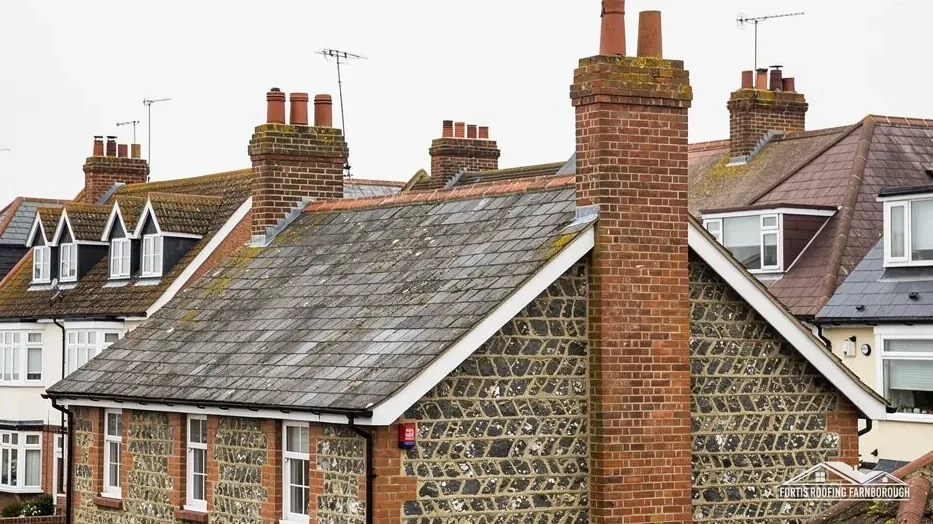
Roofs on the hill above Farnham, from flint cottages to Sandy Hill
Hale is a village on rising ground north of Farnham, beside Farnham Park, with flint cottages and low rooflines. A Hale roof is photographed and priced in a single written figure.
The original settlement was small workers' cottages along narrow, winding lanes, a pattern that survives.
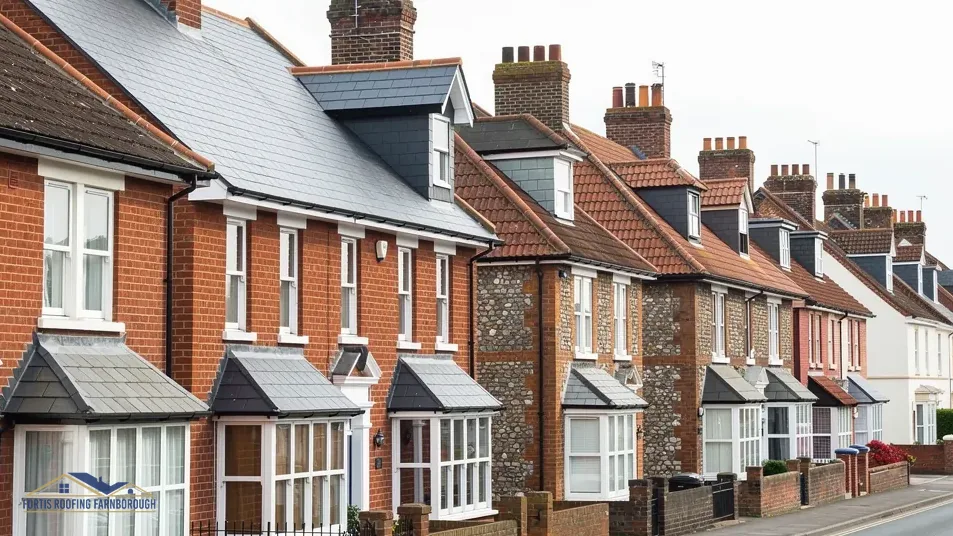
Farnham Town Council's draft design statement describes flint cottages with red brick quoins and slate roofs in Hale.
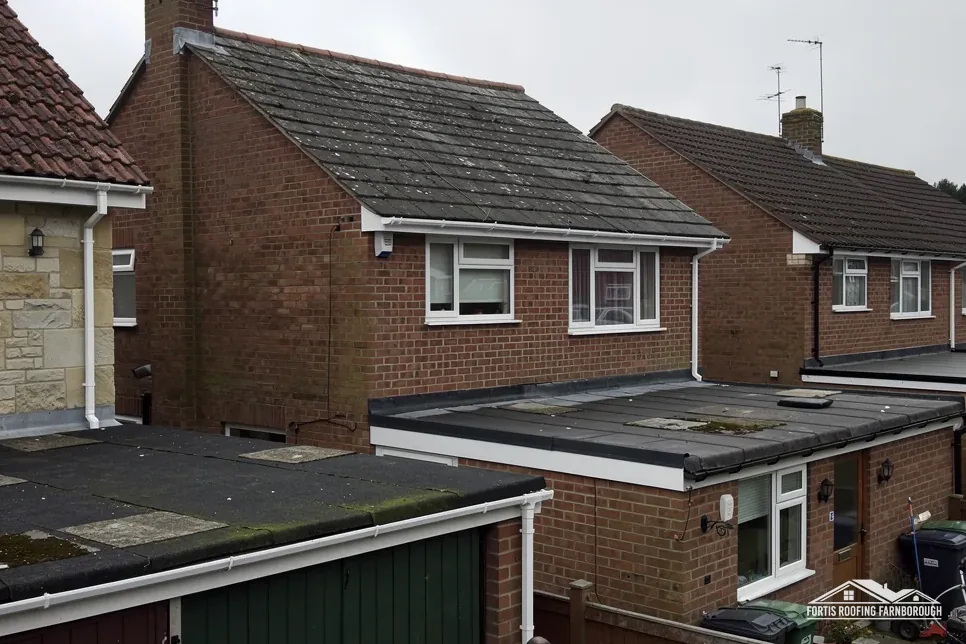
On the large Sandy Hill estate, flat roofs have been removed as part of improvements.
Map of Hale with Weybourne, Badshot Lea, Farnham, Aldershot marked around it.
Map data © OpenStreetMap contributors. Loads only when you ask for it.
Weybourne is the neighbouring place to the north-east, with Badshot Lea east, Farnham south-west, Ewshot north-west and Aldershot beyond Weybourne.
About 5.4 road miles south of Farnborough · Waverley Borough Council and Surrey County Council.
Hale, hill and cottages
What the draft Farnham Design Statement records about Hale's cottages, estates and flat roofs, which listed buildings and conservation areas lie close, and how a hillside village affects access. All figures are sourced.
| No. | Chapter | The figure it turns on |
|---|---|---|
| 01 | Workers' cottages, narrow lanes and low rooflines | Two storeys at most; bungalows |
| 02 | Flint cottages, brick quoins and slate roofs | Slate roofs named in the design statement |
| 03 | St John's, Upper Hale Road and nearby conservation areas | St John's Grade II; three areas nearby |
Chapter 01 of 03
Hale's built form in four published points
Farnham Town Council's draft Design Statement describes Hale's original settlement as small workers' cottages along narrow, winding lanes, a pattern that it says survives today. It adds that no building in Hale has more than 2 storeys, and that bungalows are common. Major developments at Sandy Hill, Park View and Folly Hill later added a broad mix of housing. The land rises steeply to the north of Farnham, so parts of Hale enjoy wide views across the town, and Farnham Park adjoins the area.
A place of cottages and bungalows is a place of low roofs, and low roofs have particular habits. They are easy to inspect, since much of the covering can be seen from a ladder, and they are short on height, which means scaffold is often unnecessary. They also tend to have large areas of roof in proportion to the walls, so a failed covering affects a lot of house. We measure the whole area before we price anything.
Narrow lanes shape the work as much as the roofs do. Delivery lorries may not reach every door, and materials may have to be carried a distance or stored at a safe point. At the survey we look at the approach, note where a lorry can stop and where it cannot, and plan the job around the road as it really is. You are told the plan before work starts, including where skips and materials will sit.
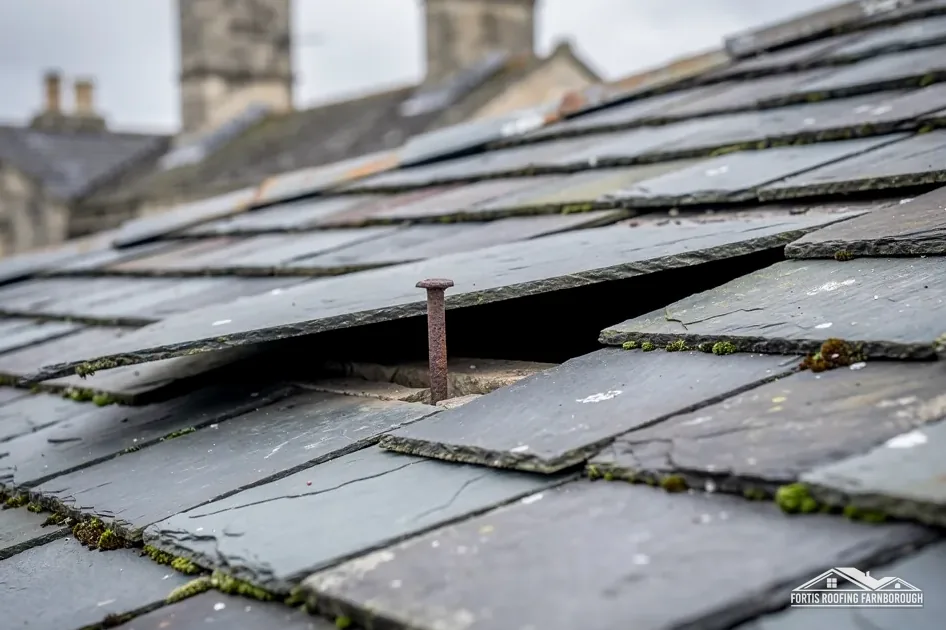
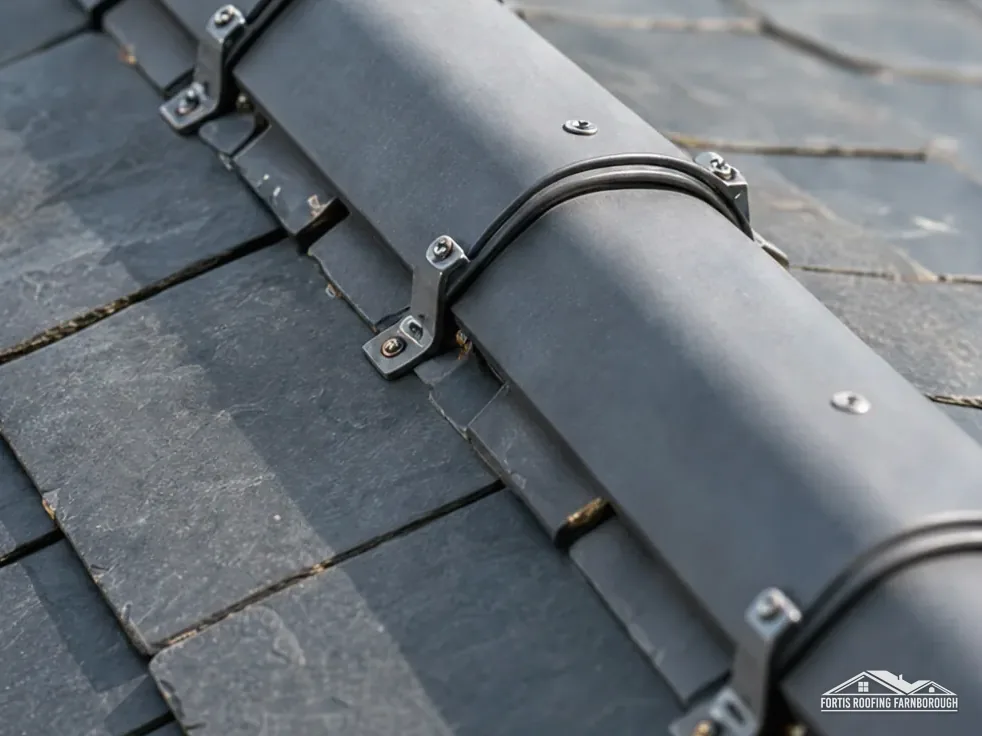
On a pitched roof we examine the fixings, junctions, drainage and roof space in that order. Slate, the covering the design statement names on Hale's cottages, gets its own attention: we check for slipped slates, nail rust and chipped corners. Slate repair and re-fixing are described on our slate roofing page.
Where the roof meets a gable or a chimney, lead flashings and soakers do the waterproofing. Old lead can split, lift or be pulled away by a wall that has moved. We record its condition and, where it has to be renewed, the lead code the position calls for; our lead roofing and lead work page explains the codes.
The steep ground has one more effect. Rainwater runs faster down a slope, and drives, paths and gardens can send it back towards walls. We look at where each gutter discharges and whether the ground beneath carries the water away from the house, and record what we see with photographs.
Chapter 02 of 03
| Feature in the statement | What we check on the roof |
|---|---|
| Flint cottages with red brick quoins | Wall-to-roof junctions at gables and eaves |
| Slate roofs | Slipped slates, nails, valleys and ridge |
| Bungalows | Large single-storey roof areas and rainwater runs |
| Flat roofs removed at Sandy Hill | Any surviving flat roof: falls, laps and outlets |
The design statement notes flint cottages with red brick quoins and slate roofs in Hale. Flint is a hard, irregular wall material, and where it meets a roof the junction is rarely straight, which makes flashings and soakers a craft job. A gable wall of flint with brick corners calls for a careful abutment, and the survey looks closely at every one.
Where a roof is slated, the question is what is wrong with it. Slate itself lasts a long time. HomeBuilding gives Welsh slate as 100+ years and Spanish natural slate as 75-100 years, though those are typical figures for new material and not a promise about any given roof. What usually fails first is the fixing, the nail that holds each slate. When nails rust, slates slip, and a run of slipped slates is the sign.
A repair means re-fixing the slipped slates, replacing any that are cracked, and checking the rest. It is a smaller job than re-slating, and it is what we recommend when the evidence supports it. If the nails are failing across the whole roof, re-slating is the better buy, and the photographs make the case.
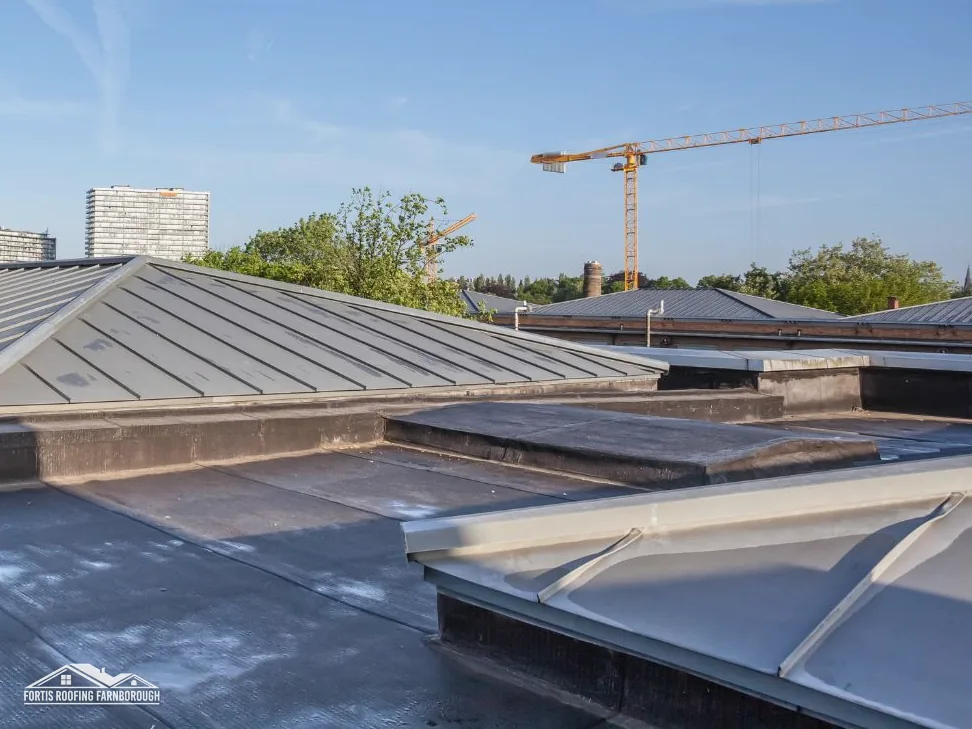
The design statement says that on the large Sandy Hill estate, flat roofs have been removed as part of improvements. It does not say that all have gone, and we assume nothing either way. If your house or its garage still has a flat roof, the survey treats it as a roof in its own right, with falls, joints and outlets recorded. Our flat roofing page explains the coverings and what each one fails from.

Moss and lichen are worth a mention. On a roof that gets little sun they spread quickly, and a slate roof can carry a good deal of growth without anything being wrong beneath it. We note where it has taken hold and whether it is blocking gutters or lifting edges. We do not recommend jet-washing a slate or tile roof, as Marley warns that it can damage the surface and shorten a covering's life. Gentle removal is the better course, and the report notes where the growth is heavy enough to matter.
Chapter 03 of 03
Four listings and areas near Hale's centre

Hale has six listed buildings within 500 m of its centre. Among them are Hale's church, St John the Evangelist, listed Grade II on 26 April 1950, 3-7 Upper Hale Road, listed Grade II on 29 December 1972, Mulberry House and the Hale Farm Flats group. St John's serves as a Church of England parish church, which means its roof falls under the faculty system and not listed building consent. For the others, listed building consent is the route whenever work would change their character.
The national dataset names three conservation areas within about 2.5 km of Hale: Farnham itself, the Great Austins area and the Shepherd and Flock area. Waverley has 44 conservation areas in all, listed by parish on its pages. The 1.5 km box drawn around Hale's place point touched none of them, so they count as nearby. Whether your own address lies inside one is for Waverley to say, and we ask before quoting for any work that would change how a roof looks.
Waverley Building Control, the council's in-house team, inspects where a Hale job needs it; a registered building control approver is the alternative. Surrey County Council licenses scaffold on Hale's roads: £208 covers a 28-day period and 10 working days of notice are wanted. Surrey's page names nobody as applicant, so the scaffolder and we decide it jointly. Poles that never leave your plot are not covered by the scheme.
West Surrey Council succeeds both Waverley and Surrey County Council on 1 April 2027, and we tell you who holds each question if your job straddles that day. On a hillside with narrow lanes, the position of any scaffold also matters, so we agree it with you at the survey.
Hale's gutters carry a lot of water off a lot of roof, and the ground falls away beneath them. The Met Office's South Farnborough averages for 1991 to 2020 show 118 wet days a year, and the steep land sends runoff quickly towards houses lower down the slope. We photograph each downpipe's outlet and note where the water goes next. Where a path or drive slopes towards a wall, the report points it out, because the cure may lie at ground level and not on the roof, and you should not pay for roof work to solve a drainage problem.
Often, yes. What tends to fail first is the nail fixing, so a run of slipped slates can be re-fixed and cracked ones replaced. We check the rest of the roof and show you the evidence, so the decision is yours. Re-slating is recommended only when the fixings are failing across the whole roof, and the photographs show why.
They change the plan, not the roof. At the survey we note lane width, where a lorry can stop, and where materials and skips can safely sit. Many small repairs are reached by ladder or tower from your own plot. Scaffold on a road still needs a Surrey County Council licence.
The draft Farnham Design Statement says flat roofs on the large Sandy Hill estate have been removed as part of improvements. It does not say every one has gone. If your house or garage still has one, we survey its falls, laps and outlets as a roof in its own right and report what we find.
Waverley Building Control, the council's in-house team, or a registered approver if you want a private firm. A few refixed slates need neither. The Planning Portal's limits are 25 per cent of the building envelope and 50 per cent of the roof; your job is measured against both at the survey.
Get your free roof quote
Give us your Hale lane and what is wrong. A survey is booked, then a single written price arrives.
10-year workmanship guarantee, in writing.